First Crypto Index From S&P: What It Includes, Excludes, and Why It Matters

Share:
S&P Dow Jones Indices and Pantera Capital launched the S&P Pantera Digital Asset Index on July 20, 2026, a revenue-weighted crypto benchmark that starts with 18 constituents and ranks networks by protocol revenue over the prior two quarters while requiring minimum market caps of $500 million for new entrants ($250 million for existing) and a liquidity ratio above 0.5. The index caps concentration (35% single asset, most at 20%), excludes Bitcoin and XRP for lacking protocol revenue, and Pantera’s backtest shows the revenue-screened methodology outperformed the S&P Broad Digital Asset Index over five years. Designed to underpin ETFs and institutional allocation, the index should boost institutional adoption and productization but may bias towards high on-chain activity such as DeFi/DEX fees versus monetary- or security-driven tokens.
Predictions Markets
See what traders are focused on


Key Insights:
- For the first time, the S&P Pantera crypto index ranks blockchain networks based on their fundamentals.
- BTC and XRP are excluded from the index because they do not generate protocol revenue. That’s a requirement of the index’s methodology.
The world’s most recognized index provider, S&P, just signalled a green flag to the crypto market through its new crypto index. It ranks blockchain networks by revenue, just like equity analysts rank listed businesses.
S&P Dow Jones Indices and Pantera Capital launched the S&P Pantera Digital Asset Index on July 20, 2026. The crypto index selects and weights its constituents based on protocol revenue. This revenue is generated from their actual economic activity rather than their market capitalization or price momentum.
It has launched with 18 constituents and is especially designed for institutional capital allocation. It can support investment products including ETFs and index funds in the future.
What This Crypto Index Actually Measures?
Most crypto indexes weigh their constituents by market value, giving more weight to larger tokens. That means price movements and recognition sometimes matter more than the actual underlying fundamentals. It puts memecoins and real infrastructure projects in the same index.
The S&P Pantera Digital Asset Index raises a unique question: which blockchain networks are generating real economic activity? To qualify for inclusion of assets in this index requires a minimum market capitalization of $500 million for new constituents (or $250 million for existing ones) and a liquidity ratio above 0.5, according to the methodology documents.
Eligible assets are then ranked based on the protocol revenue they generated over the previous two quarters. No single asset can make up more than 35% of the index, while most others are capped at 20%. The index is rebalanced every quarter using revenue data from Artemis Analytics and pricing data from Lukka.

The five largest current constituents are Ether, BNB, Solana, TRON, and Hyperliquid, according to S&P Dow Jones Indices’ own Indexology blog. On the other hand, the two major assets in the broader crypto ecosystem, Bitcoin and XRP, are not included in the index.
Those two crypto assets don’t fall under the methodology criteria of that index. Hence, this exclusion does not signal any negative impact on assets’ long-term value.
The S&P 500 Moment for Crypto Fundamentals
Institutional investors consider the S&P 500 as the global benchmark because of its consistent, rules-based methodology. Instead of ranking stocks on the basis of their price performance, it selects them based on factors such as market value, profitability, and liquidity.
The S&P Pantera Crypto Index brings the same rules-based approach to blockchain networks for the first time.

JP Morgan Private Bank research highlights that 89% of family offices currently have no exposure in digital assets at all. EY-Parthenon data also shows that 81% of institutions prefer to invest through registered investment instruments such as ETFs rather than investing through direct exchange access or on-chain positions. Those two figures highlight the product gap, which will be reduced through this index.
What the Backtest Shows and What It Doesn’t?
Pantera’s blockchain letter also included backtest results showing the revenue-screened methodology has outperformed S&P’s Broad Digital Asset Index over a five-year period, both with and without Bitcoin included in the comparison.
However, backtests only show how the index would have performed in the past if it had existed. They are not live results; the real test is whether the index can continue to outperform in the future as well.
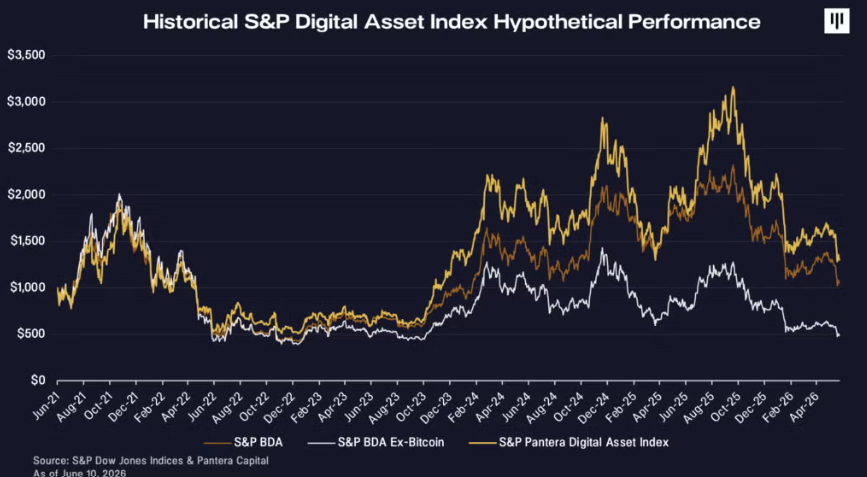
Critics have raised a genuine concern about the methodology. Strong protocol revenue does not always promise better returns or higher token prices. A blockchain can generate decent fees or revenue while its token underperforms. As a result, a revenue-based approach may favor protocols with high on-chain activity.
It may overlook assets whose value is driven by factors such as network effects, security, or monetary characteristics. Bitcoin and XRP are examples of the same asset class that got excluded from the current index despite their significance in the crypto market.
What Comes Next for the Crypto Index?
The S&P Pantera Digital Asset Index is being seen as a benchmark for future investment products and a performance standard for institutional digital asset funds, just like the S&P 500 works for equities.
The crypto index space seems to be moving toward institutional standards that look similar to those applied in equity markets. The S&P brand provides institutional credibility that most crypto index providers have failed to achieve.
Whether this credibility results in real adoption, new investment products, and increased capital inflows will depend on how well the index performs in live markets. While the backtest results are encouraging, it is worth watching the real-world performance over time.
The post First Crypto Index From S&P: What It Includes, Excludes, and Why It Matters appeared first on The Coin Republic.
In This News
Coins

$ 64.64K
+0.79%
$ 1.10
+0.51%
$ 0.332
+0.78%
$ 572.05
+1.02%
$ 74.97
+1.44%


Predictions Markets
See what traders are focused on
Share:
In This News
Coins
$ 64.64K
+0.79%$ 1.10
+0.51%$ 0.332
+0.78%$ 572.05
+1.02%$ 74.97
+1.44%Predictions Markets
See what traders are focused on
Share:
Read More

Bitcoin price has a $64.5k trap as Sunday’s close forces traders between a $68k relief rally or a drop to $60k