
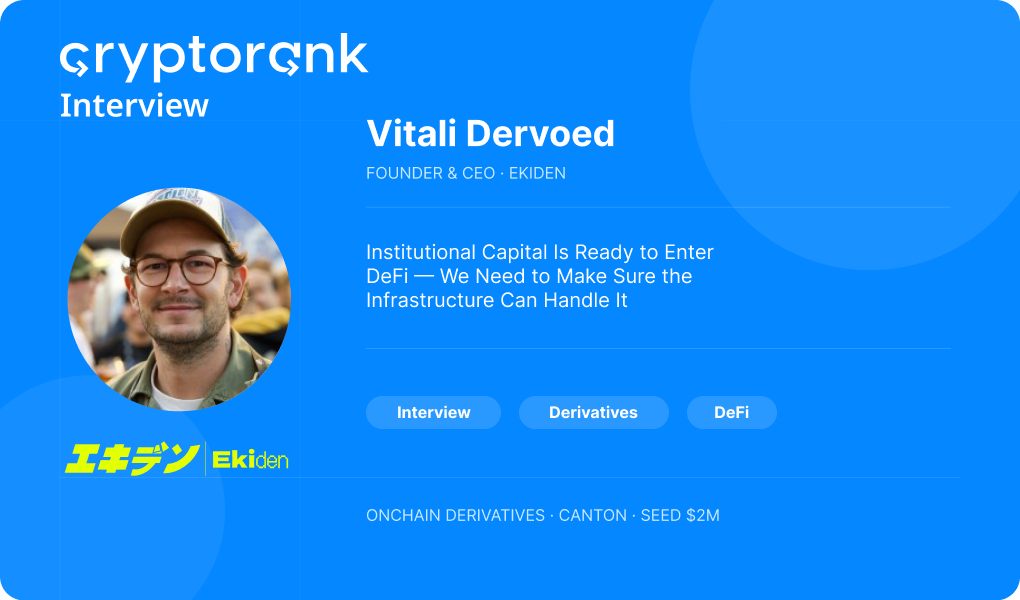
Vitali Dervoed, Ekiden: “Institutional Capital Is Ready to Enter DeFi — We Need to Make Sure the Infrastructure Can Handle It”
Share:
Predictions Markets
See what traders are focused on

Vitali Dervoed, Ekiden: “Institutional Capital Is Ready to Enter DeFi — We Need to Make Sure the Infrastructure Can Handle It”
Vitali Dervoed is the founder and CEO of Ekiden, an institutional-grade onchain derivatives trading platform. He brings more than a decade of experience across banking, fintech, and crypto infrastructure, including roles at Neon EVM, RockawayX, and Mango Markets, co-founding Composability Labs, and holding senior product positions at Raiffeisen Bank International and CIB.
Ekiden positions itself as a platform for institutional onchain derivatives trading. Where did this idea come from, and how much was it shaped by your personal experience?
It started with two things at the same time: curiosity and a clear sense that there was an obvious gap in the market.
Serum was one of the projects that fundamentally changed my perspective on what onchain trading could look like with properly designed infrastructure. But it also exposed a key limitation: trading infrastructure cannot evolve in isolation. In DeFi, liquidity, order flow, and value need to move across protocols and ecosystems — that’s what creates better yields, deeper markets, and a sustainable risk profile for participants.
I wanted to go further. To build something that works beyond a single ecosystem, can handle large trading volumes, and gives professional traders an experience comparable to traditional markets. A silo cannot compete with a major player — the winner is the one creating value across multiple environments simultaneously. To me, that’s one of the core principles of DeFi.
You’ve worked at Neon EVM, RockawayX, and Mango Markets. How did those experiences shape the way you’re building Ekiden?
Ekiden is essentially the culmination of everything I’ve done before. Each previous project contributed something specific.
Neon immersed me deeply into both Ethereum and Solana. Because of that, I developed strong relationships both with founders across the Ethereum ecosystem and within the Solana community. It’s a rare position — being able to understand both ecosystems from the inside and see their technical trade-offs directly, rather than observing one from the outside.
Mango gave me direct exposure to the perp trading community on Solana. I watched how people actually trade, what friction they face, and what’s missing in the current market structure. The team there was exceptional — hardworking and genuinely talented.
RockawayX taught me how to constantly switch between high-level strategic thinking and deep technical execution. The ability to operate on both levels simultaneously is probably one of the most valuable skills in this industry.
What technically differentiates Ekiden from competitors?
We’re building Ekiden for serious trading use cases — institutional participants and advanced retail traders. Our priorities are execution speed, reliability, and an interface designed around professional workflows, while still preserving onchain transparency and user custody.
We’re launching on Canton, which allows us to integrate directly into an existing ecosystem instead of building in isolation. We’re supporting BitSafe’s cBTC as collateral, integrating TradeCraft swaps directly into the deposit flow, and using Temple’s Vaults to improve the trading experience.
Ekiden was designed from day one as an ecosystem node rather than an isolated exchange. Infrastructure providers, liquidity sources, and user-facing products all need to operate together. That’s the only way to create a trading experience that meaningfully surpasses what currently exists onchain.
You recently closed a $2 million seed round involving market makers, infrastructure providers, and DeFi founders. What does this say about institutional demand for onchain derivatives?
Institutional appetite is starting to wake up — and honestly, that’s slightly intimidating. Once institutions fully engage, they are capable of absorbing enormous amounts of liquidity, and their appetite will likely continue growing over time.
If we’re being honest, the crypto narrative itself hasn’t changed dramatically since 2018. What changed is momentum. Regulation has become more predictable, companies have become more comfortable allocating capital into digital assets, and the timing is finally starting to align.
Perpetuals are no longer viewed as an exotic product. They’ve survived real market stress and proven their viability — institutions will increasingly integrate them into portfolios. At this point, it’s less a question of “if” and more a question of “when.”
Research shows that 46% of institutions consider infrastructure improvements the main prerequisite for entering onchain markets. How do you interpret that figure?
It reflects reality very accurately. Institutions are not staying away from onchain markets because they fail to understand the opportunity. They stay away because the infrastructure still falls short of the standards they are used to in traditional finance. Execution quality, liquidity depth, and predictable settlement are not competitive advantages for institutional participants — they are baseline requirements.
But infrastructure alone is only part of the answer.
First, institutions need collateral flexibility. They are not going to fragment balance sheets across dozens of venues. They want to use assets they already hold — BTC and eventually real-world assets — as productive collateral.
Second, liquidity movement must become seamless. Hedging and yield opportunities should move freely across protocols instead of being trapped inside isolated silos. This is exactly where onchain systems should outperform traditional infrastructure — and where most current solutions are still underperforming.
Third, the user experience must reach the level of professional trading terminals. Not “good enough for DeFi,” but genuinely institutional-grade.
Once these elements come together, that 46% from surveys will translate into actual capital flows. Our responsibility is to make sure the infrastructure layer is ready before that happens.
Keyrock joined the round as a strategic partner. What does that mean in practice for traders on the platform?
Every serious exchange depends on a small number of strategic liquidity partners. For Ekiden, Keyrock is one of them.
In practice, that means deeper liquidity, tighter spreads, and a more reliable trading experience from day one. Keyrock’s engineering team worked closely with us on exchange infrastructure, APIs, and execution quality. Their business development team was also heavily involved, which matters because exchanges are not purely a technology business — they are a combination of liquidity, distribution, and market structure.
Where do you see Ekiden over the next three to five years?
The goal is to evolve from a single product into a complete onchain trading ecosystem. In the short term, that means launching the platform, scaling liquidity, growing the team, and building strategic partnerships.
Over a longer horizon, I believe real-world markets will increasingly move onchain. Commodities such as oil, electricity, and water — alongside a broader range of financial and real-world assets — will eventually become directly accessible without intermediaries and with transparent pricing.
But for me, this is not only about infrastructure.
The ultimate goal is to make trading more accessible and improve financial literacy for as many people as possible. The best market is one that anyone who wants to participate in can freely access.


