Bitcoin’s “permanent buyers” are starting to sell as debt and cash pressures mount

Share:
Corporate and sovereign holders are liquidating Bitcoin: Genius Group sold its last 84 BTC to pay $8.5M in debt; Riot sold 5,363 BTC (~$535.5M) in 2025; MARA sold 15,133 BTC (~$1.1B) in March to retire ~$1B notes; Empery sold 370 BTC for $24.7M; Bhutan cut holdings from ~13,000 BTC (late 2024) to ~5,400 BTC and sold tens of millions in March 2026. Public companies hold ~1.165M BTC (~$77B, >5% of supply). Market impact: Bitcoin hovering around $67,000 with repeated breaches, altcoins like ETH and SOL down 4–8% daily, and an estimated $200–$400M liquidated per day last week — selling is adding supply and amplifying crypto volatility. Analytical takeaway: The treasury trade is bifurcating into deep-pocketed accumulators (Strategy 762,000 BTC; Metaplanet added 5,075 BTC in Q1 2026) versus cash‑pressured sellers; because BTC is liquid and often pledged as collateral, institutional adoption and corporate fundraising/debt dynamics may increase pro‑cyclical selling risk and undermine the ‘reserve asset’ thesis for crypto.
Predictions Markets
See what traders are focused on

In July 2025, Genius Group announced it was targeting a Bitcoin treasury of 10,000 BTC, framing it as a statement of deep strategic conviction.
This week, however, the company sold its last 84 BTC to pay off $8.5 million in debt and declared its treasury empty. The 18-month gap between those two moments is a perfect example of what's happening to the Bitcoin treasury trade right now.
Why this matters: The Bitcoin treasury narrative has been one of the market’s strongest structural bullish arguments. If corporate and sovereign holders behave like cyclical sellers rather than long-term accumulators, institutional adoption may amplify volatility instead of stabilizing it.
Public companies, including Empery, Genius Group, and Riot, have all sold Bitcoin this week, citing debt repayment, liquidity needs, or strategic pivots into AI and high-performance computing, while sovereign selling accelerates with Bhutan offloading more holdings.
Taken individually, each of these is an easily explainable non-event. But taken together, they expose a structural problem with a trade built on the promise of permanence: for a growing number of holders, Bitcoin is now the first asset they sell when the bills arrive.
The treasury trade rests on a simple pitch. Starting around 2020 and accelerating through 2024, publicly traded companies began buying Bitcoin with corporate cash or borrowed money and presenting it to investors as a reserve asset superior to inflation-eroded cash.
A few high-profile early movers delivered spectacular returns, and the strategy spread. Public companies now hold roughly 1.165 million bitcoin worth approximately $77 billion, more than five percent of the currency's fixed supply of 21 million coins.
The problem is that a reserve asset only functions as advertised if the holder never needs the cash back.
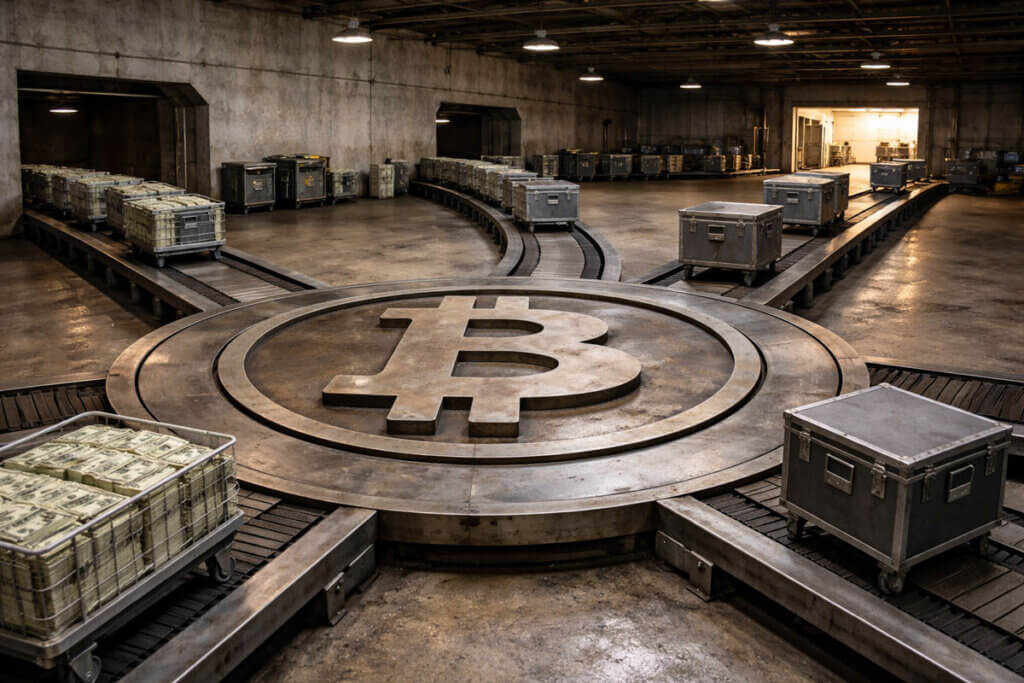
In the Bitcoin treasury trade, the debt comes first
Riot Platforms, one of the largest publicly traded Bitcoin miners in the US, sold 5,363 BTC for approximately $535.5 million in 2025, with its annual filing explicitly tying retention decisions to cash requirements for operations and expansion.
An earlier filing had already disclosed 3,300 BTC pledged as collateral against a $200 million credit facility. Riot continues to tap its treasury to fund a pivot into AI and high-performance computing, a strategy increasingly seen across the mining industry.
MARA Holdings sold 15,133 BTC for around $1.1 billion in March, using the proceeds to retire approximately $1 billion of convertible senior notes. Empery Digital sold 370 BTC for $24.7 million and used the proceeds to repay its outstanding term loan in full, freeing 1,800 BTC it had previously posted as collateral. Its shares are down 75% from their 2025 high.
The sequence is consistent across all of them: Bitcoin accumulated during optimism, pledged when capital was needed, and liquidated when the debt came due.
It's worth noting that the largest and best-capitalized players are still adding to their positions.
Metaplanet acquired 5,075 BTC in the first quarter of 2026, making it the third-largest corporate holder, while Strategy holds over 762,000 BTC as by far the largest treasury position in existence.
This tells us that the treasury trade isn't collapsing uniformly, but sorting into two camps: deep-pocketed accumulators who can afford to wait, and cash-pressured sellers who discover, when conditions tighten, that their strategic reserve is their most liquid asset.
The reserve asset that was always too easy to sell
The Bitcoin treasury trade gets quite a bit of weight when sovereign actors enter it.
Bhutan, a small Himalayan kingdom, built one of the world's more unusual government Bitcoin positions by mining it using surplus hydroelectric power at near-zero cost. The country's stack has fallen from a peak of about 13,000 BTC in late 2024 to roughly 5,400 BTC, a 58% reduction, with activity managed by its state-owned investment arm, Druk Holding and Investments.
Throughout March 2026, Bhutan offloaded tens of millions worth of BTC through controlled, low-impact transfers with no market disruption. This kind of distribution pattern shows that the treasury was running a planned drawdown rather than being shaken out by debt.
A significant portion of the cash from the offloaded Bitcoin was directed toward Gelephu Mindfulness City, a major national development project requiring real capital. Because Bhutan mined its coins rather than bought them, every sale it made was pure profit. The underlying logic, though, is exactly like that of our previously mentioned corporate sellers: the position exists to be monetized when a need for funding arises.
Bitcoin has been struggling to retain support at $67,000, going above and below the critical level for days. Altcoins are also struggling, with larger coins like ETH and SOL losing anywhere between 4% and 8% daily, while smaller tokens keep seeing even wilder volatility. With $200 million to $400 million liquidated every day in the past week, it's safe to say that crypto markets have been feeling the geopolitical pressure hard.
In that environment, treasury selling does more than just add supply to a struggling market. It exposes something the treasury trade's most enthusiastic architects may not have fully reckoned with: they built a buyer base out of the wrong material.
There's a deep irony in this. The very properties that made Bitcoin attractive as a treasury asset in the first place (its liquidity, its 24-hour markets, the frictionless ease of converting it to cash at any hour on any day) are exactly the properties that make it the first thing a cash-pressured CFO reaches for when a debt payment looms.
Compared to gold, Bitcoin is trivially quick and easy to sell, and the Bitcoin treasury promise of having a liquid alternative to cash inadvertently handed companies, well…a liquid alternative to cash.
Liquidity, by definition, gets used. Every company that pledged its BTC as loan collateral was simultaneously creating a forced-selling mechanism and embedding a potential margin call into its own balance sheet.
The longer-term consequence for Bitcoin is harder to quantify but still worth considering seriously. The institutional adoption story has been one of the most durable bullish arguments for Bitcoin over the past four years, resting on the assumption that corporate and sovereign buyers represent a fundamentally different, stickier class of holder than retail speculators.
If the current wave of selling establishes instead that treasury holders are just pro-cyclical, buying during enthusiasm, pledging during expansion, and then liquidating during stress, then the arrival of institutional capital does nothing to change Bitcoin's volatility profile. It just adds a more elaborately dressed version of the same behavior.
The buyers still standing, Strategy with its 762,000 BTC and Metaplanet with its methodical quarterly accumulation, may yet prove the thesis right, but they're proving it almost alone, which was never the point.
The treasury trade was supposed to be a movement, a permanent re-rating of how the world's balance sheets relate to a fixed-supply digital asset. What it turns out to have been, for a significant and growing number of its participants, is a short-term financing strategy wearing the mask of long-term conviction. When the mask comes off, what remains is an asset people buy when they have money to spare and sell when they don't, which is not a reserve but just another position.
The post Bitcoin’s “permanent buyers” are starting to sell as debt and cash pressures mount appeared first on CryptoSlate.
In This News
Coins

$ 63.81K
+0.40%
$ 1.86K
+0.22%
$ 73.49
+0.14%
1654073624197.png)
$ 73.68
+0.76%


Predictions Markets
See what traders are focused on
Share:
In This News
Coins
$ 63.81K
+0.40%$ 1.86K
+0.22%$ 73.49
+0.14%$ 73.68
+0.76%Predictions Markets
See what traders are focused on
Share:
Read More

This $163M crypto stash collapsed to just $15M, forcing ZeroStack to literally stake its survival on token rewards