On-Chain RWA Market Cap Reaches All-Time High of $33.7 Billion
Share:
On-chain tokenized real-world assets reached an all-time high market cap of $33.7 billion after roughly $1.5 billion of recent inflows, led by Franklin Templeton’s iBENJI and BlackRock’s BUIDL tokenized U.S. Treasury products with the bulk of activity on Ethereum. The surge signals growing institutional adoption in crypto and DeFi as tokenized Treasuries provide yield-bearing, lower-risk alternatives to stablecoins that could boost liquidity and market stability, though regulatory clarity will determine the pace of future growth.
Predictions Markets
See what traders are focused on

BitcoinWorld
On-Chain RWA Market Cap Reaches All-Time High of $33.7 Billion
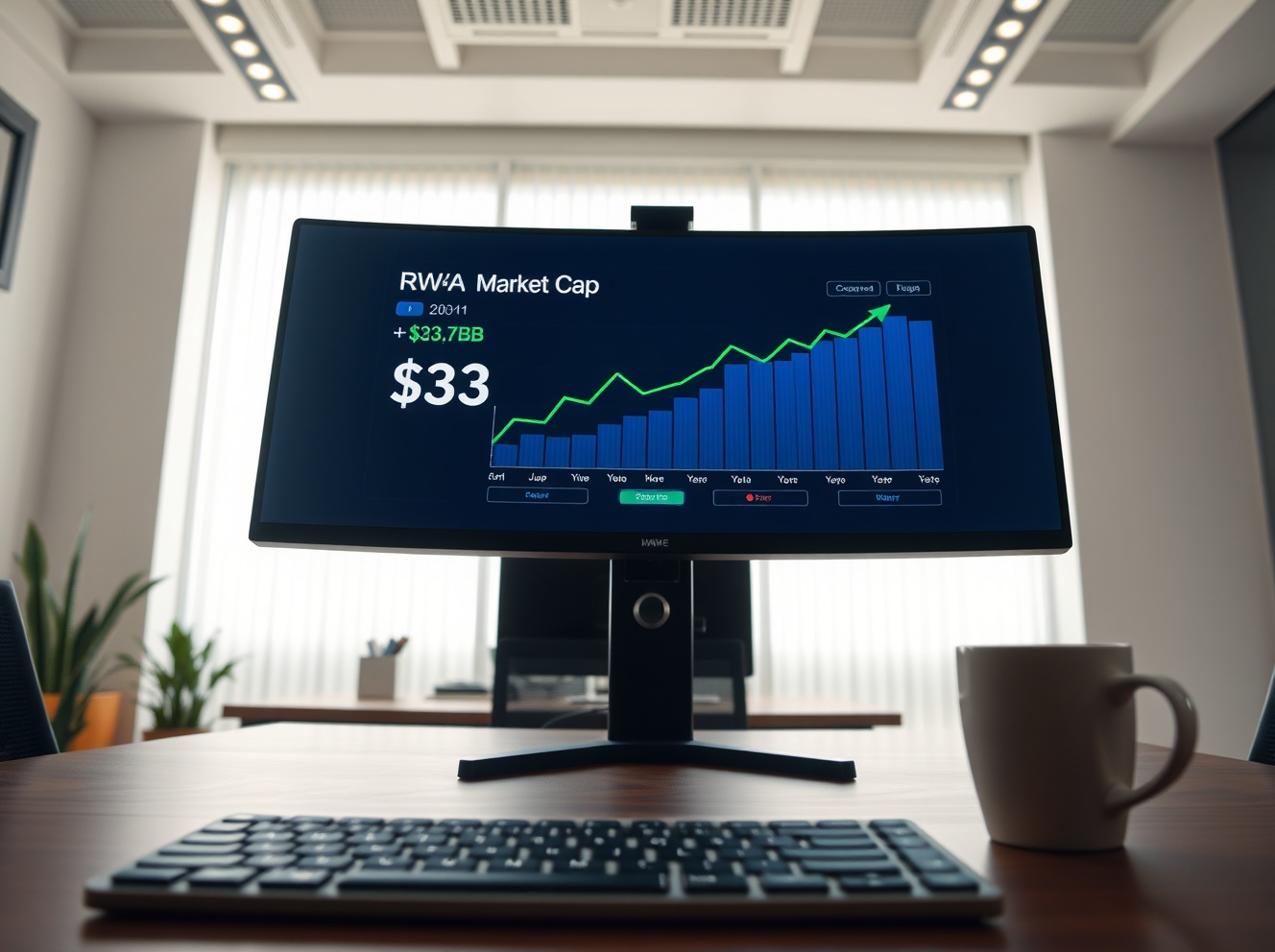
The market capitalization of on-chain tokenized real-world assets (RWA) has reached a new all-time high of $33.7 billion, according to data from RWA.xyz. The milestone comes after a recent influx of approximately $1.5 billion into tokenized assets, with the majority flowing into Ethereum-based tokenized U.S. Treasury products.
What Is Driving the Surge in Tokenized Real-World Assets?
The latest growth in the RWA sector is largely attributed to two major institutional products. Franklin Templeton’s newly launched tokenized fund, iBENJI, has attracted significant capital, while BlackRock’s BUIDL fund continues to see sustained inflows. These products allow investors to gain exposure to U.S. Treasury yields through blockchain-based tokens, combining traditional financial stability with the efficiency of decentralized networks.
The broader trend reflects a growing appetite among institutional investors for on-chain representations of traditional assets. Tokenized Treasuries, in particular, offer a yield-bearing alternative to stablecoins, which have dominated the on-chain cash market. The appeal lies in their ability to settle faster, operate 24/7, and provide transparent, auditable ownership records.
Why Ethereum Leads the Tokenized Treasury Market
Ethereum remains the dominant blockchain for tokenized RWAs, hosting the majority of the $1.5 billion recent inflow. Its robust smart contract infrastructure, established developer ecosystem, and widespread adoption among institutional custodians make it the preferred platform for asset managers like BlackRock and Franklin Templeton.
Other blockchains, including Polygon, Solana, and Avalanche, have also seen activity in the RWA space, but Ethereum’s first-mover advantage and security profile continue to attract the largest share of institutional capital. The concentration of liquidity on Ethereum further reinforces its position as the primary settlement layer for tokenized assets.
What This Means for Investors and the Broader Crypto Market
The growth of on-chain RWAs signals a maturing market where traditional finance and decentralized finance (DeFi) are converging. For investors, tokenized Treasuries offer a low-risk, yield-generating option within the crypto ecosystem, potentially reducing reliance on more volatile assets. For the broader market, increased institutional participation through RWAs could bring greater liquidity and stability.
Regulatory developments will play a key role in determining the pace of future growth. Clearer guidelines around tokenized securities, custody, and cross-chain interoperability could accelerate adoption. Conversely, fragmented regulatory frameworks across jurisdictions may slow institutional entry.
Conclusion
The on-chain RWA market cap crossing $33.7 billion represents a significant milestone in the integration of traditional finance with blockchain technology. Driven by products like Franklin Templeton’s iBENJI and BlackRock’s BUIDL, the sector is attracting institutional capital seeking efficiency, transparency, and yield. As the infrastructure matures and regulatory clarity improves, tokenized real-world assets are poised to become a cornerstone of the digital asset ecosystem.
FAQs
Q1: What are tokenized real-world assets (RWAs)?
Tokenized RWAs are digital tokens that represent ownership of traditional financial assets, such as U.S. Treasury bonds, real estate, or commodities, on a blockchain. They allow for fractional ownership, faster settlement, and global accessibility.
Q2: Why is the market cap of on-chain RWAs growing so quickly?
The growth is driven by institutional demand for yield-bearing, low-risk assets within the crypto ecosystem. Products like BlackRock’s BUIDL and Franklin Templeton’s iBENJI offer competitive yields from U.S. Treasuries while leveraging blockchain efficiency.
Q3: Which blockchain is most used for tokenized RWAs?
Ethereum currently hosts the majority of tokenized RWA market cap, due to its established smart contract capabilities, security, and institutional support. Other blockchains like Polygon and Solana are also emerging in this space.
This post On-Chain RWA Market Cap Reaches All-Time High of $33.7 Billion first appeared on BitcoinWorld.
In This News
Coins

$ 1.79K
+2.42%
$ 77.76
-0.44%
$ 6.74
+0.35%
$ 0.00155
-0.05%
$ 0.380
-0.97%

Predictions Markets
See what traders are focused on
Share:
In This News
Coins
$ 1.79K
+2.42%$ 77.76
-0.44%$ 6.74
+0.35%$ 0.00155
-0.05%$ 0.380
-0.97%Predictions Markets
See what traders are focused on
Share:
Read More

Solana RWA ecosystem hits $3.6 billion, quadrupling in first half of 2024