Bitcoin's price fell below $85K, causing a big drop in the crypto market. Total market cap decreased by over 5%. Many traders are cautious as liquidations rose and sentiment worsened, remaining in the extreme fear zone.
Bearish
Bitcoin opened December with a flash crash during the latter half of the Asian trading session, rattling already nervous investors and forcing bulls to retreat as liquidations piled up across the board.
The wipeout erased a significant chunk of value from the broader crypto market, with total market capitalization dropping more than 5% over the past 24 hours, one of the largest single-day declines in recent weeks.
At the time of writing, the market cap was hovering just above the $3 trillion mark, a level it had only recently reclaimed.
Sentiment took another hit as the Crypto Fear and Greed Index plunged deeper into the “extreme fear” zone, settling at 24.
The gauge has now lingered in this range for several weeks, reflecting traders’ persistent caution and uncertainty.
While most digital assets traded lower or flat, a handful of altcoins managed to squeeze out modest single-digit gains.
Overall, market activity remained subdued as participants waited for signs of stability before reentering positions.
Why is Bitcoin price crashing?
Bitcoin briefly dipped below a weekly low of $85,000 earlier in the day, a move that rattled traders and signaled just how fragile market confidence remains.
Losing key support levels during heightened uncertainty often acts as a bearish trigger, and this episode was no exception.
Several overlapping factors appear to have accelerated the decline.
Derivatives markets saw a massive flush-out, with more than $792 million in liquidations over the past 24 hours, $318 million of that from Bitcoin alone.
Long positions accounted for over $725 million of the total wipeout, as over 238,000 traders were forced out of positions, adding to the downward spiral.
Profit-taking amid broader risk-off sentiment also played a role, particularly as global economic data failed to inspire confidence.
In Asia, manufacturing activity continued to slow in Japan and China. Japan’s factory PMI dropped to 48.7, staying below the neutral 50 mark, while China marked its eighth consecutive month of contraction in the manufacturing sector.
Regional equities also struggled to find direction. Although Hong Kong’s Hang Seng index managed to inch higher, Taiwan and South Korea posted declines, underscoring the fragile backdrop.
As institutional investors increasingly treat Bitcoin and digital assets as part of broader macro portfolios, risk appetite in regional stock markets often bleeds into crypto sentiment.
Adding to the pressure, a string of negative headlines weighed on sentiment. One of the more notable concerns came from S&P Global, which downgraded Tether’s rating on transparency and asset quality.
The agency flagged potential mismatches between Tether’s reserves and its outstanding liabilities over time, raising fresh doubts about the stablecoin’s long-term ability to maintain its peg under stress.
While Tether remains the most widely used stablecoin in crypto markets, any cracks in its credibility tend to ripple across the ecosystem.
That’s because Tether underpins a large share of trading pairs, lending protocols, and market liquidity.
If traders begin to question whether USDT is fully backed or could face redemption pressure, it introduces systemic uncertainty, especially during already fragile market conditions.
Tether has repeatedly defended the robustness of its reserves, but the downgrade served as a timely reminder of the trust-based foundation that much of the market still rests on.
When confidence in that foundation slips, risk appetite tends to evaporate quickly.
Meanwhile, Strategy, the largest corporate holder of Bitcoin, has warned that it may be forced to sell Bitcoin if its market-based valuation falls below a key threshold, an alarming development given the firm’s large BTC holdings.
Seasonal factors are also working against bullish momentum. Historically, when Bitcoin has closed November in the red, December tends to follow with further losses.
Bitcoin fell more than 17% last month, and the negative momentum seems to have carried over into December as many traders are worried that a similar situation could unfold this time around.
In the meantime, ETF outflows have further deepened the market’s woes. Bitcoin spot ETFs recorded more than $3.5 billion in net outflows in November, while Ethereum funds posted their first month of redemptions in several months.
All these elements fed into each other, creating a cascade of sell pressure that left bulls scrambling and market participants bracing for further volatility.
In the current environment, risk management has become the primary focus for traders as the market remains vulnerable to sharp downside moves with even minor catalysts.
Will Bitcoin price go up in December?
Bitcoin’s fate over the upcoming trading sessions remains closely tied to how well markets absorb and respond to incoming positive catalysts.
While sentiment is still fragile, several developments on the horizon could help turn the tide if they land the right way.
One of the biggest macro drivers will be the Federal Reserve’s interest rate decision on December 15. Markets are pricing in a strong chance of a rate cut, which would bring the benchmark down to the 3.50% to 3.75% range.
While the first cut itself may not be the key trigger, if the Fed signals a clear path toward continued easing in 2026, risk assets like Bitcoin could benefit from renewed appetite as investors rotate out of cash and back into higher volatility plays.
Meanwhile, reports have risen that Donald Trump may nominate Kevin Hassett as the next Fed Chair.
Hassett has been openly supportive of the crypto industry and favors a lower interest rate environment.
Such a change at the central bank could be viewed as structurally bullish for digital assets over the long run.
On the crypto-native side, catalysts are also starting to build. One of the most talked-about themes is the potential launch of new altcoin-based ETFs.
Assets like Binance Coin, Cardano, and Chainlink have all been floated as possible candidates for ETF approval later this month.
If even one or two of these proposals are greenlit, it could reignite retail and institutional interest, especially during a seasonally favorable period for risk assets.
Historically, Bitcoin has shown a tendency to recover in the final weeks of December, especially when major catalysts converge with lower trading volumes and holiday-driven optimism.
And with the Fear and Greed Index stuck in extreme fear territory for weeks now, some seasoned traders may begin to interpret this as a potential bottoming signal and re-enter the market.
For any meaningful upside rally to materialise, Bitcoin needs to aggressively defend the $85,000 support area and subsequently reclaim $90,000.
According to the 24-hour liquidation heatmap, a dense cluster of liquidation activity sits just above the $87,000 to $90,000 range.
This area is packed with previously built long leverage positions, meaning that if Bitcoin begins to push higher and moves through these zones, it could trigger a cascade of short liquidations that may help fuel momentum in the short term.
On the downside, the chart shows that sell pressure intensified significantly below $85,000, with large swathes of long positions wiped out between $84,000 and $82,000.
If bulls fail to hold this level, the next cluster of potential support lies closer to $81,000, where a thinner concentration of long liquidations suggests fewer active bids and weaker defense.
On the upside, regaining ground above $88,000 could flip short-term momentum and open the door toward $90,000, where another heavy concentration of liquidation levels may trigger a short squeeze.
Beyond that, a clean break above $91,000 would begin to repair the broader structure and give bulls room to target the $94,000 zone, which remains largely untapped based on current liquidation interest.
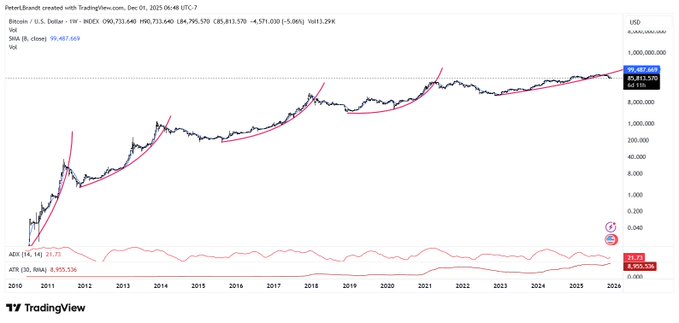
However, many market pundits remain skeptical about any sustained upward move. One of the more cautious voices is trading veteran Peter Brandt, who believes the market may still be due for a deep correction of up to 75%. See below.
There have been five major bull market cycles in $BTC since inception. In all previous cycles the violation of the dominant parabolic advance has been followed by a 75%-plus correction — NO EXCEPTIONS!!
You better have a great reason to bet against this pattern.
At press time, Bitcoin was trading just above $84,500, with losses of roughly 7.5% on the day.
Top altcoin gainers today
The altcoin market cap initially fell from nearly $1.4 trillion to $1.19 trillion before recovering from part of its losses and settling at $1.27 trillion when writing, down 9.3% over the day.
Ethereum (ETH), the leading altcoin by market share, fell over 7% from over $3,000 to around $2,800 level in the session, while other large-cap altcoins that followed, such as XRP (XRP), BNB (BNB), Solana (SOL), Dogecoin (DOGE), and Cardano (ADA) posted losses between 8-10%.
At press time, the Altcoin Season Index that measures the performance of top altcoins against BTC stood at 25, a level from which it has not shown much improvement since its drop in mid-October.
Only two crypto assets among the top 100 managed to stay adrift, with MYX Finance (MYX) holding on to 8% gains for the day, largely driven by market chatter over a potential Binance listing and renewed investor interest in its V2 upgrade that promises enhanced liquidity features.
Just (JST) followed with gains of 3.5%, while Tether Gold (XAUT), a stablecoin backed by physical gold, made it to the green as traders appeared to be rotating into safer assets amid heightened volatility across the broader crypto market.
Bitcoin's price fell below $85K, causing a big drop in the crypto market. Total market cap decreased by over 5%. Many traders are cautious as liquidations rose and sentiment worsened, remaining in the extreme fear zone.
Bearish
Bitcoin opened December with a flash crash during the latter half of the Asian trading session, rattling already nervous investors and forcing bulls to retreat as liquidations piled up across the board.
The wipeout erased a significant chunk of value from the broader crypto market, with total market capitalization dropping more than 5% over the past 24 hours, one of the largest single-day declines in recent weeks.
At the time of writing, the market cap was hovering just above the $3 trillion mark, a level it had only recently reclaimed.
Sentiment took another hit as the Crypto Fear and Greed Index plunged deeper into the “extreme fear” zone, settling at 24.
The gauge has now lingered in this range for several weeks, reflecting traders’ persistent caution and uncertainty.
While most digital assets traded lower or flat, a handful of altcoins managed to squeeze out modest single-digit gains.
Overall, market activity remained subdued as participants waited for signs of stability before reentering positions.
Why is Bitcoin price crashing?
Bitcoin briefly dipped below a weekly low of $85,000 earlier in the day, a move that rattled traders and signaled just how fragile market confidence remains.
Losing key support levels during heightened uncertainty often acts as a bearish trigger, and this episode was no exception.
Several overlapping factors appear to have accelerated the decline.
Derivatives markets saw a massive flush-out, with more than $792 million in liquidations over the past 24 hours, $318 million of that from Bitcoin alone.
Long positions accounted for over $725 million of the total wipeout, as over 238,000 traders were forced out of positions, adding to the downward spiral.
Profit-taking amid broader risk-off sentiment also played a role, particularly as global economic data failed to inspire confidence.
In Asia, manufacturing activity continued to slow in Japan and China. Japan’s factory PMI dropped to 48.7, staying below the neutral 50 mark, while China marked its eighth consecutive month of contraction in the manufacturing sector.
Regional equities also struggled to find direction. Although Hong Kong’s Hang Seng index managed to inch higher, Taiwan and South Korea posted declines, underscoring the fragile backdrop.
As institutional investors increasingly treat Bitcoin and digital assets as part of broader macro portfolios, risk appetite in regional stock markets often bleeds into crypto sentiment.
Adding to the pressure, a string of negative headlines weighed on sentiment. One of the more notable concerns came from S&P Global, which downgraded Tether’s rating on transparency and asset quality.
The agency flagged potential mismatches between Tether’s reserves and its outstanding liabilities over time, raising fresh doubts about the stablecoin’s long-term ability to maintain its peg under stress.
While Tether remains the most widely used stablecoin in crypto markets, any cracks in its credibility tend to ripple across the ecosystem.
That’s because Tether underpins a large share of trading pairs, lending protocols, and market liquidity.
If traders begin to question whether USDT is fully backed or could face redemption pressure, it introduces systemic uncertainty, especially during already fragile market conditions.
Tether has repeatedly defended the robustness of its reserves, but the downgrade served as a timely reminder of the trust-based foundation that much of the market still rests on.
When confidence in that foundation slips, risk appetite tends to evaporate quickly.
Meanwhile, Strategy, the largest corporate holder of Bitcoin, has warned that it may be forced to sell Bitcoin if its market-based valuation falls below a key threshold, an alarming development given the firm’s large BTC holdings.
Seasonal factors are also working against bullish momentum. Historically, when Bitcoin has closed November in the red, December tends to follow with further losses.
Bitcoin fell more than 17% last month, and the negative momentum seems to have carried over into December as many traders are worried that a similar situation could unfold this time around.
In the meantime, ETF outflows have further deepened the market’s woes. Bitcoin spot ETFs recorded more than $3.5 billion in net outflows in November, while Ethereum funds posted their first month of redemptions in several months.
All these elements fed into each other, creating a cascade of sell pressure that left bulls scrambling and market participants bracing for further volatility.
In the current environment, risk management has become the primary focus for traders as the market remains vulnerable to sharp downside moves with even minor catalysts.
Will Bitcoin price go up in December?
Bitcoin’s fate over the upcoming trading sessions remains closely tied to how well markets absorb and respond to incoming positive catalysts.
While sentiment is still fragile, several developments on the horizon could help turn the tide if they land the right way.
One of the biggest macro drivers will be the Federal Reserve’s interest rate decision on December 15. Markets are pricing in a strong chance of a rate cut, which would bring the benchmark down to the 3.50% to 3.75% range.
While the first cut itself may not be the key trigger, if the Fed signals a clear path toward continued easing in 2026, risk assets like Bitcoin could benefit from renewed appetite as investors rotate out of cash and back into higher volatility plays.
Meanwhile, reports have risen that Donald Trump may nominate Kevin Hassett as the next Fed Chair.
Hassett has been openly supportive of the crypto industry and favors a lower interest rate environment.
Such a change at the central bank could be viewed as structurally bullish for digital assets over the long run.
On the crypto-native side, catalysts are also starting to build. One of the most talked-about themes is the potential launch of new altcoin-based ETFs.
Assets like Binance Coin, Cardano, and Chainlink have all been floated as possible candidates for ETF approval later this month.
If even one or two of these proposals are greenlit, it could reignite retail and institutional interest, especially during a seasonally favorable period for risk assets.
Historically, Bitcoin has shown a tendency to recover in the final weeks of December, especially when major catalysts converge with lower trading volumes and holiday-driven optimism.
And with the Fear and Greed Index stuck in extreme fear territory for weeks now, some seasoned traders may begin to interpret this as a potential bottoming signal and re-enter the market.
For any meaningful upside rally to materialise, Bitcoin needs to aggressively defend the $85,000 support area and subsequently reclaim $90,000.
According to the 24-hour liquidation heatmap, a dense cluster of liquidation activity sits just above the $87,000 to $90,000 range.
This area is packed with previously built long leverage positions, meaning that if Bitcoin begins to push higher and moves through these zones, it could trigger a cascade of short liquidations that may help fuel momentum in the short term.
On the downside, the chart shows that sell pressure intensified significantly below $85,000, with large swathes of long positions wiped out between $84,000 and $82,000.
If bulls fail to hold this level, the next cluster of potential support lies closer to $81,000, where a thinner concentration of long liquidations suggests fewer active bids and weaker defense.
On the upside, regaining ground above $88,000 could flip short-term momentum and open the door toward $90,000, where another heavy concentration of liquidation levels may trigger a short squeeze.
Beyond that, a clean break above $91,000 would begin to repair the broader structure and give bulls room to target the $94,000 zone, which remains largely untapped based on current liquidation interest.
However, many market pundits remain skeptical about any sustained upward move. One of the more cautious voices is trading veteran Peter Brandt, who believes the market may still be due for a deep correction of up to 75%. See below.
There have been five major bull market cycles in $BTC since inception. In all previous cycles the violation of the dominant parabolic advance has been followed by a 75%-plus correction — NO EXCEPTIONS!!
You better have a great reason to bet against this pattern.
At press time, Bitcoin was trading just above $84,500, with losses of roughly 7.5% on the day.
Top altcoin gainers today
The altcoin market cap initially fell from nearly $1.4 trillion to $1.19 trillion before recovering from part of its losses and settling at $1.27 trillion when writing, down 9.3% over the day.
Ethereum (ETH), the leading altcoin by market share, fell over 7% from over $3,000 to around $2,800 level in the session, while other large-cap altcoins that followed, such as XRP (XRP), BNB (BNB), Solana (SOL), Dogecoin (DOGE), and Cardano (ADA) posted losses between 8-10%.
At press time, the Altcoin Season Index that measures the performance of top altcoins against BTC stood at 25, a level from which it has not shown much improvement since its drop in mid-October.
Only two crypto assets among the top 100 managed to stay adrift, with MYX Finance (MYX) holding on to 8% gains for the day, largely driven by market chatter over a potential Binance listing and renewed investor interest in its V2 upgrade that promises enhanced liquidity features.
Just (JST) followed with gains of 3.5%, while Tether Gold (XAUT), a stablecoin backed by physical gold, made it to the green as traders appeared to be rotating into safer assets amid heightened volatility across the broader crypto market.