Bitcoin price sinks to 9-month low as macro pressures loom, STABLE, RIVER buck market trend

Share:
Predictions Markets
See what traders are focused on


Bitcoin price visited a 9-month low before stabilising around $77,000 as the crypto market continued to tumble for the fourth straight day.
Market sentiment remained completely risk-averse as investors digested a plethora of bearish headlines.
Reflecting the current mood, the Crypto Fear and Greed Index fell to its lowest in over a month at 15, firmly in the extreme fear territory.
The total crypto market cap struggled to reclaim its footing above the $3 trillion mark and had settled near $2.7 trillion when writing.
Altcoins had mostly given away all of their January gains, but a handful of the top tokens managed modest recovery as Bitcoin bounced back from its intraday lows. A few outliers closed the Asian trading session with double-digit profits.
Why is Bitcoin price down today?
Bitcoin price has fallen nearly 17% over the past 4 days as market sentiment has been hammered by a confluence of macroeconomic and geopolitical pressures.
A hawkish shift from the US Federal Reserve and heightened Middle East tensions have significantly eroded appetite for risk, sending investors scrambling for liquidity across all asset classes.
Last week’s decision by the Fed to hold interest rates steady at 3.5% to 3.75% left little room for the kind of policy support many had anticipated.
Meanwhile, President Donald Trump’s nomination of Kevin Warsh as the next Fed Chair further unsettled investors, given his known preference for tighter monetary policy and criticism of early rate cuts in past cycles.
With borrowing costs now largely expected to remain high, traders began pulling capital from leveraged bets and high-volatility markets.
Bitcoin, long seen by some as a hedge against fiat debasement, failed to live up to that role under current conditions.
Instead, as the dollar strengthened and bond yields stayed elevated, capital fled volatile instruments like crypto in favour of cash or short-term Treasury exposure.
Over the weekend, selling pressure intensified as regulatory margin hikes in traditional commodities spilt over into crypto.
Several traders were forced to offload liquid assets like Bitcoin to meet capital requirements, particularly after silver’s steep decline added to portfolio stress.
The combination of mechanical selling, ETF outflows, and deteriorating sentiment has left little room for bullish narratives to take hold.
Outflows from spot Bitcoin ETFs have crossed $2.7 billion since mid-January, signalling a market-wide retreat by institutional players who had previously underpinned market confidence.
Geopolitical headlines have also played a role in amplifying volatility.
Reports of potential US strikes and Iran’s warnings of regional consequences have pushed global investors into defensive positioning, leaving assets like Bitcoin exposed to further downside.
With Bitcoin unable to reclaim key levels and technical patterns now flashing bearish signals, traders appear hesitant to buy the dip.
Until there is greater clarity on both the monetary policy front and geopolitical risks, risk appetite is likely to remain limited.
Will Bitcoin price crash?
Today, Bitcoin bulls have managed to defend the long-time support zone between $74,000-$75,000.
With this area acting as a technical and psychological floor, Bitcoin price managed to recover back above $78,000 before stabilising amidst a tentative easing of the recent liquidation pressure.
For any meaningful upside, bulls will be eyeing a reclaim of the $80,000 level, which will be key to reinstating short-term confidence and signal that the weekend’s flash crash has finally exhausted itself.
On the downside, the $74,000-$75,000 range remains the defensive bastion that is holding off a broader capitulation.
If it fails to hold, Bitcoin price risks a steep decline towards $60,000, which several analysts are eyeing as the next major support area and the ultimate pain point for long-term holders.
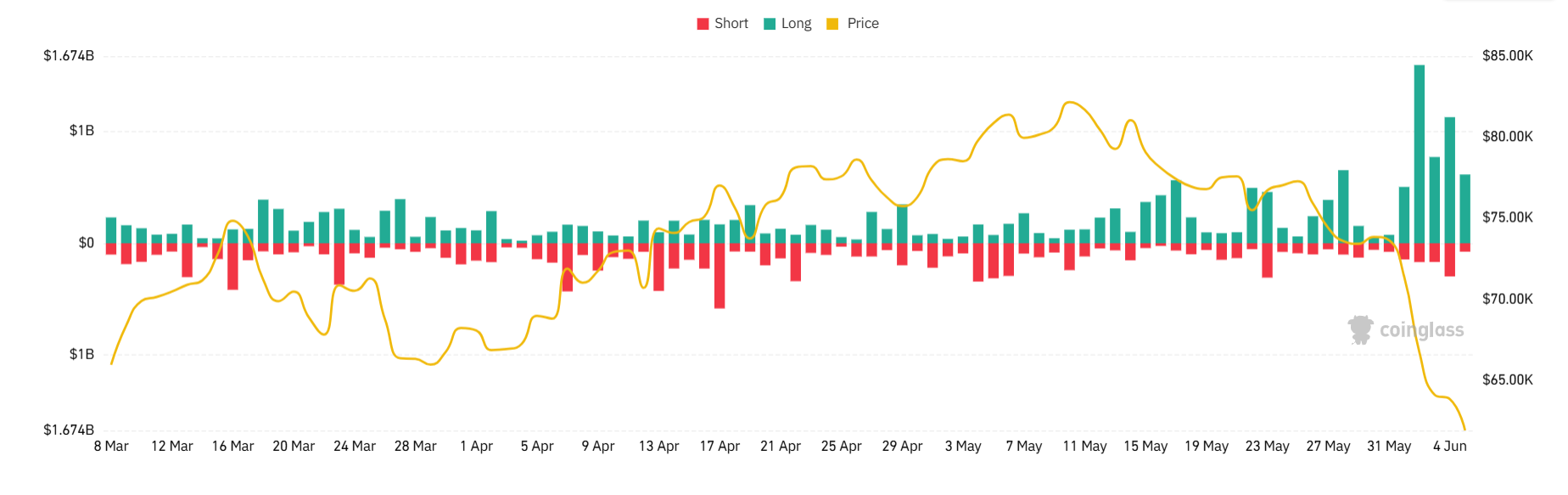
When gauging the 24-hour liquidation heatmap, a clear band of short liquidations is visible between $78,500 and $80,000, marking this range as the immediate overhead pressure zone.

Bitcoin 24-hour liquidation heatmap. Source: Coingalss.
If bulls manage to push price through this wall, it could trigger a cascade of short covers that accelerates upside momentum toward $82,000 or higher.
Below $74,000, the heatmap shows minimal liquidation clusters until the low $70,000s, indicating weak structural support.
A clean breakdown could invite further forced selling, potentially dragging Bitcoin price into the $65,000 to $60,000 range where larger long interest may begin to step in.
According to well-followed analyst Rekt Capital, if bulls struggle to break through the $80,000, it would likely confirm the level has flipped from support into resistance.

BTC/USD 1-week price chart. Source: Rekt Capital on X.
Bitcoin has now closed a weekly candle below $80,000. From a technical standpoint, when price closes below a key level on the higher timeframe (like the weekly), that level often flips into resistance.
Per the analyst, if $80,000 holds as resistance in the coming days or weeks, it validates the recent breakdown and opens the door for deeper downside.
However, according to fellow market commentator Ted Pillows, there may still be scope for a short-term relief bounce that allows Bitcoin to return above $80,000.
In a recent X post, the analyst pointed to a CME gap around $84,500, which has remained unfilled following the sharp sell-off.

CME gap formed on BTC chart. Source: Ted Pillows on X.
CME gaps tend to act as price magnets, often drawing Bitcoin back toward those levels during periods of heightened volatility. As such, Bitcoin could attempt a rebound toward the $84,500 area if selling pressure continues to ease.
“Most CME gaps fill within a week, so keep an eye on this,” the analyst wrote.
When writing, the Bitcoin price was hovering just below $79,000 with gains of roughly 2.5% on the day.
Top altcoin gainers
The market cap of all altcoins combined tanked 8.5% to an intraday low of $962 billion before recovering back above $1 trillion.
The late-day recovery saw Ethereum (ETH), which led the earlier downtrend with a 8.5% drop, wiping off the day’s losses, before settling around $2,350.
Other major cryptocurrencies such as BNB (BNB), XRP (XRP), Solana (SOL), Dogecoin (DOGE), and Cardano (ADA) moved back into the green, posting gains between 2-3% each.
The majority of the remaining top 100 altcoins also recouped from losses by the end of the daily session.
Stable (STABLE) outperformed the market with a nearly 33% rally, fueled primarily by its listing on crypto exchange BitTap.
Its gains were also driven by investor anticipation for a major mainnet upgrade scheduled for later this week that will transition native gas fees to USDT0, a gas-optimised version of Tether, and is expected to boost liquidity and transaction volume on the network.
River (RIVER) staged a 25% rebound today as it reclaimed key support levels following a sharp 34% drop during the February 1 market crash.
This recovery was powered by a massive short squeeze that forced bearish traders to exit their positions, effectively turning a steep sell-off into a rapid relief rally.
For MYX Finance (MYX), its 24% surge today was largely driven by the recent rollout of its V2 upgrade, which significantly enhanced capital efficiency for derivatives traders.
This momentum was further amplified by an ongoing airdrop campaign that has intensified wallet activity and generated substantial new demand for the token.

Source: CoinMarketCap
The post Bitcoin price sinks to 9-month low as macro pressures loom, STABLE, RIVER buck market trend appeared first on Invezz
In This News
Coins

$ 61.80K
-2.78%
$ 1.60K
-9.33%
$ 1.11
-4.58%
$ 0.160
-11.6%
$ 0.99969
+0.07%


Predictions Markets
See what traders are focused on
Share:
In This News
Coins
$ 61.80K
-2.78%$ 1.60K
-9.33%$ 1.11
-4.58%$ 0.160
-11.6%$ 0.99969
+0.07%Predictions Markets
See what traders are focused on
Share:
Read More

Nearly $1B liquidated as crypto longs get wiped out