
The popularity of crypto cards continues to grow steadily
Share:
 CryptoRank
Share:
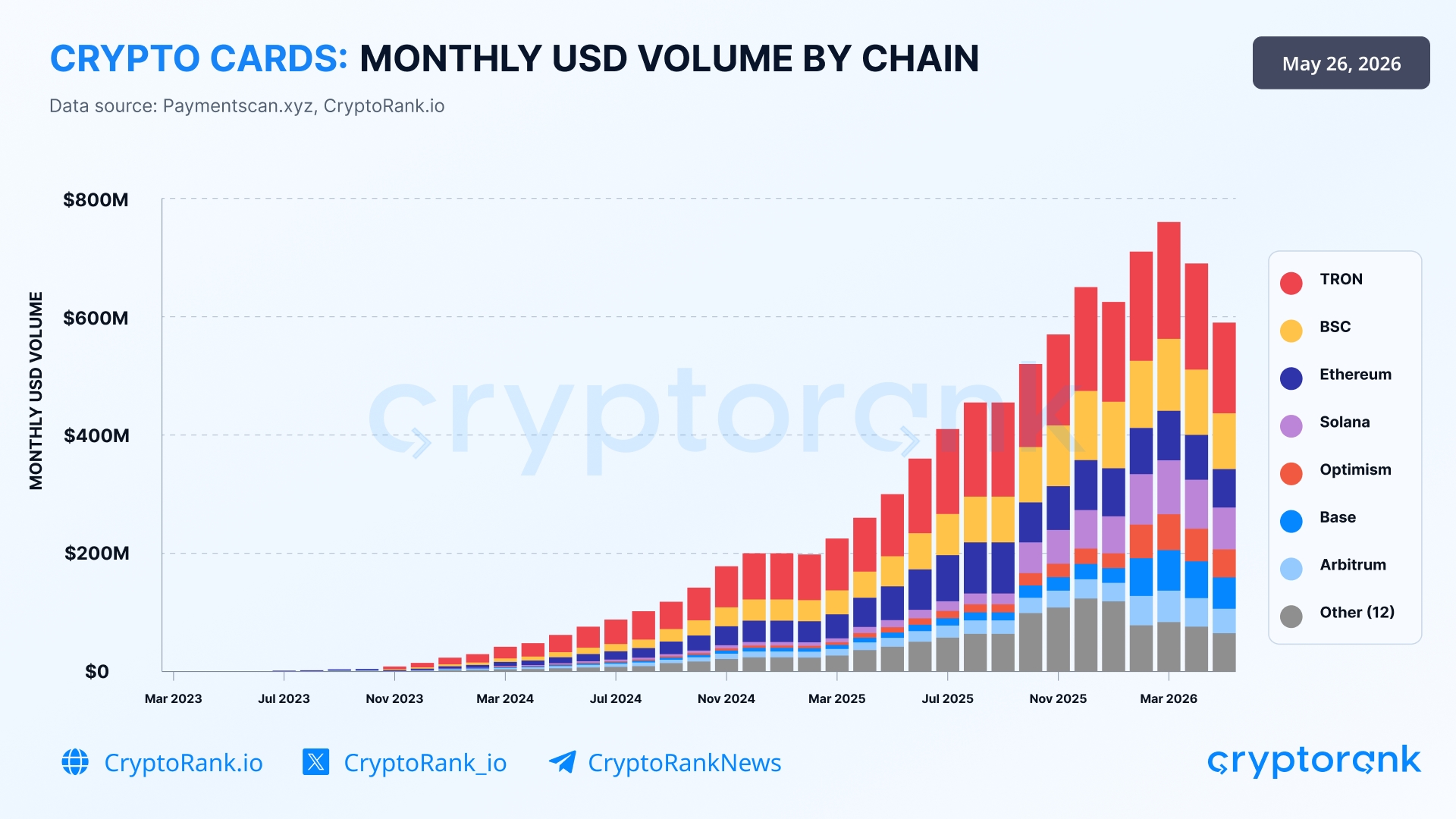
By April 2026, total volume approached ~$660M/month.
And the most interesting part is who actually controls this market.
TRON remains the largest network in the segment, processing $213M in volume in April. However, its market share declined from ~45% in 2023 to ~32% in 2026.
BSC is also losing its share. BNB Chain’s share fell by ~8%, from ~23% in 2023 to ~15% in 2026.
BSC still maintains a strong position largely thanks to:
- the Binance ecosystem;
- cheap on-chain transactions;
- integrations with card providers.
Ethereum and Solana are gradually increasing their share not only through DeFi speculation, but through real-world usage.
For years, the market discussed mass adoption as an abstract concept:
- NFTs;
- metaverses;
- Web3 social;
- GameFi.
But crypto cards have become one of the first truly working bridges between crypto and everyday payments.
Solana’s share grew from 0% in 2024 to ~11.6% in 2026.
Meanwhile, Ethereum’s share declined from ~55% in 2023 to ~11% in 2026, gradually losing liquidity to its L2 ecosystem, where the leaders by volume in April 2026 were:
What’s also interesting is that this growth is happening despite:
- a weak altseason;
- declining DeFi activity;
- falling NFT volumes.
At the same time, the data highlights an important structural trend:
The Payments sector currently accounts for 33% of total investment focus, and since the beginning of 2026 ~$3.6B has already raised into this segment. This suggests that part of the market is gradually shifting from speculative use cases → to utilitarian finance.