
SpaceX’s IPO Will Trigger a Crash In Stocks and Crypto?
Share:
SpaceX plans to raise $75 billion in an IPO valuing the company near $1.75 trillion with demand reportedly above $250 billion, and could join the Nasdaq-100 within about 15 trading days which would force index funds to buy an estimated $15–$30 billion of shares. That dynamic risks a liquidity squeeze as investors sell stocks and crypto to fund allocations, already coinciding with >$2 billion crypto ETF outflows in May 2026 and Bitcoin sliding to roughly $59,500, posing downside risk to crypto markets and DeFi adoption.
Predictions Markets
See what traders are focused on

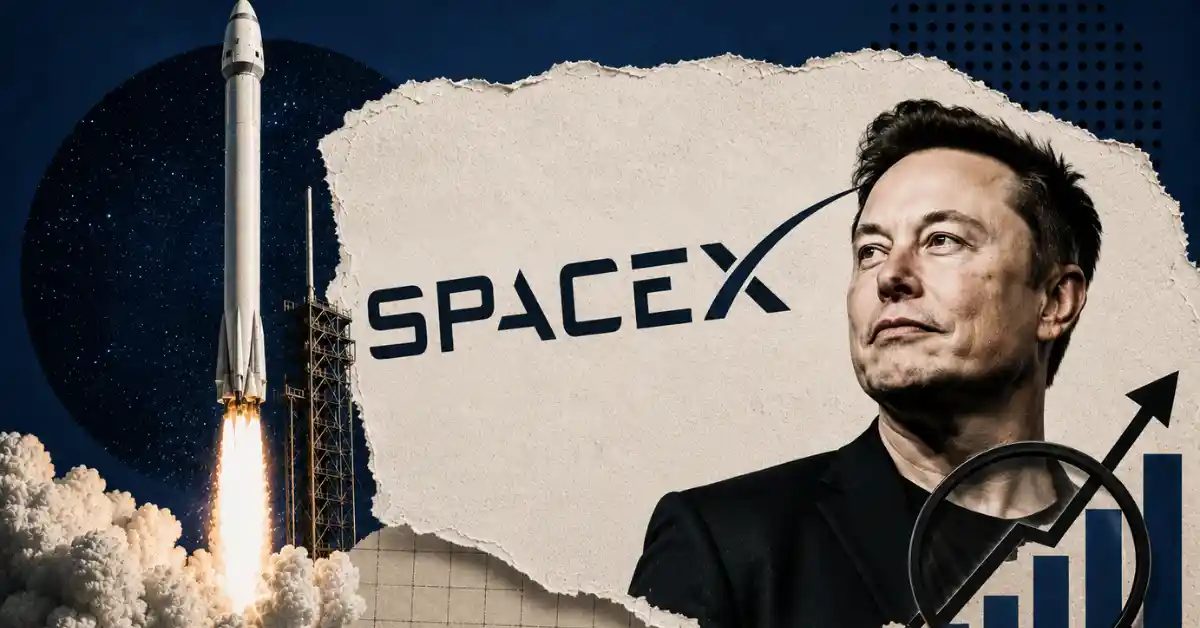
Elon Musk’s SpaceX is just hours away from launching the biggest IPO in history, while seeking to raise $75 billion. Demand has already exceeded supply by nearly four times. Now, investors are wondering where the money will come from.
If investors sell their existing holdings to secure a Space IPO, that could create a liquidity squeeze across both stock and crypto, which would crash the market.
Where Will The $75B Come From?
Unlike a stock market rally, an IPO does not create new money. The company is reportedly raising $75 billion at a valuation near $1.75 trillion, while demand has already exceeded $250 billion
To participate in such a massive offering, investors often sell existing positions to free up capital.
When investors need cash fast, they usually sell stocks, crypto, or other assets they can quickly turn into money.
The crypto market may be particularly vulnerable because many investors interested in high-growth technology companies are the same investors who allocate capital to Bitcoin and other digital assets. So, if they need funds, they can move it quickly without asking permission.
Nasdaq Rule That Could Force More Selling
The bigger concern may arrive after the IPO. Under Nasdaq’s fast-entry rules, SpaceX could join the Nasdaq 100 within approximately 15 trading days after listing.
That would force index funds and ETFs tracking the benchmark to buy an estimated $15 billion to $30 billion worth of SpaceX shares.
Those funds do not typically hold large cash reserves.
Instead, they create room by selling existing holdings, often targeting their largest positions such as Nvidia, Microsoft, Apple, and other mega-cap technology stocks.
Successful Listing May Lead To More Sell-Off
The biggest risk may not be the IPO itself but the weeks that follow. If institutional demand remains strong and index funds begin buying aggressively, liquidity could continue flowing toward SpaceX and away from other risk assets.
Crypto ETFs have already seen more than $2 billion in outflows in May 2026, and some believe that trend could continue as investors shift funds toward the highly anticipated offering. This is also seen as one factor behind Bitcoin’s recent drop to around $59,500.
However, if the IPO hype fades after listing, some of that capital could rotate back into technology stocks and cryptocurrencies.


Predictions Markets
See what traders are focused on
Share:
Predictions Markets
See what traders are focused on
Share: