Michael Saylor reveals how ChatGPT helped Strategy unlock $15 billion for its Bitcoin machine
Share:
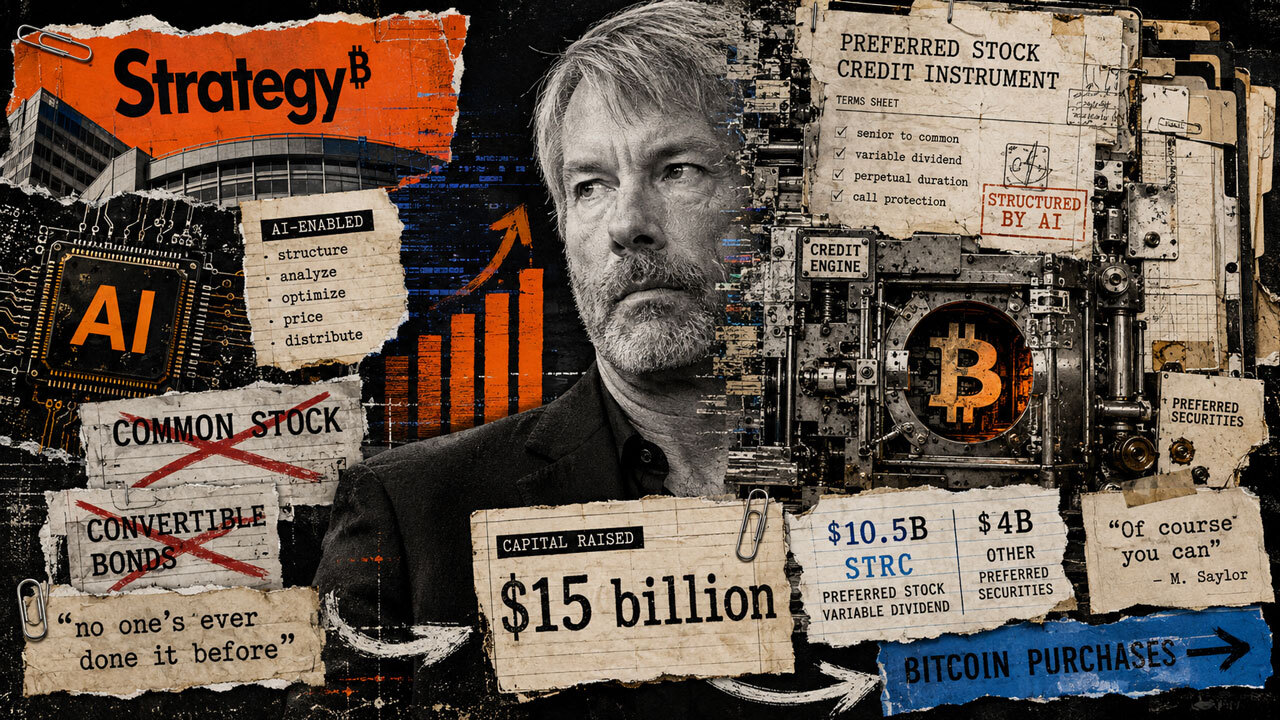
Michael Saylor said Strategy used AI (ChatGPT/OpenAI) starting in early 2025 to design variable-rate preferred-stock instruments that raised about $15 billion to fund Bitcoin purchases, including roughly $10.5 billion from STRC and about $4 billion from related products, per his Aug. 6 podcast remarks. The AI-designed preferred stock created a new fundraising channel alongside common equity and convertibles, supporting further corporate accumulation of Bitcoin (Strategy holds over 840,000 BTC) and highlighting an innovative use of generative AI in crypto corporate finance and fundraising.
Predictions Markets
See what traders are focused on

Michael Saylor says Strategy used AI to design a new class of preferred stocks that ultimately allowed the company to raise roughly $15 billion for its Bitcoin strategy.
The Strategy executive chairman said he turned to AI after the company’s existing financing channels, including common-stock sales and convertible bonds, were becoming harder to scale.
“I used AI to make $15 billion last year,” Saylor said during an Aug. 6 appearance on The Diary of a CEO podcast.
Saylor was referring to capital raised through securities rather than $15 billion of personal income or corporate profit. He said Strategy ultimately sold about $10.5 billion of one preferred-stock instrument and another roughly $4 billion across related products.
He did not initially identify the AI system by name. Later in the discussion, after Saylor described asking an AI how Strategy could structure an unusual variable-dividend preferred stock, host Steven Bartlett asked whether he meant ChatGPT and OpenAI. Saylor affirmed the characterization.
Strategy turned to AI after its old Bitcoin playbook hit limits
According to Saylor, the experiment began in early 2025 as Strategy searched for another way to finance Bitcoin purchases.
By then, Saylor said the company had already pushed heavily into common-stock issuance and had become one of the world’s largest issuers of convertible bonds.
Those instruments had powered much of Strategy’s first several years of Bitcoin accumulation, but he believed neither market could support the scale of capital the company wanted to raise next.
He said:
“We needed to invent a new type of security, a new type of credit instrument that we could use to borrow money to buy more Bitcoin.”
He continued that he began using AI to explore the design of preferred shares, securities whose terms can combine characteristics of debt and equity.
That process first produced STRK, a convertible preferred stock. Strategy later moved toward a different structure designed to behave more like short-duration credit and trade close to its $100 stated value.
To keep that price relatively stable, Strategy developed a preferred stock whose dividend rate could be adjusted as market conditions changed.
Saylor said the structure was unfamiliar enough that conventional advisers were skeptical.
“Their answer, by the way, is no one’s ever done it before, and people don’t do that,” he said.
Saylor said Strategy used AI to work through how the structure could be built within existing securities rules.
He said:
“We go to the AI. We said, ‘Well, can we do it?’ They’re like, ‘Of course you can do it.’”
That work ultimately contributed to STRC, Strategy’s variable-rate preferred stock.
Saylor said Strategy raised about $2.5 billion in the initial offering and later sold another roughly $8 billion through subsequent issuance, taking the total raised through that instrument to about $10.5 billion.
Combined with roughly $4 billion raised through its other preferred securities, he put the total at about $15 billion.
“So we basically sold $15 billion of credit,” Saylor said.
The result was a new financing channel sitting alongside Strategy’s common equity and convertible debt markets, giving the company another way to raise capital for Bitcoin purchases.
Saylor’s account also illustrates a less conventional use of generative AI in corporate finance. Rather than using the technology to trade assets or forecast prices, Strategy used AI as part of the process for exploring how a new security could be structured.
Strategy is the largest corporate holder of the top crypto, with more than 840,000 BTC in its coffers.
The post Michael Saylor reveals how ChatGPT helped Strategy unlock $15 billion for its Bitcoin machine appeared first on CryptoSlate.
In This News
Coins

$ 65.17K
+0.21%
$ 0.0249
-1.31%
$ 0.0017

Funds

Predictions Markets
See what traders are focused on
Share:
In This News
Coins
$ 65.17K
+0.21%$ 0.0249
-1.31%$ 0.0017
Funds
Predictions Markets
See what traders are focused on
Share:
Read More

Bitcoin’s AI security sprint found 6,700 issues in 55 hours, but no one knows how many are real