Crypto’s CLARITY push heats up, but prediction markets aren’t buying the August deadline
Share:
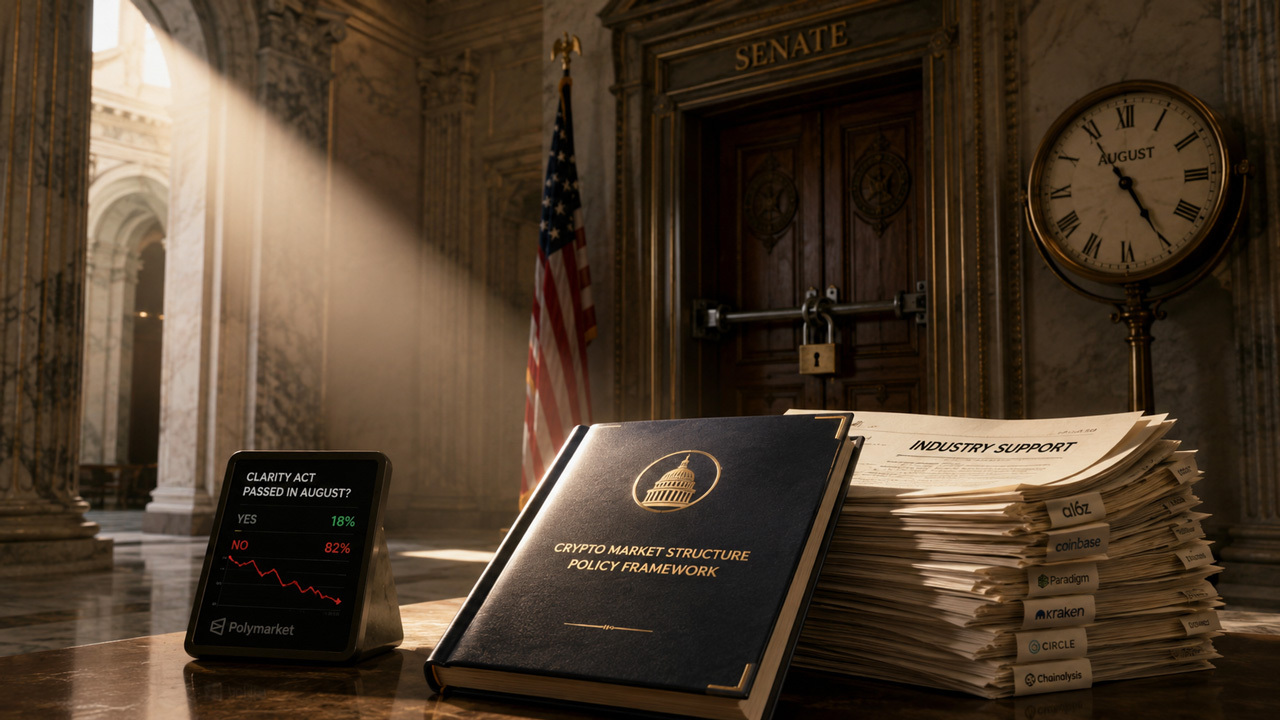
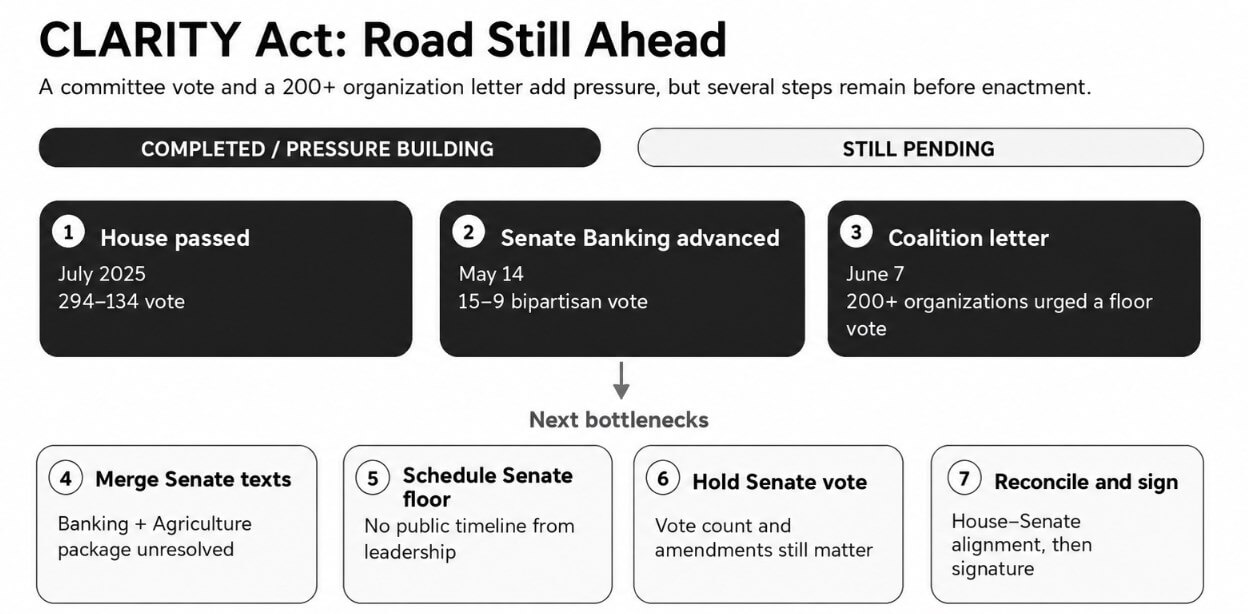
On June 7 a coalition of more than 200 crypto firms including Stand With Crypto, the Blockchain Association and the Crypto Council urged Senate leaders to schedule a floor vote on the CLARITY Act after the bill advanced 15–9 out of the Senate Banking Committee on May 14, but the text still requires reconciliation with the Agriculture Committee's DCI Act and faces objections over BSA/AML, ethics, and a stablecoin-yield loophole. Prediction markets and institutions have trimmed near-term passage odds—Polymarket fell from 62% to 51% (June 3–8), Kalshi's before-August contract dropped from 39.7% to 22.1%, Galaxy cut its estimate from 75% to 60% and JPMorgan puts odds below 50%—signaling calendar and regulatory risk that mutes near-term upside for exchanges, token issuance, DeFi adoption and Bitcoin ETF flows (US spot ETFs drained $4.4 billion over 13 sessions).
Predictions Markets
See what traders are focused on

A coalition of more than 200 companies and organizations sent a letter dated June 7 to Senate Majority Leader John Thune and Senate Minority Leader Charles Schumer, urging them to bring the CLARITY Act to the full Senate floor for a vote without delay.
Signed by Stand With Crypto, the Blockchain Association, the Crypto Council for Innovation, and The Digital Chamber, the letter frames the bill as a competitiveness imperative, arguing that without a federal framework, digital asset activity will continue moving to offshore jurisdictions with weaker consumer protections and less transparency.
The push comes roughly three weeks after the Senate Banking Committee advanced the CLARITY Act on May 14 by a 15-9 bipartisan vote. The bill now awaits floor scheduling, but Senate leadership has not publicly committed to a timeline.
Per Davis Wright Tremaine's analysis, the Senate Banking Committee's substitute text still needs to be reconciled with the Senate Agriculture Committee's Digital Commodity Intermediaries Act before full Senate consideration, and any version the Senate passes would then need to be reconciled with the House-passed CLARITY Act.
Senate GOP allies amplify the urgency
Sen. Cynthia Lummis, one of the bill's most vocal champions, posted June 7 that CLARITY “passed committee” and that “the floor is next,” adding that supporters did not travel this far “to quit at the 5-yard line.”
Senate Banking Chair Tim Scott followed on June 8, saying CLARITY “takes the side of everyday Americans” and would bring digital assets into a “safer, fairer, and more transparent” system.
As chair of the committee whose panel drove the bipartisan 15-9 vote that moved the bill to this stage, Scott's involvement goes beyond standard floor advocacy.
The Crypto Council for Innovation and Hedera both posted June 8 that they joined the coalition letter and echoed the call for Senate leadership to schedule consideration “as soon as possible.”
The coalition letter's momentum runs into another letter, sent June 4 and signed by the National Consumers League, Americans for Financial Reform, Consumer Federation of America, Public Citizen, and other advocacy groups, urging Thune and Schumer to oppose the Senate version.
The letter cites three objections: weak Bank Secrecy Act and anti-money laundering requirements, insufficient ethics provisions, and a stablecoin-yield loophole.
Those objections target the exact provisions that Democratic vote-counters and some moderate Republicans have flagged as needing revision before floor consideration, and they explain why a large coalition on one side has not produced a floor vote date.

Markets price the disconnect between noise and outcome
Polymarket's contract on whether CLARITY gets signed into law in 2026 sat at 62% on June 3 and fell to 51% by June 8.
Kalshi's market implied probability that a crypto market structure law passes before August dropped from 39.7% to 22.1% over the same window. Kalshi's contract on whether any such law passes before 2027 moved only marginally, from 52.1% to 51.5%, suggesting traders see an outside shot at full-year enactment but have sharply cut their estimate of a fast signing.
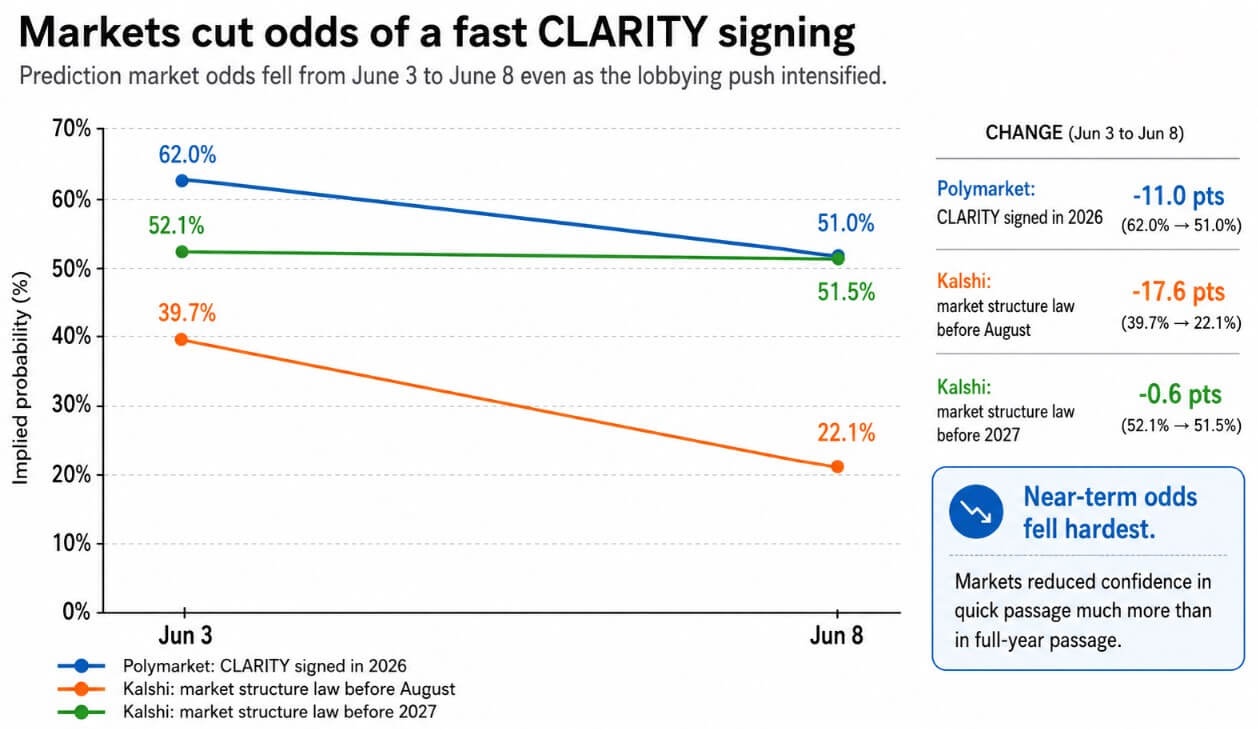
Outside forecasters have moved in the same direction, with Galaxy Digital's Alex Thorn reportedly trimming his 2026 CLARITY passage estimate from 75% to 60% on Senate calendar risk, while JPMorgan has put its own estimate below 50%.
Prediction market traders have pulled back even as institutional backers reached their loudest point since committee passage.
Those markets are pricing three concrete bottlenecks: whether Senate leadership can find floor time, whether the ethics and AML disputes can be resolved without reopening larger fights, and whether the calendar survives competition from budget reconciliation, national security legislation, and other election-year priorities.
What the bull and bear cases actually price
In the bull case, Senate leadership finds July floor time, and the ethics and illicit-finance language gets revised enough to hold the bipartisan coalition together without triggering a new wave of defections.
Under that outcome, Polymarket could reprice toward 70% to 80%, Kalshi's before-August market could recover toward 40% to 55%, and institutions exposed to exchange regulation, token issuance, and tokenized asset markets would see the policy discount in their valuations compress.
| Scenario | Legislative trigger | Prediction market repricing | Market impact |
|---|---|---|---|
| Bull case | Senate leadership finds July floor time; ethics and illicit-finance language revised enough to preserve bipartisan support | Polymarket moves toward 70%-80%; Kalshi before-August rebounds toward 40%-55% | Policy discount compresses for exchanges, token issuers, tokenization firms; Bitcoin gets secondary support from improved institutional risk appetite |
| Bear case | No floor time before recess; Senate calendar fills with higher-priority legislation; disputes over AML, ethics, and stablecoin-yield language remain unresolved | Polymarket drifts toward 25%-40%; Kalshi full-year market falls below 35% | Crypto markets refocus on ETF flows, macro liquidity, and Bitcoin’s technical range; offshore-migration argument strengthens |
Bitcoin would get a secondary bid from improved institutional risk appetite and ETF flow normalization, following 13 consecutive sessions that drained $4.4 billion in flows from US-traded spot Bitcoin ETFs.
In the bear case, no floor time materializes before recess, the Senate calendar fills with higher-priority legislation, and the coalition letter becomes the latest in a series of well-organized but ultimately ineffective pressure campaigns.
Under that scenario, Polymarket drifts toward 25% to 40%, Kalshi's full-year market falls below 35%, and crypto markets refocus on ETF flows, macro liquidity, and Bitcoin's technical range rather than legislative catalysts.
That outcome would also accelerate the offshore-migration argument the coalition letter used to frame CLARITY as urgent, since the EU MiCA transitional period expires July 1, after which crypto-asset service providers without a MiCA license must stop serving EU clients.
The US regulatory vacuum the coalition letter describes is already costing market share to jurisdictions that completed their frameworks first.
The June 7 coalition letter stands as the most formally coordinated industry push for a CLARITY floor vote since the Senate Banking Committee's bipartisan passage in May.
The post Crypto’s CLARITY push heats up, but prediction markets aren’t buying the August deadline appeared first on CryptoSlate.
In This News
Coins

$ 64.17K
+0.10%
$ 0.0684
-2.38%


Predictions Markets
See what traders are focused on
Share:
In This News
Coins
$ 64.17K
+0.10%$ 0.0684
-2.38%Predictions Markets
See what traders are focused on
Share:
Read More
SEC could start writing crypto rules before the Senate votes on CLARITY