Cardano and Solana face governance roadblocks as voter participation lags

Share:
Cardano and Solana are experiencing governance roadblocks as low voter participation among DReps, staking pool operators and delegated-stake validators, plus disputes over majority versus supermajority thresholds, are causing quorum failures and stalling proposals for protocol upgrades and treasury spending. The deadlock risks concentrating power, delays security fixes and feature rollouts, and could undermine crypto adoption, token-holder confidence and governance credibility in DeFi use cases.
Predictions Markets
See what traders are focused on

BitcoinWorld
Cardano and Solana face governance roadblocks as voter participation lags
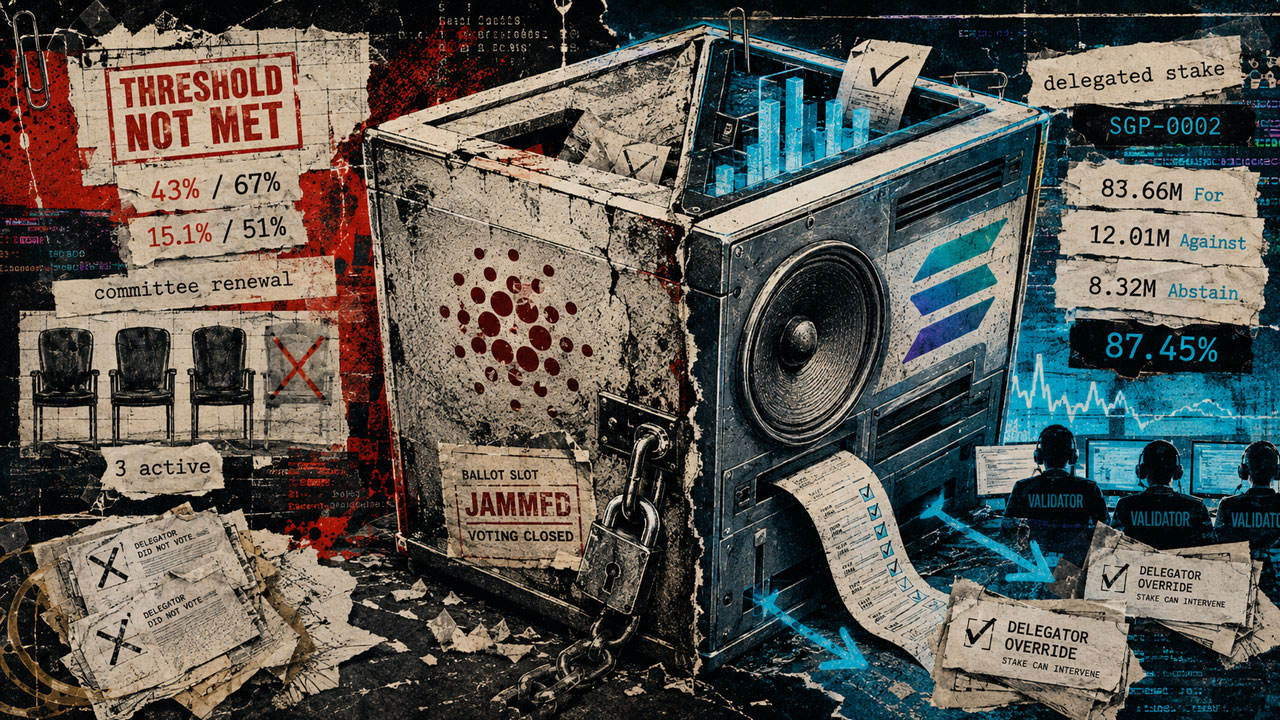
Cardano and Solana, two of the largest proof-of-stake networks, are encountering distinct governance challenges as both protocols test on-chain decision-making systems. Low voter participation and complications with delegated voting are slowing progress, according to a recent report from CryptoSlate.
Cardano’s DRep bottleneck
Cardano’s governance model requires approval from delegated representatives (DReps) and staking pool operators (SPOs) to advance proposals. However, participation from both groups has been insufficient, preventing the network from moving forward on key decisions. The system, introduced as part of the Voltaire era, was designed to give ADA holders a voice through delegation, but the current participation levels are raising concerns about the model’s viability.
Data from Cardano’s governance dashboard shows that only a fraction of eligible DReps are actively voting on proposals, and SPO engagement has also been sporadic. This creates a deadlock where proposals cannot reach the required approval thresholds, even when there is community interest. The lack of quorum is not just a technical issue—it reflects a broader challenge of incentivizing meaningful participation in decentralized governance.
Solana’s validator voting conflicts
Solana’s governance approach relies on validators voting with delegated stake, but the system is facing its own set of issues. Individual governance votes have highlighted conflicts of interest among validators, who may prioritize their own interests over those of the token holders they represent. Additionally, there is confusion over how the rules governing passage thresholds should be interpreted, leading to disputes and delays.
For instance, recent proposals have seen validators split over whether a simple majority or a supermajority is required for approval, with no clear consensus on the interpretation. This ambiguity creates uncertainty and undermines the credibility of the governance process. It also raises questions about the effectiveness of delegated proof-of-stake as a governance mechanism, as token holders may not fully understand how their stake is being used.
Why participation matters
Low participation in on-chain governance is a systemic issue across many blockchain networks, but it carries particular weight for Cardano and Solana as they seek to position themselves as decentralized alternatives to traditional finance. Governance is not just a technical feature—it is a core component of the value proposition for these networks. If token holders are not engaged, the networks risk becoming effectively centralized in the hands of a few active participants.
This also has practical implications. Proposals related to protocol upgrades, treasury spending, and parameter changes can be stalled, slowing innovation and reducing the networks’ ability to adapt to market conditions. For users, this means potential delays in improvements or fixes that could affect the usability and security of the platforms.
Comparing the two models
While both networks face participation challenges, their governance models differ significantly. Cardano’s DRep system is more structured, with formal roles and responsibilities, but it requires a higher level of commitment from participants. Solana’s validator-based model is more flexible, but it concentrates power in the hands of validators, who may not always act in the best interest of the broader community.
Both approaches are experiments in decentralized decision-making, and their outcomes will be closely watched by other blockchain projects. The industry is still in the early stages of figuring out how to balance efficiency, security, and decentralization in governance, and the experiences of Cardano and Solana offer valuable lessons.
Conclusion
Cardano and Solana are at a crossroads in their governance evolution. Low participation and proxy voting issues are exposing weaknesses that could undermine their long-term decentralization goals. As these networks continue to grow, addressing these governance hurdles will be critical to maintaining trust and ensuring that they can effectively serve their communities. The coming months will be telling as both protocols attempt to refine their models and encourage broader engagement.
FAQs
Q1: What are DReps in Cardano?
DReps, or delegated representatives, are individuals or entities chosen by ADA holders to vote on governance proposals on their behalf. They play a central role in Cardano’s on-chain governance system, alongside staking pool operators.
Q2: How does Solana’s governance work?
Solana uses a delegated proof-of-stake model where validators vote on proposals using stake delegated to them by token holders. This system is designed to be efficient, but it has raised concerns about validator influence and conflicts of interest.
Q3: Why is low voter participation a problem?
Low participation can lead to governance gridlock, where proposals cannot reach the required approval thresholds. It also risks concentrating decision-making power among a small group, undermining the decentralized ethos of these networks.
This post Cardano and Solana face governance roadblocks as voter participation lags first appeared on BitcoinWorld.
In This News
Coins

$ 0.215
+2.07%
$ 104.05
+7.15%
$ 0.0000989
-0.49%
$ 0.000377
-3.56%Predictions Markets
See what traders are focused on
Share:
In This News
Coins
$ 0.215
+2.07%$ 104.05
+7.15%$ 0.0000989
-0.49%$ 0.000377
-3.56%Predictions Markets
See what traders are focused on
Share:
Read More
Cardano and Solana just exposed crypto governance’s biggest weakness