Samsung, AMD expand AI chip ties: here’s why it matters

Share:
Samsung and AMD signed an MoU (press release 2026-03-18) to integrate Samsung HBM4 memory (up to 13 Gbps, 3.3 TB/s, mass production on 10nm-class DRAM with a 4nm logic base die) into AMD’s Instinct MI455X GPU and to develop DDR5 for AMD’s 6th‑gen EPYC “Venice”; the deal also contemplates a potential Samsung foundry role. The partnership targets AI memory bottlenecks via Helios full‑stack integration to boost large-scale training and inference, strengthens Samsung’s HBM position (22% share vs SK Hynix 57%), dovetails with AMD’s multi‑year AI supply deals (including a potential $60B tie‑up with Meta), and should expand AI compute capacity—indirectly benefiting crypto infrastructure, on‑chain analytics, DeFi/DEX/CEX trading tools, and broader adoption.
Predictions Markets
See what traders are focused on

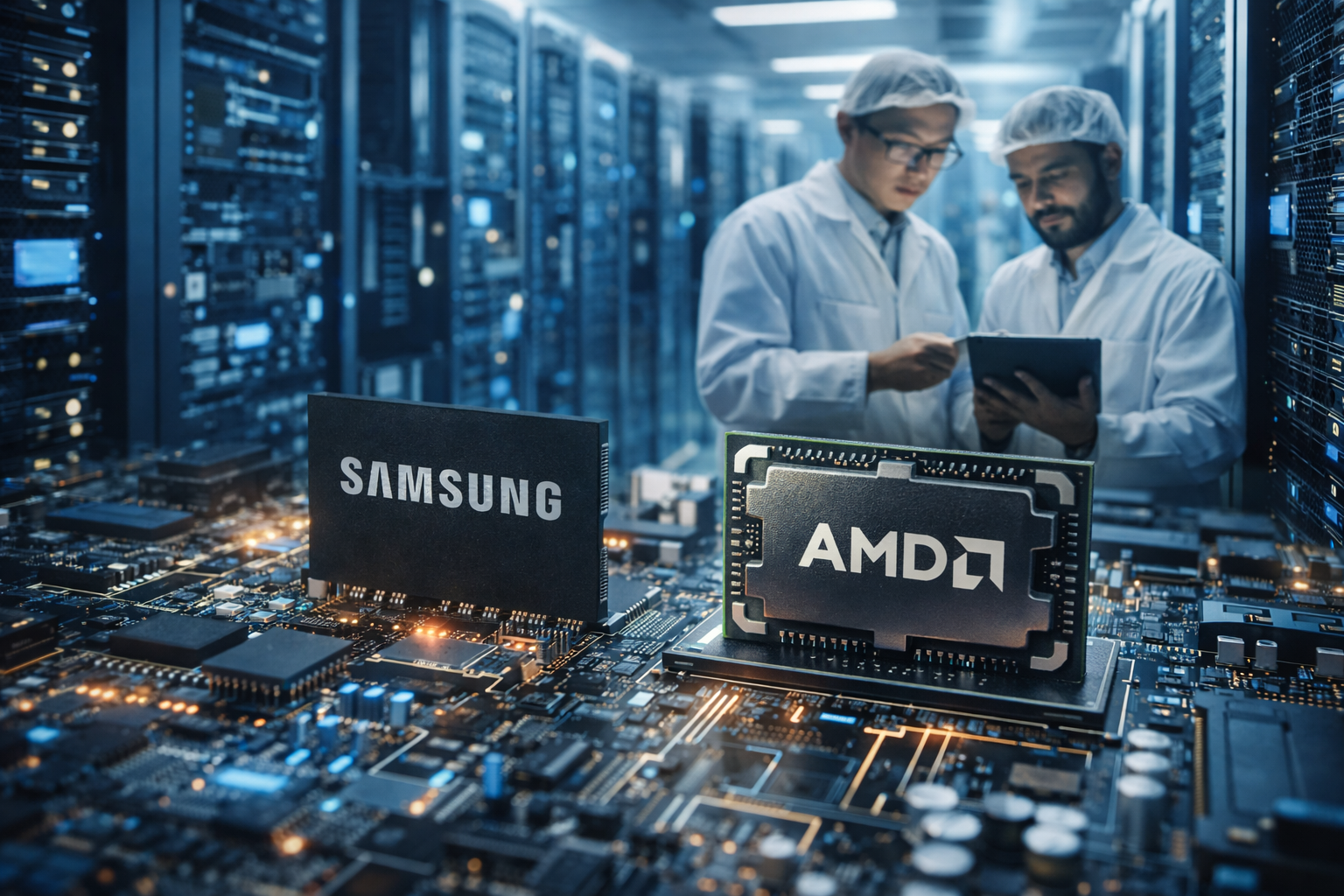
Samsung Electronics and AMD have deepened their long-standing partnership with a new agreement focused on artificial intelligence infrastructure, as global demand for high-performance data centre systems accelerates.
The memorandum of understanding was signed at Samsung’s semiconductor campus in Pyeongtaek, South Korea, during a visit by AMD chief executive Lisa Su, alongside Samsung Electronics vice-chairman and chief executive Young Hyun Jun.
The deal reflects a broader industry shift, where chipmakers are moving closer together to address bottlenecks in AI computing, particularly around memory speed, power efficiency, and system integration.
Why memory is becoming the AI bottleneck
The agreement centres on tighter coordination between memory and computing technologies.
Samsung is expected to supply its next-generation high-bandwidth memory, HBM4, for AMD’s upcoming Instinct MI455X AI accelerator.
It will also develop DDR5 memory tailored for AMD’s sixth-generation EPYC processors, codenamed Venice.
As AI models grow larger, memory bandwidth and efficiency have become critical constraints.
Advanced AI workloads require systems where GPUs, CPUs, and memory operate seamlessly together.
This collaboration aims to improve both training and inference performance in next-generation data centres.
Samsung’s HBM4 is designed to reach speeds of up to 13 gigabits per second and deliver bandwidth of up to 3.3 terabytes per second.
The memory is built on a sixth-generation 10-nanometre-class DRAM process with a 4nm logic base die and is entering mass production.
How the chips will power next-gen systems
AMD’s Instinct MI455X GPU, expected to incorporate Samsung’s HBM4, is being positioned for large-scale AI workloads.
It will be part of AMD’s Helios rack-scale architecture, which integrates compute, memory, and networking at the system level.
The companies are focusing on full-stack integration, combining AMD Instinct GPUs, EPYC CPUs, and advanced memory into unified platforms.
This approach is increasingly seen as essential for scaling AI systems efficiently across data centres.
In addition to the memory supply, the agreement includes discussions around a potential foundry partnership.
Samsung could manufacture future AMD chips, expanding its role beyond memory into contract chip production.
How the deal fits the global chip race
The partnership comes at a time when competition in the AI semiconductor market is intensifying.
Companies are racing to secure long-term supply chains for advanced memory, particularly HBM chips, which are in limited supply.
Samsung currently holds around 22% of the global HBM market, according to Counterpoint, trailing SK Hynix, which leads with 57%.
Strengthening ties with AMD could help Samsung narrow that gap.
The announcement also coincides with Nvidia’s annual GTC developer conference, where chief executive Jensen Huang highlighted Samsung’s HBM4 capabilities and confirmed a foundry partnership with the company.
Why is big tech demand driving urgency?
The urgency behind such partnerships is being driven by large-scale AI investments from technology firms.
AMD recently agreed to a multi-year deal to supply AI chips to Meta Platforms, reportedly worth up to $60 billion, with terms that could include Meta taking up to a 10% stake in the company.
It signed a similar deal with OpenAI last year.
These agreements are reshaping the semiconductor landscape, pushing chipmakers to collaborate more closely across the computing stack.
Samsung and AMD have worked together for nearly two decades across graphics, mobile, and computing technologies.
More recently, Samsung supplied HBM3E memory for AMD’s MI350X and MI355X accelerators, laying the groundwork for this expanded collaboration.
The post Samsung, AMD expand AI chip ties: here’s why it matters appeared first on Invezz


Read More

European Earnings Season: Can the Continent Finally Catch Up to the US?