Convicted scammer’s “seized” crypto moves to unknown wallets while in prison as DOJ failed to secure funds
Share:
The DOJ says convicted exchange owner Rossen Iossifov allegedly routed about $290,000 in cryptocurrency through exchanges and illicit mixers in January 2024 after a court ordered the assets forfeited, and announced charges on July 9 for removal of property to prevent seizure and conspiracy to commit money laundering; Iossifov was convicted of RICO and money laundering, sentenced to 121 months in 2021 (reduced to 111 months in May 2024) and ordered to pay $2.64 million in restitution. The case highlights a custody and security gap between forfeiture orders and practical wallet control and underscores DOJ policy recommendations to rapidly transfer seized crypto into agency-controlled unhosted wallets and cold storage to prevent transfers before private keys are secured, posing enforcement and crypto custody risks.
Predictions Markets
See what traders are focused on

The US Justice Department says a prisoner serving a nine-year sentence for money laundering conspired to move about $290,000 in cryptocurrency in January 2024 after a court ordered the assets forfeited to the United States.
The case highlights a potential gap between a court’s forfeiture order and the government obtaining control of assets that can still be transferred.
Until an agency obtains practical control of the wallet, someone with valid access may still be able to send the assets elsewhere.
In a July 9 announcement, the Justice Department said Rossen Iossifov allegedly routed the cryptocurrency through multiple exchanges and illicit mixing services, preventing the United States from obtaining possession.
Iossifov owned Bulgaria-based crypto exchange RG Coins and was convicted of RICO conspiracy and conspiracy to commit money laundering.
Prosecutors said Romanian scammers posted fake listings for vehicles and other expensive goods on sites such as Craigslist and eBay, took payments from at least 900 Americans, then converted the proceeds into crypto.
The release calls the funds seized and forfeited but leaves a crucial gap: Had agents taken the private keys or moved the crypto into a government wallet before the alleged transfer?
According to the DOJ, they had not. The crypto moved before the government secured it.
A seizure order still needs a key-custody plan
The Justice Department's Asset Forfeiture Policy Manual outlines what must happen after agencies obtain authority to seize cryptocurrency.
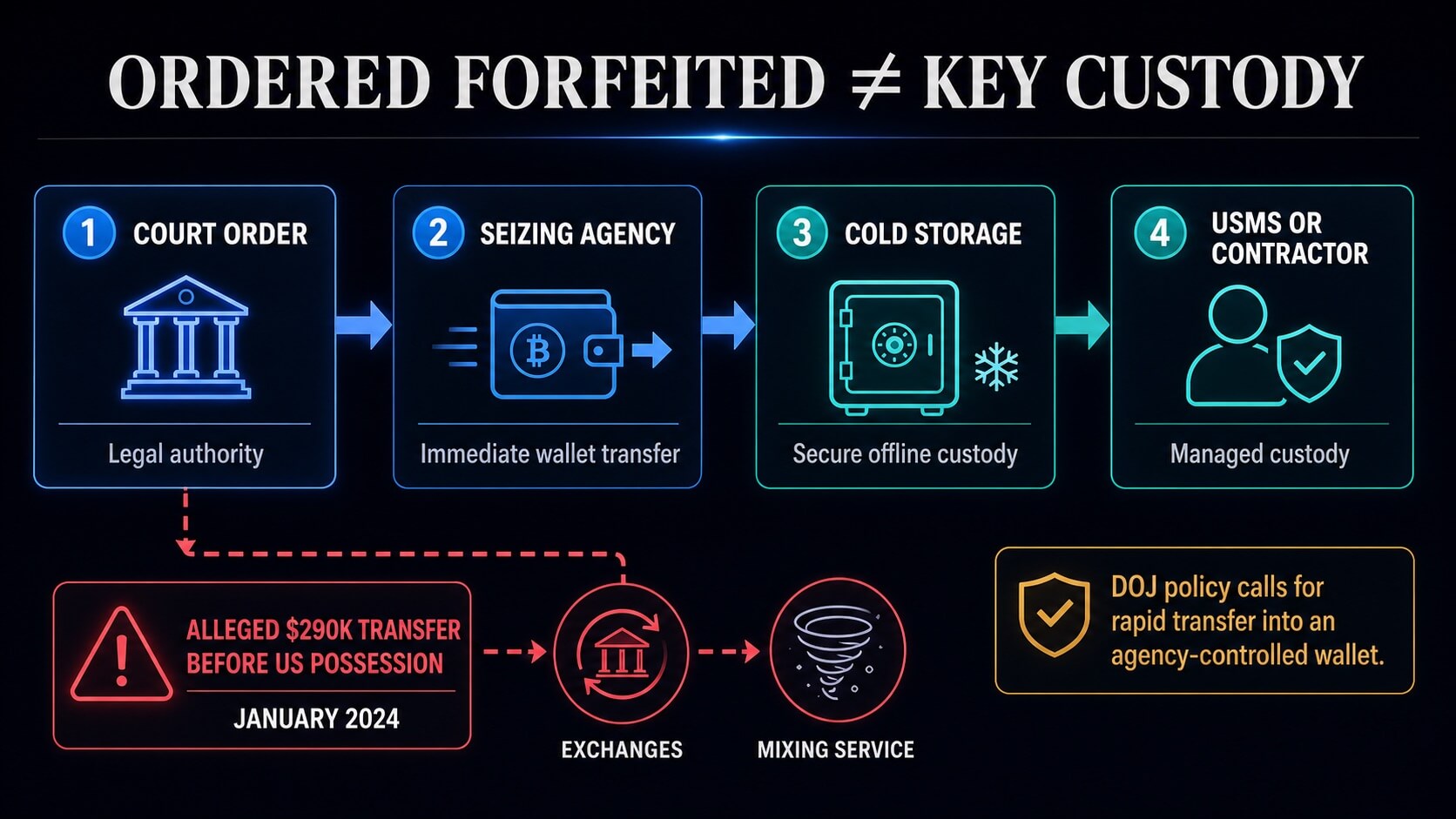
The seizing agency should immediately transfer the assets to an agency-controlled, unhosted wallet, as others may hold copies of the private key.
It should then keep the cryptocurrency in cold storage until transfer to a wallet controlled by the US Marshals Service or its contractor.

A warrant or forfeiture order can freeze the account, but control changes hands only once every usable key and credential is out of reach. Exclusive control begins only when another usable key or account credential can no longer authorize a transaction.
Iossifov was in prison when the alleged conduct occurred.
The filings do not say where Iossifov’s crypto was held, who had the keys, which services moved it, or how he pulled it off from prison. The specific failure point and any prior arrival in an agency-controlled wallet remain unresolved.
A November 2024 court order states that Iossifov received a 121-month sentence in January 2021, which was reduced to 111 months in May 2024.
DOJ says Iossifov had also been ordered to pay $2.64 million in restitution to victims of the earlier fraud scheme.
The new indictment charges him with removal of property to prevent seizure and conspiracy to commit money laundering, carrying a combined maximum of 25 years if he is convicted.
The case exposes the operational gap that can remain between a court’s forfeiture decision and technical control of the assets. For future seizures, DOJ policy calls for agencies to pair court authority with a rapid transfer into a wallet they control.
What remains unanswered in this case is where that chain of control stopped short.
The post Convicted scammer’s “seized” crypto moves to unknown wallets while in prison as DOJ failed to secure funds appeared first on CryptoSlate.


Read More
Louisiana just armed crypto ATM users with a legal cheat code to demand full refunds from unlicensed operators