Currencies37065
Market Cap$ 2.44T-1.41%
24h Spot Volume$ 40.57B+5.49%
DominanceBTC56.64%+0.47%ETH9.97%+0.82%
ETH Gas0.03 Gwei
Cryptorank
/

Arthur Hayes Says He Wouldn’t Buy Bitcoin Yet: Wait For This


by Jake Simmons
for NewsBTC
Arthur Hayes Says He Wouldn’t Buy Bitcoin Yet: Wait For This

Share:

AI Overview

- Arthur Hayes (BitMEX co-founder, Maelstrom CIO) said on a March 10 podcast he remains “structurally very very long” Bitcoin but will not buy now; he’s waiting for a macro catalyst: central bank liquidity/money printing. - Hayes sees triggers for Fed easing as a prolonged Iran war or AI-driven job losses that create credit stress, bank re-pricing, deposit flight and emergency Fed support; BTC traded at $69,538 at press time. - Near-term risk is tightening liquidity and payout from leverage-driven losses, but long-term adoption case for non-state money strengthens—keywords: crypto, Bitcoin, Fed, money printing, liquidity, AI, credit stress, adoption, DeFi, CEX.

Bullish

Arthur Hayes is still structurally bullish on Bitcoin. He just does not think now is the moment to buy.

Speaking on the Coin Stories podcast on March 10, the BitMEX co-founder and Maelstrom CIO said he would stay patient until a more familiar macro catalyst arrives: central bank liquidity. In Hayes’ telling, a prolonged Iran war and the credit stress that could follow from AI-driven economic disruption may ultimately force the Federal Reserve back into money printing, and that, rather than the conflict itself, is the signal he is waiting for.

“If I had $1 to invest right now, would I be putting it into Bitcoin? No. I would wait,” Hayes said near the end of the interview. “I think that the longer that this conflict goes on, the higher the likelihood that the Fed has to print money to support the American war machine and that’s when I’m going to buy Bitcoin when the central banks start printing money.”

That distinction mattered throughout the conversation. Hayes pushed back on the idea that war is automatically bullish for Bitcoin, arguing that the real transmission mechanism is liquidity expansion. “If you’re saying, ‘Okay, war is good for Bitcoin,’ what you’re really saying is war means money printing. Money printing is good for Bitcoin,” he said. “So wait for the money printing. Don’t try to time it because you could get it wrong.”

Arthur Hayes Sees More Bitcoin Pain Ahead

The argument fits a broader framework Hayes laid out across the interview: Bitcoin is less a clean debasement trade than a “liquidity alarm,” one that is already reacting to tightening conditions, credit stress and a lack of fresh dollar creation. He tied that view to the rise of AI, which he said could accelerate white-collar job losses, pressure private credit and banking exposures, and force markets to price in a much sharper economic break than many currently expect.

“I think it’s going to happen faster than people think just because of the exponential nature of how fast AI is improving,” Hayes said. “It only takes 10 to 20% [job displacement]. And then the leverage in the banking system will do the rest. At some point the market goes, ‘Oh, this is worth zero.’”

In that scenario, he said, the market’s recognition of the problem could come well before the full economic damage is visible in the data. Regional banks, private credit and broader financial equities could reprice violently, with deposit flight and emergency Fed support following close behind. That is the moment Hayes sees as far more constructive for Bitcoin than the current backdrop.

Still, his near-term caution did not extend to Bitcoin’s long-run role. Hayes described himself as “structurally very very long” crypto and argued that the case for non-state money is stronger now than it was at Bitcoin’s launch. He also warned against shaping the industry around institutional preferences, saying crypto should not reduce itself to a more complicated version of traditional finance.

“Bitcoin got from zero to whatever $66,000 whatever the price is today with no government support, unclear regulations, hostile banking infrastructure and regulators,” Hayes said. “So why are we bending over backwards to try to gain acceptance from these folks who don’t have our best interest at heart?”

He was equally dismissive of conspiracy-driven explanations for weak market performance, including claims that market makers are deliberately suppressing Bitcoin’s price. More often, he said, losses come down to poor positioning, bad timing or leverage used by traders who are not equipped for crypto’s pace.

For investors frustrated that Bitcoin has not delivered instant life-changing returns, Hayes’ answer was blunt: adjust expectations. “The market’s job is not to make you money. The market’s job is to take your money,” he said, arguing that long-term compounding still matters far more than trying to force a six-month windfall.

At press time, BTC traded at $69,538.
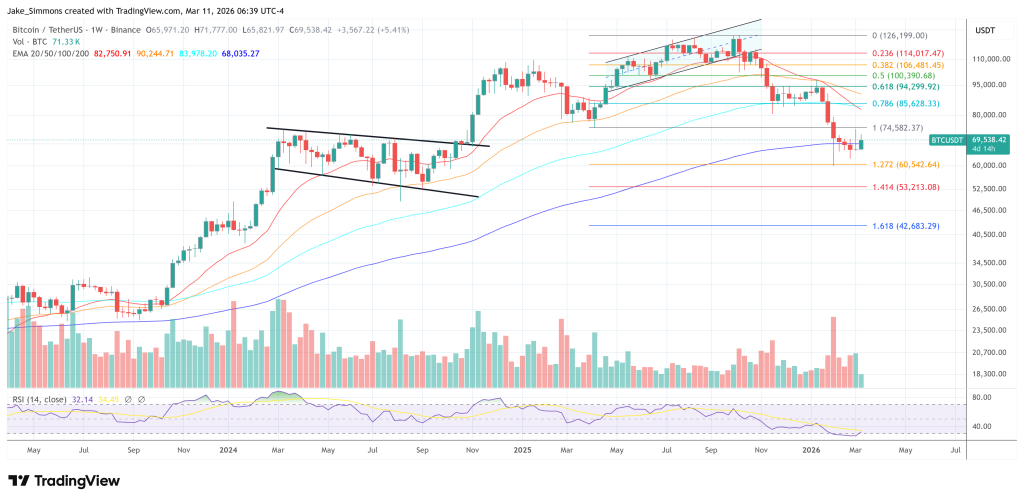
Bitcoin price chart
Read the article at NewsBTC

In This News

Coins

$ 69.35K

-0.98%

$ 0.00239


Share:

In This News

Coins

$ 69.35K

-0.98%

$ 0.00239


Share:

Read More

Bitcoin Vault Security Advances With Babylon-Ledger Integration

Bitcoin Vault Security Advances With Babylon-Ledger Integration

The security architecture surrounding Bitcoin continues to evolve as new infrastructu...
What To Expect For The Bitcoin Price After The Weekend Breakdown Below $70,000

What To Expect For The Bitcoin Price After The Weekend Breakdown Below $70,000

Crypto analyst Doctor Profit has provided insights into what to expect from the Bitco...

Arthur Hayes Says He Wouldn’t Buy Bitcoin Yet: Wait For This


by Jake Simmons
for NewsBTC
Arthur Hayes Says He Wouldn’t Buy Bitcoin Yet: Wait For This

Share:

AI Overview

- Arthur Hayes (BitMEX co-founder, Maelstrom CIO) said on a March 10 podcast he remains “structurally very very long” Bitcoin but will not buy now; he’s waiting for a macro catalyst: central bank liquidity/money printing. - Hayes sees triggers for Fed easing as a prolonged Iran war or AI-driven job losses that create credit stress, bank re-pricing, deposit flight and emergency Fed support; BTC traded at $69,538 at press time. - Near-term risk is tightening liquidity and payout from leverage-driven losses, but long-term adoption case for non-state money strengthens—keywords: crypto, Bitcoin, Fed, money printing, liquidity, AI, credit stress, adoption, DeFi, CEX.

Bullish

Arthur Hayes is still structurally bullish on Bitcoin. He just does not think now is the moment to buy.

Speaking on the Coin Stories podcast on March 10, the BitMEX co-founder and Maelstrom CIO said he would stay patient until a more familiar macro catalyst arrives: central bank liquidity. In Hayes’ telling, a prolonged Iran war and the credit stress that could follow from AI-driven economic disruption may ultimately force the Federal Reserve back into money printing, and that, rather than the conflict itself, is the signal he is waiting for.

“If I had $1 to invest right now, would I be putting it into Bitcoin? No. I would wait,” Hayes said near the end of the interview. “I think that the longer that this conflict goes on, the higher the likelihood that the Fed has to print money to support the American war machine and that’s when I’m going to buy Bitcoin when the central banks start printing money.”

That distinction mattered throughout the conversation. Hayes pushed back on the idea that war is automatically bullish for Bitcoin, arguing that the real transmission mechanism is liquidity expansion. “If you’re saying, ‘Okay, war is good for Bitcoin,’ what you’re really saying is war means money printing. Money printing is good for Bitcoin,” he said. “So wait for the money printing. Don’t try to time it because you could get it wrong.”

Arthur Hayes Sees More Bitcoin Pain Ahead

The argument fits a broader framework Hayes laid out across the interview: Bitcoin is less a clean debasement trade than a “liquidity alarm,” one that is already reacting to tightening conditions, credit stress and a lack of fresh dollar creation. He tied that view to the rise of AI, which he said could accelerate white-collar job losses, pressure private credit and banking exposures, and force markets to price in a much sharper economic break than many currently expect.

“I think it’s going to happen faster than people think just because of the exponential nature of how fast AI is improving,” Hayes said. “It only takes 10 to 20% [job displacement]. And then the leverage in the banking system will do the rest. At some point the market goes, ‘Oh, this is worth zero.’”

In that scenario, he said, the market’s recognition of the problem could come well before the full economic damage is visible in the data. Regional banks, private credit and broader financial equities could reprice violently, with deposit flight and emergency Fed support following close behind. That is the moment Hayes sees as far more constructive for Bitcoin than the current backdrop.

Still, his near-term caution did not extend to Bitcoin’s long-run role. Hayes described himself as “structurally very very long” crypto and argued that the case for non-state money is stronger now than it was at Bitcoin’s launch. He also warned against shaping the industry around institutional preferences, saying crypto should not reduce itself to a more complicated version of traditional finance.

“Bitcoin got from zero to whatever $66,000 whatever the price is today with no government support, unclear regulations, hostile banking infrastructure and regulators,” Hayes said. “So why are we bending over backwards to try to gain acceptance from these folks who don’t have our best interest at heart?”

He was equally dismissive of conspiracy-driven explanations for weak market performance, including claims that market makers are deliberately suppressing Bitcoin’s price. More often, he said, losses come down to poor positioning, bad timing or leverage used by traders who are not equipped for crypto’s pace.

For investors frustrated that Bitcoin has not delivered instant life-changing returns, Hayes’ answer was blunt: adjust expectations. “The market’s job is not to make you money. The market’s job is to take your money,” he said, arguing that long-term compounding still matters far more than trying to force a six-month windfall.

At press time, BTC traded at $69,538.

Bitcoin price chart
Read the article at NewsBTC

In This News

Coins

$ 69.35K

-0.98%

$ 0.00239


Share:

In This News

Coins

$ 69.35K

-0.98%

$ 0.00239


Share:

Read More

Bitcoin Vault Security Advances With Babylon-Ledger Integration

Bitcoin Vault Security Advances With Babylon-Ledger Integration

The security architecture surrounding Bitcoin continues to evolve as new infrastructu...
What To Expect For The Bitcoin Price After The Weekend Breakdown Below $70,000

What To Expect For The Bitcoin Price After The Weekend Breakdown Below $70,000

Crypto analyst Doctor Profit has provided insights into what to expect from the Bitco...