Bitcoin Supply Shock? Binance Flags 500,000 BTC Leaving Exchange

Share:
On May 17 Binance Research said four on-chain metrics — ~60% of BTC dormant >1 year (peaked 69.5% in Jan 2024), SLRV in a historical bottom zone, STH MVRV reclaiming 1.0, and exchange balances down from 17.6% to 15.0% of supply (~500,000 BTC off exchanges) — point to tightening supply and exhausted sell pressure. At BTC $76,761 the report argues reduced CEX liquidity and dominant long-term holders lower immediate sell-side risk and can amplify demand-led price moves and adoption, historically a setup preceding sustained recoveries, though downside risk remains.
Predictions Markets
See what traders are focused on

Binance Research said a cluster of Bitcoin on-chain indicators is pointing toward tighter available supply and reduced sell pressure, with exchange balances falling to a six-year low as roughly 500,000 BTC have left trading venues since the COVID-era peak.
In a May 17 thread, the research arm of Binance argued that four metrics now point in the same direction: long-term holders remain dominant, speculative activity is subdued, exchange supply has declined, and short-term holders are only beginning to rebuild unrealized profits. The combined readout, according to Binance Research, suggests that Bitcoin’s market structure has shifted away from forced selling and toward a more supply-constrained setup.
“Four on-chain signals point to the same conclusion: supply is tightening and sell pressure is exhausted,” Binance Research wrote.
Why Bitcoin Sell Pressure May Be Fading Fast
The first signal centers on Bitcoin supply dormancy. Binance Research said nearly 60% of BTC supply has not moved in more than a year, compared with 27% in 2012. Dormant supply peaked at 69.5% in January 2024, the same month U.S. spot Bitcoin ETFs were approved.
“Despite the subsequent sell-the-news reaction, supply dormancy has remained near historically elevated levels, suggesting sustained long-term holder conviction,” the firm wrote.
For market participants, the implication is straightforward: a large portion of Bitcoin’s supply remains in the hands of holders that have shown little willingness to transact, even after major market events. High dormancy does not eliminate downside risk, but it can reduce the amount of supply immediately available to be sold into rallies or volatility spikes.
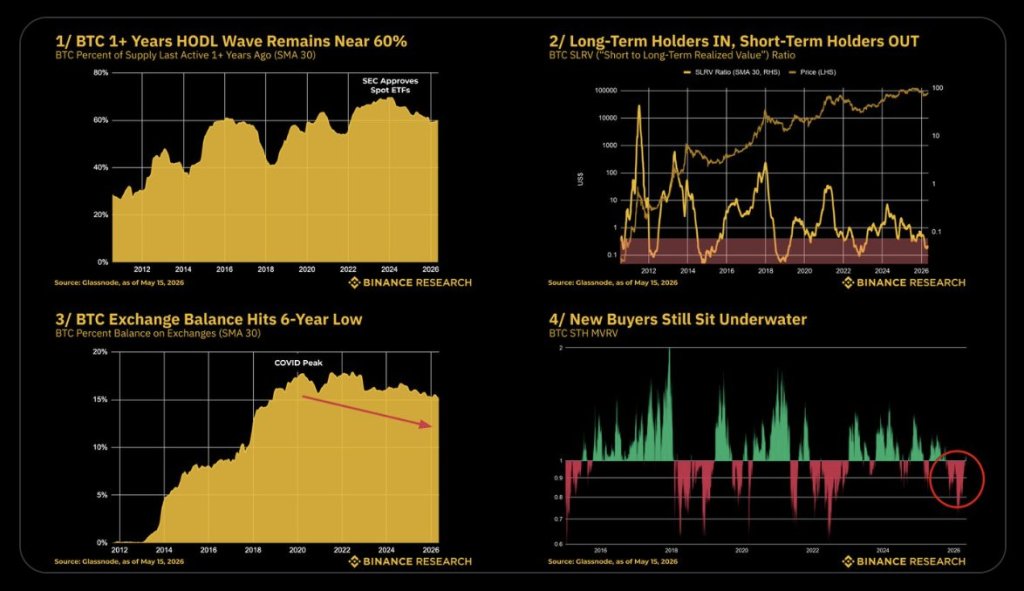
The second metric cited by Binance Research was SLRV, a ratio used to compare shorter-term and longer-term coin activity. The firm said the indicator remains “deep in its historical bottom zone,” which it interpreted as a sign of market apathy rather than overheated speculation.
“Long-term holders dominate supply while short-term speculators have largely exited,” Binance Research said. “Historically, every prior cycle bottom coincided with the ratio entering the shaded zone.”
That framing is notable because it separates the current setup from periods driven primarily by fast-moving speculative capital. In Binance Research’s reading, the low SLRV level suggests that short-duration market participants have already been flushed out to a significant degree, leaving long-term holders with a larger share of active supply influence.
Exchange balances form the third and most direct supply signal. According to Binance Research, Bitcoin held on exchanges has fallen from 17.6% of supply during the COVID-era peak to 15.0% today. The firm said that equates to around 500,000 BTC leaving exchanges, cutting available sell-side supply to a six-year low.
That movement matters because coins held on exchanges are generally more liquid and more readily available for sale. A decline in exchange balances does not automatically mean those coins will never return, but it does indicate that less BTC is immediately positioned on trading platforms. In a market where marginal liquidity often drives price action, the shift can sharpen the impact of new demand if selling remains contained.
The fourth signal relates to short-term holder profitability. Binance Research said BTC STH MVRV stayed below 1.0 for most of the period since November 2024, a condition it linked to the gradual exhaustion of sell-side pressure. The metric has now moved back above 1.0, meaning short-term holders are again sitting on unrealized gains.
“BTC STH MVRV remained below 1.0 for most of the period since November 2024, gradually exhausting sell-side pressure — a dynamic historically consistent with cycle bottoms,” Binance Research wrote. “It has now reclaimed 1.0, marking the point where short-term holders begin rebuilding unrealized gains. With profit accumulation still in its early stages, a new wave of selling pressure is unlikely to materialize imminently — historically a setup that has preceded sustained recoveries.”
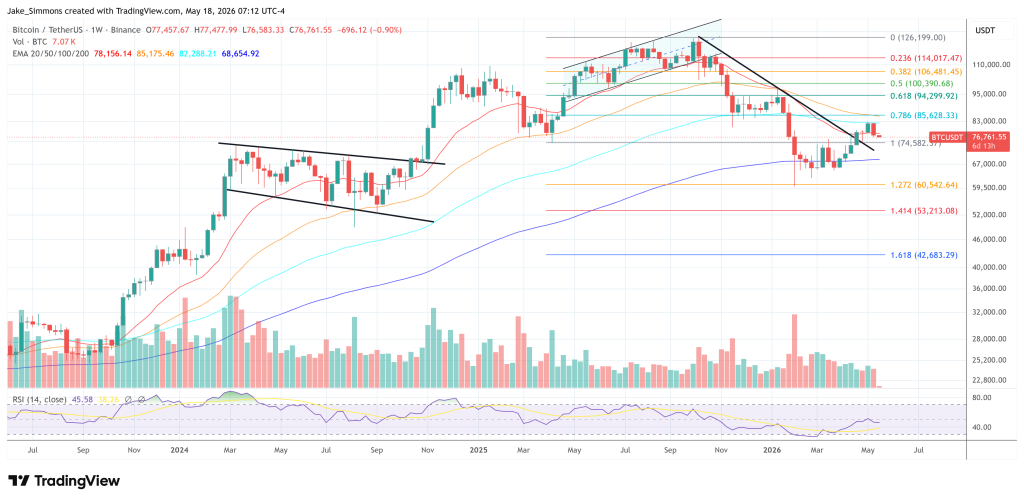
At press time, BTC traded at $76,761.


Read More

Binance Rolls Out BTC Yield: Covered Call Strategy Targets Bitcoin Holders’ Income Demand