
Top 100 Coins

Trending Cryptos

Performance

Recently Listed

Gainers

All Categories

All Time High

Blockchains

Global Market Data

Ecosystems


Research

Rewards

Heatmaps

Drop Hunting

Alerts

Converter

Widgets

Market Data API

Futures and Options

Affiliate Program
CAR’s Crypto Push Hands Power to Elites, Foreign Criminal Networks, Report Warns

Share:
The Central African Republic’s ambitious embrace of cryptocurrency has deepened elite control over financial resources and exposed the country to potential exploitation by foreign criminal networks, according to a recent report by the Global Initiative Against Transnational Organized Crime.
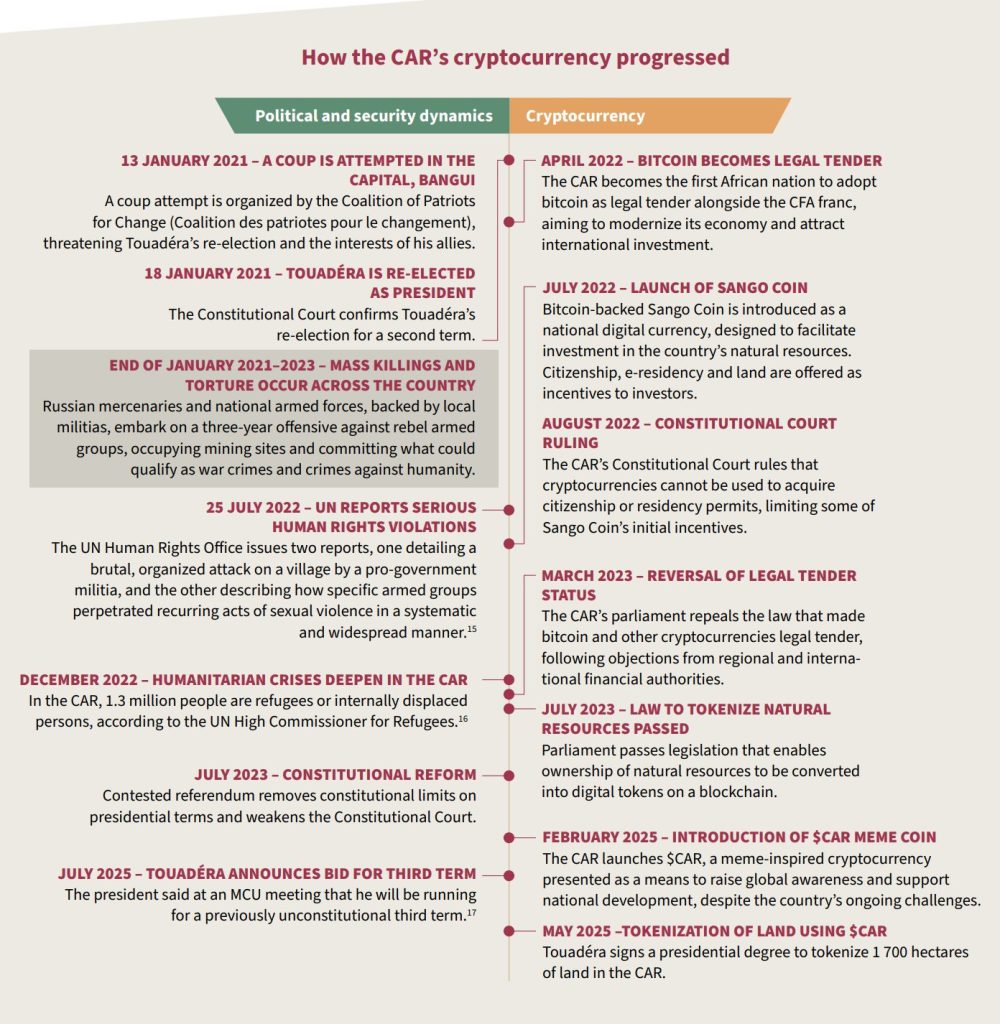
The report, titled “Behind the blockchain: Cryptocurrency and criminal capture in the Central African Republic,” paints a stark picture of how the country’s crypto ventures, from adopting Bitcoin to launching Sango Coin and the CAR meme token, have unfolded in a fragile state marked by limited electricity, low internet penetration, and weak regulatory oversight.
Report Says CAR’s Crypto Projects Excluded Most Citizens
The report noted that the government framed these initiatives as tools for economic growth, modernization, and national development.
In practice, however, meaningful participation by the majority of citizens has been largely impossible.
Limited access to digital infrastructure and the country’s ongoing insecurity have effectively excluded most of the population from engaging with these crypto projects.
The report traces the rollout of these initiatives alongside broader political trends, including the consolidation of executive power and the increasing influence of foreign actors.
Critics have argued that the CAR’s crypto projects primarily serve elite interests, offering investment opportunities in mining, forestry, and tokenized land largely inaccessible to ordinary citizens.
Sango Coin, launched in mid-2022, promised infrastructure projects such as a “Crypto City” and offered foreign investors access to land and e-residency.
Despite heavy promotion, only a small fraction of the tokens were sold, and many promised outcomes remain unrealized.
The subsequent $CAR meme coin, introduced in early 2025, experienced extreme volatility, technical irregularities, and opaque governance, raising further concerns about market manipulation and speculative practices.
The GI-TOC report highlights the role of shadow networks, foreign private actors, and individuals with histories of fraud in promoting the CAR’s crypto agenda.
President Touadéra has been described as surrounded by crypto enthusiasts, pro-Russian businesspeople, and controversial figures, including Nicolae Bogdan Buzaianu, linked to alleged illegal timber trafficking, and Émile Parfait Simb, associated with multiple fraud convictions.
The report concludes that these initiatives appear designed to enrich a narrow circle of insiders while opening new channels for foreign influence and transnational organized crime at the expense of the wider population.
Weak Oversight and Poor Infrastructure Hamper CAR’s Crypto Ambitions
The CAR’s crypto ventures have also faced significant domestic and regional challenges.
Bitcoin’s adoption as legal tender was widely criticized by international financial institutions, regional regulators, and the country’s own Constitutional Court.
In March 2023, after regional groups pushed for change, the CAR parliament scrapped Bitcoin’s legal tender status and adjusted its rules to match the Central African Economic and Monetary Community standards.
The report shows the concentration of power within the Sango ecosystem. The way things are set up mostly benefits public officials and a small circle of insiders, raising concerns about transparency and accountability.
Additionally, the tokenization of natural resources and land carries substantial risks of misappropriation and rent-seeking, especially in a context of weak oversight and ongoing insecurity.
Efforts to mitigate the risks of elite capture and criminal exploitation have been limited. The CAR has begun to work with regional regulators to align cryptocurrency rules with broader monetary frameworks.
However, infrastructure deficits, extreme poverty, and ongoing political instability continue to constrain citizen participation and oversight.
Observers warn that without stronger regulation, public education, and international cooperation, the country’s crypto ventures may remain tools that concentrate wealth and influence among elites while exposing the nation to criminal and financial vulnerabilities.
The post CAR’s Crypto Push Hands Power to Elites, Foreign Criminal Networks, Report Warns appeared first on Cryptonews.
In This News


Share:
In This News
Share:
Read More
Futures Liquidated: The Shocking $102 Million Hour That Rocked Crypto Markets

Critical Challenge for Bitcoin Miners in 2026: The AI Temptation
CAR’s Crypto Push Hands Power to Elites, Foreign Criminal Networks, Report Warns
Share:
The Central African Republic’s ambitious embrace of cryptocurrency has deepened elite control over financial resources and exposed the country to potential exploitation by foreign criminal networks, according to a recent report by the Global Initiative Against Transnational Organized Crime.
The report, titled “Behind the blockchain: Cryptocurrency and criminal capture in the Central African Republic,” paints a stark picture of how the country’s crypto ventures, from adopting Bitcoin to launching Sango Coin and the CAR meme token, have unfolded in a fragile state marked by limited electricity, low internet penetration, and weak regulatory oversight.
Report Says CAR’s Crypto Projects Excluded Most Citizens
The report noted that the government framed these initiatives as tools for economic growth, modernization, and national development.
In practice, however, meaningful participation by the majority of citizens has been largely impossible.
Limited access to digital infrastructure and the country’s ongoing insecurity have effectively excluded most of the population from engaging with these crypto projects.
The report traces the rollout of these initiatives alongside broader political trends, including the consolidation of executive power and the increasing influence of foreign actors.
Critics have argued that the CAR’s crypto projects primarily serve elite interests, offering investment opportunities in mining, forestry, and tokenized land largely inaccessible to ordinary citizens.
Sango Coin, launched in mid-2022, promised infrastructure projects such as a “Crypto City” and offered foreign investors access to land and e-residency.
Despite heavy promotion, only a small fraction of the tokens were sold, and many promised outcomes remain unrealized.
The subsequent $CAR meme coin, introduced in early 2025, experienced extreme volatility, technical irregularities, and opaque governance, raising further concerns about market manipulation and speculative practices.
The GI-TOC report highlights the role of shadow networks, foreign private actors, and individuals with histories of fraud in promoting the CAR’s crypto agenda.
President Touadéra has been described as surrounded by crypto enthusiasts, pro-Russian businesspeople, and controversial figures, including Nicolae Bogdan Buzaianu, linked to alleged illegal timber trafficking, and Émile Parfait Simb, associated with multiple fraud convictions.
The report concludes that these initiatives appear designed to enrich a narrow circle of insiders while opening new channels for foreign influence and transnational organized crime at the expense of the wider population.
Weak Oversight and Poor Infrastructure Hamper CAR’s Crypto Ambitions
The CAR’s crypto ventures have also faced significant domestic and regional challenges.
Bitcoin’s adoption as legal tender was widely criticized by international financial institutions, regional regulators, and the country’s own Constitutional Court.
In March 2023, after regional groups pushed for change, the CAR parliament scrapped Bitcoin’s legal tender status and adjusted its rules to match the Central African Economic and Monetary Community standards.
The report shows the concentration of power within the Sango ecosystem. The way things are set up mostly benefits public officials and a small circle of insiders, raising concerns about transparency and accountability.
Additionally, the tokenization of natural resources and land carries substantial risks of misappropriation and rent-seeking, especially in a context of weak oversight and ongoing insecurity.
Efforts to mitigate the risks of elite capture and criminal exploitation have been limited. The CAR has begun to work with regional regulators to align cryptocurrency rules with broader monetary frameworks.
However, infrastructure deficits, extreme poverty, and ongoing political instability continue to constrain citizen participation and oversight.
Observers warn that without stronger regulation, public education, and international cooperation, the country’s crypto ventures may remain tools that concentrate wealth and influence among elites while exposing the nation to criminal and financial vulnerabilities.
The post CAR’s Crypto Push Hands Power to Elites, Foreign Criminal Networks, Report Warns appeared first on Cryptonews.
In This News
Share:
In This News
Share:
Read More
Futures Liquidated: The Shocking $102 Million Hour That Rocked Crypto Markets