Bitcoin ETFs lose over $424M, wiping out last week’s gains as recovery fails first test

Share:
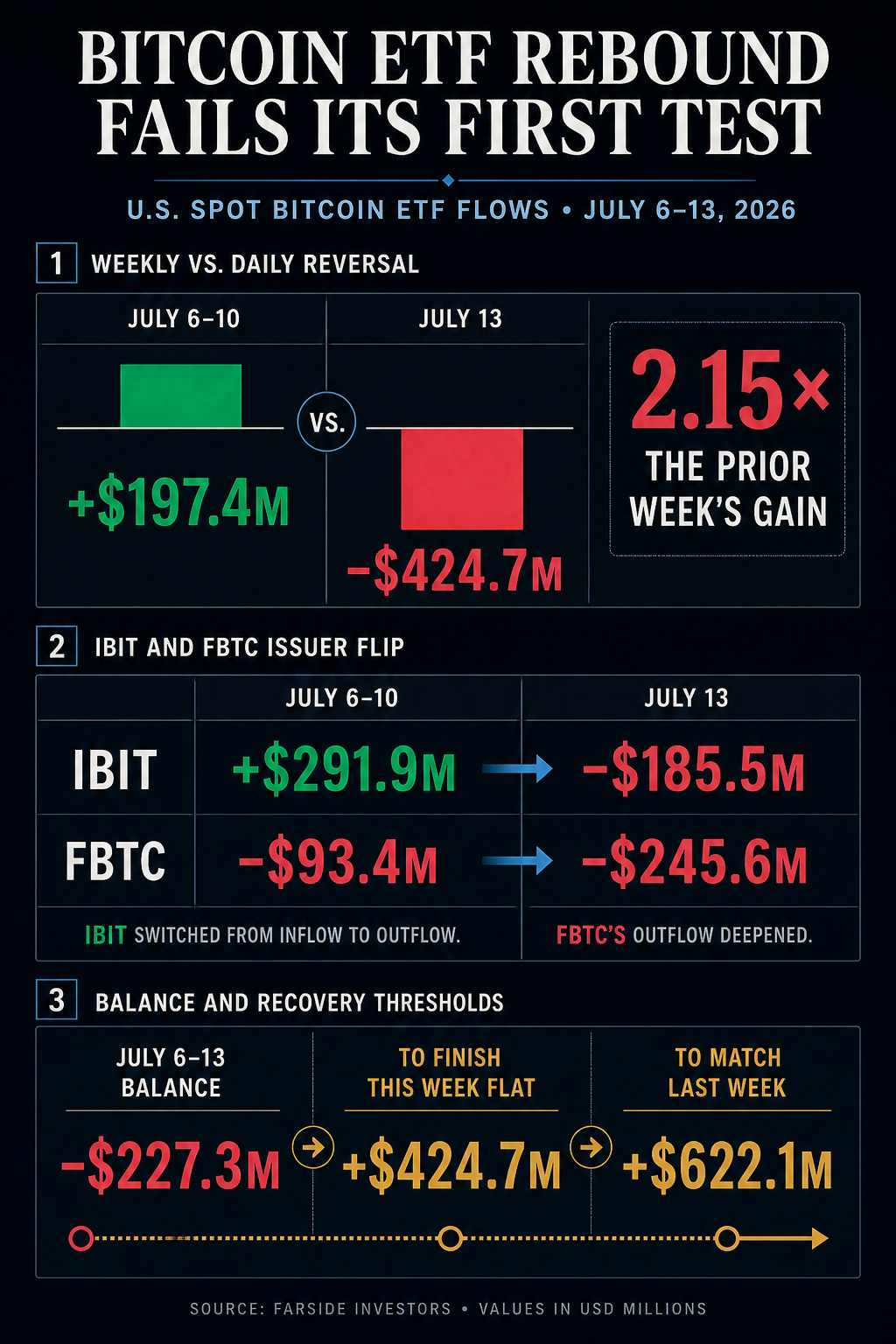
On July 13 spot Bitcoin ETFs suffered $424.7 million of net outflows, more than twice the $197.4 million they had attracted across the prior five trading days, leaving July 6–13 cumulative flows at negative $227.3 million and wiping out last week’s gains. BlackRock's IBIT and Fidelity's FBTC drove the moves—FBTC lost $245.6 million and IBIT $185.5 million on July 13—while modest inflows to VanEck and Grayscale partially offset a $431.1 million combined outflow, signaling fragile ETF demand and downside risk for BTC price and broader crypto adoption.
Predictions Markets
See what traders are focused on

Spot Bitcoin ETFs posted $424.7 million of net outflows on July 13, more than twice the $197.4 million they had attracted across the previous five trading days.
The one-day loss pushed the cumulative balance for July 6 through July 13 to negative $227.3 million, failing the first follow-through test after the prior week ended an eight-week outflow streak.

BlackRock's IBIT accounted for $291.9 million in inflows from July 6 to July 10, exceeding the industry's entire weekly gain. Fidelity's FBTC, meanwhile, posted $93.4 million in outflows over the same period.
According to Farside Investors, on July 13, FBTC lost another $245.6 million, while IBIT recorded $185.5 million in outflows.
The funds' combined $431.1 million outflow was partly offset by $6.1 million entering VanEck's HODL and $53.4 million entering Grayscale's lower-fee BTC fund. Grayscale's GBTC recorded $53.1 million in outflows.
Although investors did not exit every product, withdrawals from FBTC and IBIT show that the previous week's positive total was driven more by a single fund than by a broad rebound in ETF demand.
CryptoSlate's earlier analysis of the July 6 rebound identified broader participation across issuers as the signal needed to turn one strong IBIT session into durable support. Instead, IBIT reversed course while the existing pressure on FBTC intensified.

Bitcoin is trading near $62,611 on July 14, according to CryptoSlate data, but neither the price nor the flow data explains why investors reduced their exposure.
The figures don't tell us who was selling. It could have been retail investors, financial advisers, institutions, or some mix of all three. They also don't show whether every dollar leaving a Bitcoin ETF meant a dollar of Bitcoin was sold on the open market that same day.
The SEC approved in-kind creations and redemptions for crypto exchange-traded products back in July 2025, allowing some fund shares to be exchanged for underlying assets rather than cash.

To offset Monday's $424.7 million outflow, the funds would need to attract a combined $424.7 million over the remaining sessions for the week to finish flat.
To match the previous week's $197.4 million net inflow, they would need to bring in $622.1 million over the rest of the week.
The distribution of those inflows will be as important as the total. A broad rebound across several issuers would provide stronger evidence that demand is recovering.
Another negative week, or a rebound driven by one fund while major peers continue to lose assets, would suggest that the first positive week in nine was only a pause in the broader outflow trend.
The post Bitcoin ETFs lose over $424M, wiping out last week’s gains as recovery fails first test appeared first on CryptoSlate.


Read More

Bitcoin holds $64,000 as private hiring drops 53% before today’s macro test that could break support