Strategy Backs Market Structure Bill After Reporting $8.22B Quarterly Loss

Share:
Strategy, formerly MicroStrategy, reported Q2 on July 30 with an $8.32 billion write-down and an $8.22 billion net loss ($24.45 per diluted share) versus a $32.60 per-share profit a year earlier, while raising $17.06 billion via at‑the‑market programs and $7.53 billion from STRC preferred issuance (a 254% increase). The company backed a market-structure bill proposing an SEC/CFTC split for securities-like tokens and digital commodities, arguing regulatory clarity could boost institutional adoption, lower its 12% STRC funding cost and 10.8% hurdle rate, and potentially resume per-share accretion relative to Bitcoin, but the large loss and high funding costs remain a near-term headwind for crypto funding and price.
Predictions Markets
See what traders are focused on

Strategy, formerly known as MicroStrategy, endured a bruising second quarter, yet the company wasted little time shifting attention back to crypto policy. One day after reporting earnings on July 30, the company backed the market structure bill, arguing that clearer digital asset regulations could improve institutional participation and, ultimately, its own funding model.
The numbers were hard to ignore. Strategy reported an $8.32 billion write-down, resulting in an $8.22 billion net loss, or $24.45 per diluted share. That’s a sharp reversal from the $32.60 per-share profit recorded during the same quarter a year earlier.
Why The Bill Matters More
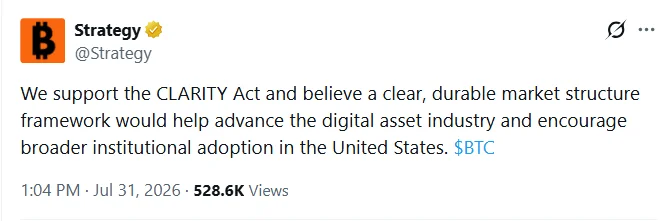
For Strategy, the proposed market structure bill isn’t simply about digital assets but it’s about capital.
Under the proposal, securities-like tokens would fall under the SEC, while digital commodities would be regulated by the CFTC. The clearer jurisdictional split could make institutional investors more comfortable participating in the market.
That matters because the company has relied heavily on raising capital this year. Strategy secured $17.06 billion through at-the-market equity programs, while STRC preferred issuance contributed another $7.53 billion, representing a 254% increase.
Funding Costs Remain The Key Battle
The real issue is the price of that capital. Strategy currently pays 12% on STRC because the preferred shares continue trading below their $100 stated value.
According to the company’s argument, broader institutional demand could reduce borrowing costs and lower its current 10.8% hurdle rate.
Institutional Demand Drives The Debate
If funding costs eventually fall below the company’s Bitcoin yield, per-share accretion could resume. That’s the central investment thesis separating Strategy from directly holding Bitcoin.
The company’s leadership has consistently argued that clearer regulation encourages institutional adoption rather than restricting it. Whether lawmakers ultimately agree remains to be seen, but for Strategy, the debate appears to be as much about cheaper capital as it is about crypto regulation.
In This News
Coins

$ 62.53K
-0.67%


Predictions Markets
See what traders are focused on
Share:
In This News
Coins
$ 62.53K
-0.67%Predictions Markets
See what traders are focused on
Share:
Read More

$7B Stablecoin Outflow Raises Liquidity Concerns Despite Bitcoin Holding Above $60K