


Bitcoin Miner Cango Sells 4,445 $BTC To Cover Collateralized Loan as $SUBBD Makes Waves
Share:
What to Know:
- Cango’s sale of 4,445 $BTC to cover loans underscores the post-halving profitability squeeze facing hardware-dependent mining operations.
- As infrastructure costs rise for legacy PoW miners, investment flows are shifting toward high-margin software protocols in the AI and Web3 sectors.
- SUBBD Token uses AI and Ethereum smart contracts to disrupt the $85B creator economy, offering a capital-efficient alternative to traditional mining investments.
- With over $1.4M raised, the project demonstrates strong market demand for decentralized solutions that lower fees and empower content creators.
Cango just dumped 4,445 Bitcoin.
That massive divestment, roughly $300M hitting the order books, marks a significant liquidity event in a market already struggling with post-halving economics. It highlights the crushing pressure on Proof-of-Work (PoW) entities to service their collateralized debt obligations.

When a miner starts liquidating the family silver (treasury assets) rather than relying on freshly minted coins, the strategy shifts from accumulation to survival, a capitulation that often precedes a broader market rotation.
Why does this matter? Because miners are usually the ultimate hodlers. When they sell to cover loans, it signals that operational costs and debt servicing have outpaced the immediate profitability of mining rewards. This structural squeeze is forcing smart money to look elsewhere for yield. While legacy infrastructure providers fight over thin margins and high overhead, capital is quietly rotating into capital-efficient, software-driven sectors.
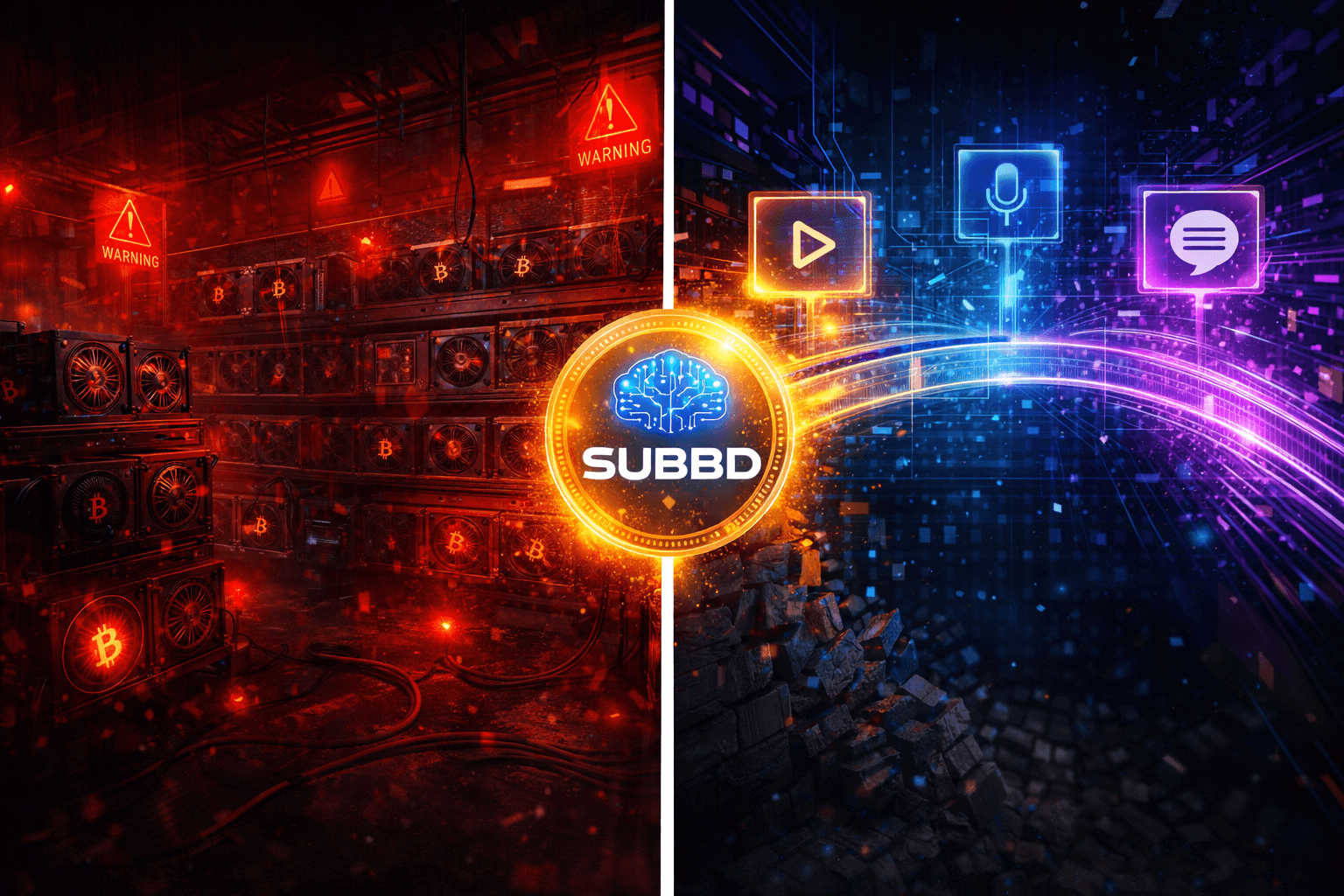
The intersection of AI and the $85B creator economy is emerging as a serious alternative, with projects like SUBBD Token ($SUBBD) catching a bid as miners deleverage.
De-Leveraging The Blockchain: Why Capital Efficiency Shifts To AI
People often view ‘miner capitulation’ solely through a bearish lens, but it frequently acts as a clearing event that redistributes liquidity.
As Cango and similar entities sell BTC to satisfy creditors, the market absorbs the supply shock, often leading to consolidation. But look closer at the second-order effect: investors are becoming wary of the heavy infrastructure risks associated with pure-play mining stocks. They’re seeking exposure to Web3 protocols that offer immediate utility without the massive electricity bills.
That’s where the creator economy creates a compelling divergence.
Unlike Bitcoin mining—which competes for diminishing block rewards, the content creation industry is expanding. SUBBD Token ($SUBBD) addresses the sector’s most glaring inefficiency: the ‘middleman tax.’ Traditional Web2 platforms often snatch up to 70% of creator earnings in fees. By using Ethereum-based architecture, $SUBBD cuts out these intermediaries, letting creators keep the vast majority of their revenue.
The platform distinguishes itself by integrating proprietary AI models directly into the workflow. Features like the AI Personal Assistant for automated interactions and AI Voice Cloning tools allow creators to scale their output without increasing their workload. It’s a sharp contrast to the capital-intensive nature of the Cango sell-off.
While miners burn cash to solve hashes, SUBBD Token uses AI to solve the scalability issues of the creator economy.
SUBBD Token Integrates Web3 Tools For Creator Sovereignty
Beyond the macro shift from hardware to software, the specific mechanics of the SUBBD Token ecosystem are turning heads. The project builds a circular economy where the token isn’t just a speculative asset, it’s fuel.
Users use $SUBBD for subscriptions, pay-per-view (PPV) access, and tipping, while creators access advanced AI tools and token-gated content features.
The market’s appetite for this utility is showing up in the order book. According to live data, the presale has already raised $1.4M so far, a solid figure for a specialized utility token.
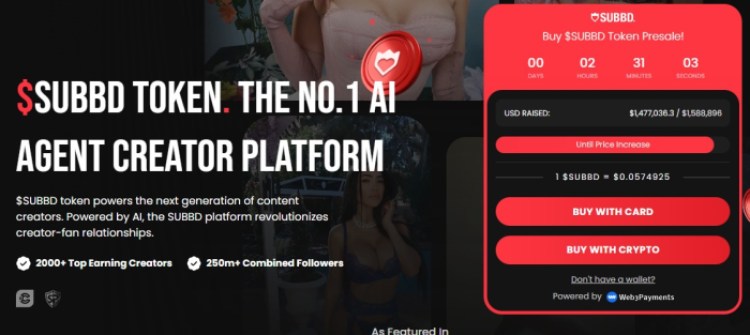
The current entry price of $0.0574925 offers an accessible price point relative to the project’s roadmap, which targets the massive disruption of arbitrary platform bans and fragmented payment systems.
Plus, the protocol incentivizes long-term holding through a structured staking model, something notably absent from holding raw Bitcoin. Investors can lock tokens to earn a fixed 20% APY during the first year. That’s a predictable yield that contrasts with the volatility of mining stocks. This staking mechanism, combined with XP multipliers for platform engagement, aligns the incentives of creators, fans, and investors.
As the platform rolls out features like AI-exclusive content and decentralized governance, the utility demand for $SUBBD is positioned to grow independently of Bitcoin’s price action.
Disclaimer: This article is for informational purposes only and does not constitute financial advice. Cryptocurrencies are high-risk assets, and presales carry inherent volatility. Always conduct your own due diligence before investing.
In This News


Share:
In This News
Share:
Read More

Crypto Industry Set For Big Shakeups, Massive Consolidation Expected: CEO

Bernstein Discusses Bitcoin’s Weakest Bear Market Yet – “Nothing Broke”
Bitcoin Miner Cango Sells 4,445 $BTC To Cover Collateralized Loan as $SUBBD Makes Waves
Share:
What to Know:
- Cango’s sale of 4,445 $BTC to cover loans underscores the post-halving profitability squeeze facing hardware-dependent mining operations.
- As infrastructure costs rise for legacy PoW miners, investment flows are shifting toward high-margin software protocols in the AI and Web3 sectors.
- SUBBD Token uses AI and Ethereum smart contracts to disrupt the $85B creator economy, offering a capital-efficient alternative to traditional mining investments.
- With over $1.4M raised, the project demonstrates strong market demand for decentralized solutions that lower fees and empower content creators.
Cango just dumped 4,445 Bitcoin.
That massive divestment, roughly $300M hitting the order books, marks a significant liquidity event in a market already struggling with post-halving economics. It highlights the crushing pressure on Proof-of-Work (PoW) entities to service their collateralized debt obligations.
When a miner starts liquidating the family silver (treasury assets) rather than relying on freshly minted coins, the strategy shifts from accumulation to survival, a capitulation that often precedes a broader market rotation.
Why does this matter? Because miners are usually the ultimate hodlers. When they sell to cover loans, it signals that operational costs and debt servicing have outpaced the immediate profitability of mining rewards. This structural squeeze is forcing smart money to look elsewhere for yield. While legacy infrastructure providers fight over thin margins and high overhead, capital is quietly rotating into capital-efficient, software-driven sectors.
The intersection of AI and the $85B creator economy is emerging as a serious alternative, with projects like SUBBD Token ($SUBBD) catching a bid as miners deleverage.
De-Leveraging The Blockchain: Why Capital Efficiency Shifts To AI
People often view ‘miner capitulation’ solely through a bearish lens, but it frequently acts as a clearing event that redistributes liquidity.
As Cango and similar entities sell BTC to satisfy creditors, the market absorbs the supply shock, often leading to consolidation. But look closer at the second-order effect: investors are becoming wary of the heavy infrastructure risks associated with pure-play mining stocks. They’re seeking exposure to Web3 protocols that offer immediate utility without the massive electricity bills.
That’s where the creator economy creates a compelling divergence.
Unlike Bitcoin mining—which competes for diminishing block rewards, the content creation industry is expanding. SUBBD Token ($SUBBD) addresses the sector’s most glaring inefficiency: the ‘middleman tax.’ Traditional Web2 platforms often snatch up to 70% of creator earnings in fees. By using Ethereum-based architecture, $SUBBD cuts out these intermediaries, letting creators keep the vast majority of their revenue.
The platform distinguishes itself by integrating proprietary AI models directly into the workflow. Features like the AI Personal Assistant for automated interactions and AI Voice Cloning tools allow creators to scale their output without increasing their workload. It’s a sharp contrast to the capital-intensive nature of the Cango sell-off.
While miners burn cash to solve hashes, SUBBD Token uses AI to solve the scalability issues of the creator economy.
SUBBD Token Integrates Web3 Tools For Creator Sovereignty
Beyond the macro shift from hardware to software, the specific mechanics of the SUBBD Token ecosystem are turning heads. The project builds a circular economy where the token isn’t just a speculative asset, it’s fuel.
Users use $SUBBD for subscriptions, pay-per-view (PPV) access, and tipping, while creators access advanced AI tools and token-gated content features.
The market’s appetite for this utility is showing up in the order book. According to live data, the presale has already raised $1.4M so far, a solid figure for a specialized utility token.
The current entry price of $0.0574925 offers an accessible price point relative to the project’s roadmap, which targets the massive disruption of arbitrary platform bans and fragmented payment systems.
Plus, the protocol incentivizes long-term holding through a structured staking model, something notably absent from holding raw Bitcoin. Investors can lock tokens to earn a fixed 20% APY during the first year. That’s a predictable yield that contrasts with the volatility of mining stocks. This staking mechanism, combined with XP multipliers for platform engagement, aligns the incentives of creators, fans, and investors.
As the platform rolls out features like AI-exclusive content and decentralized governance, the utility demand for $SUBBD is positioned to grow independently of Bitcoin’s price action.
Disclaimer: This article is for informational purposes only and does not constitute financial advice. Cryptocurrencies are high-risk assets, and presales carry inherent volatility. Always conduct your own due diligence before investing.
In This News
Share:
In This News
Share:
Read More
Crypto Industry Set For Big Shakeups, Massive Consolidation Expected: CEO