
What Are the Differences Between Layer 2s
Share:
Share:
Plasma
Plasma is a solution based on which sidechains work. It uses Merkle trees to create an unlimited number of copies of the core network or sidechains.
Its advantages include speed and low fees. As for Plasma downsides, there are safety concerns due to a separate consensus mechanism.
The most popular Plasma-based sidechain is Polygon.
State Channels
State channels are a way to exchange private transactions outside the blockchain. Participants create a channel by freezing funds in a multi-signature contract. In the channel, they can conduct as many transactions as they like that are not recorded on the blockchain.
The advantages of state channels include efficiency in saving time and resources as well as confidentiality. However, the possible liquidity crisis is its huge downside.
This solution is used in Lightning Network and Celer Network.
Rollup
Rollup is a solution that aims to speed up and cheapen transactions on the underlying network. They move some of the computations to sidechains and write them to the main blockchain after verification. There are two types of rollups: ZK-roll-ups and Optimistic roll-ups, which differ in the way transactions are verified.
Rollup’s biggest upsides are high speed of about 1000-4000 transactions per second, good security and decentralization, convenience, and ease of use. It is, nevertheless, less liquid than the underlying network, and the fees are higher than in sidechains.
Rollups are booming right now, and here are the reasons why:
-
Convenience and simplicity for users.
-
Best scalability solution for approaching mass adoption.
The best known are Optimistic rollups Arbitrum, Optimism, and the upcoming ZK rollups zkSync and Polygon zkEVM.


Read More
What Are ZK Stack and Hyperchains?
 CryptoRank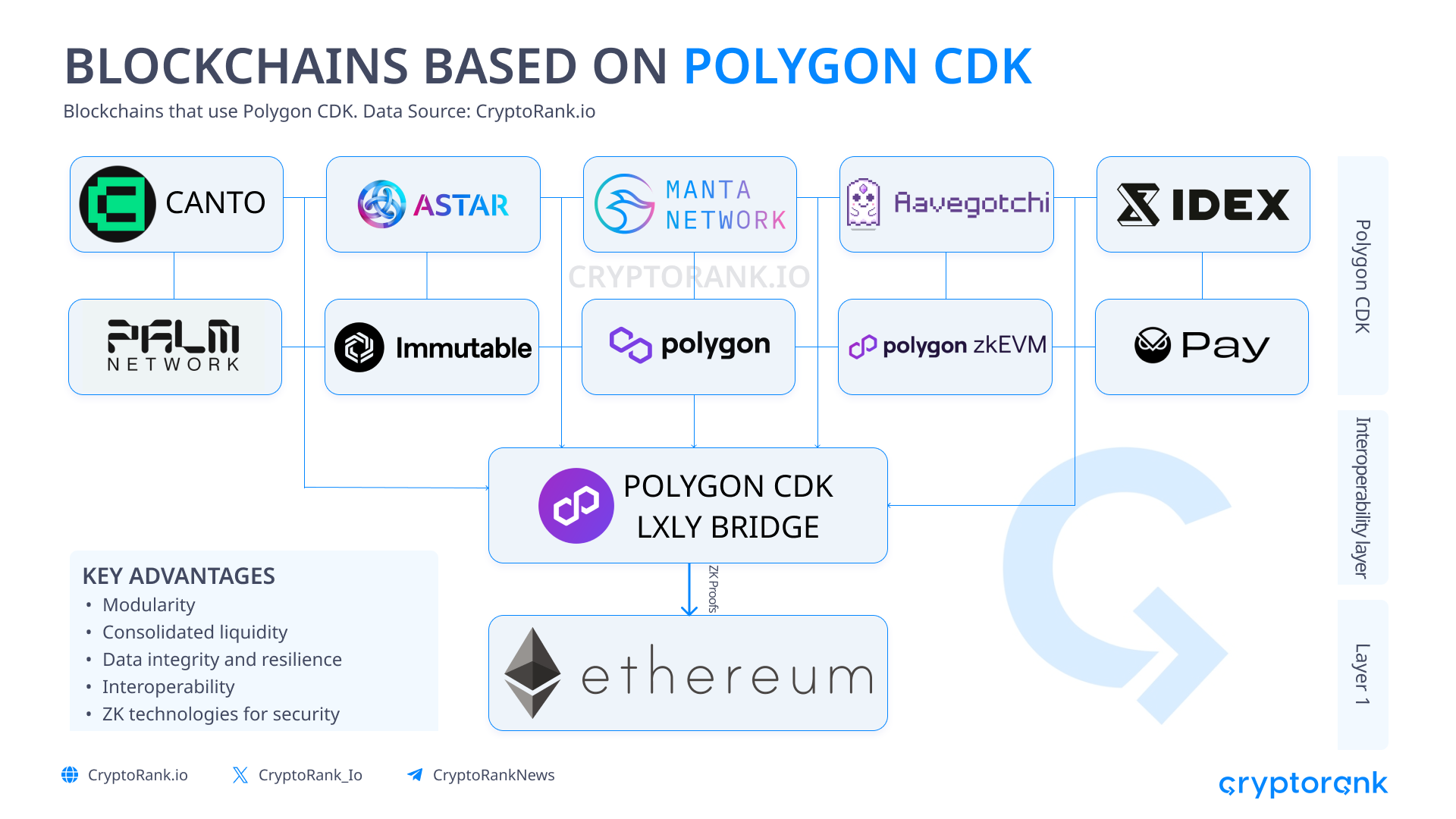
What Is Polygon CDK?
CryptoRankShare: