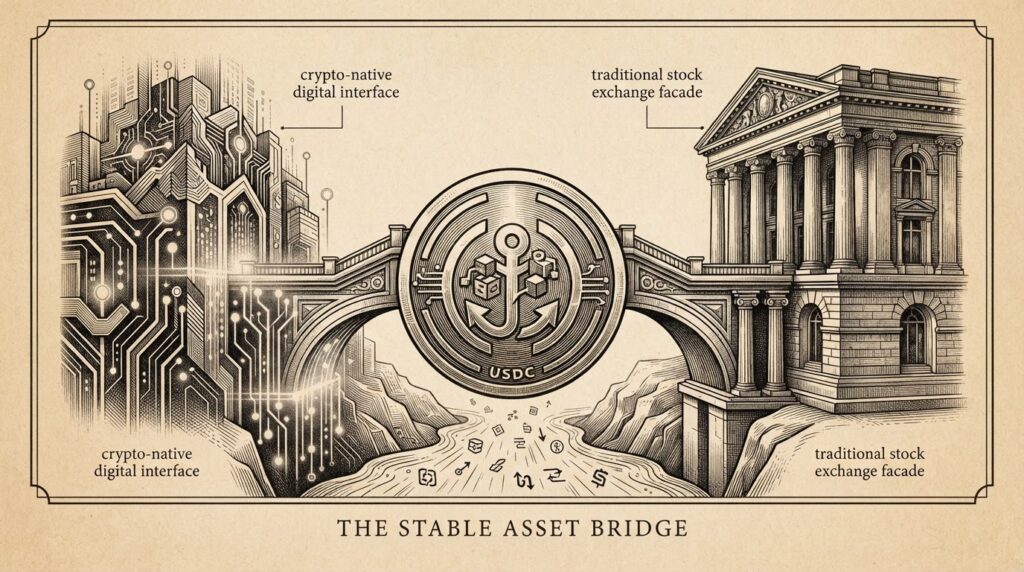
The Reward Loophole: CLARITY Act’s Functional Line

Share:
The CLARITY Act's Section 404, advanced 15-9 by the Senate Banking Committee on May 14, 2026, would ban stablecoin yield that is 'economically or functionally equivalent' to bank interest while carving out activity-based rewards and leaving definitions to a 360-day SEC/CFTC rulemaking that will decide what counts as transactions, staking, liquidity provision, market-making, or governance rewards. The stakes are massive: the U.S. Treasury estimates $6.6 trillion in deposits at risk and Standard Chartered projects up to $500 billion migration by 2028; Coinbase earned $1.35 billion in stablecoin revenue in 2025 (19% of total) via a Circle revenue split paying up to 3.50% APY, banks are building tokenized deposits (Clearing House H1 2027, Wells Fargo Fall 2026), and Polymarket odds for 2026 passage collapsed to ~15% as of August 8, leaving crypto, DeFi and CEX/DEX stablecoin models subject to high regulatory uncertainty.
Predictions Markets
See what traders are focused on

The CLARITY Act’s viability hinges on a single distinction: the functional line between prohibited passive yield and permitted activity-based rewards. Section 404 of the bill, born from the Tillis-Alsobrooks compromise and advanced by the Senate Banking Committee in a 15-9 vote on May 14, 2026, attempts to codify this boundary. While the GENIUS Act already prohibits issuer-direct yield on stablecoins, the CLARITY Act serves as an overlay — specifically targeting the exchange-intermediary arrangements that currently define the market.
The prohibitions are clean enough: stablecoin yield that is “economically or functionally equivalent” to bank deposit interest is banned. What survives is a carveout for rewards tied to bona fide activities — transactions, payments, transfers, market-making, liquidity provision, governance, validation, and staking. The bill defines neither term. A 360-day joint SEC and CFTC rulemaking will fill that vacuum, making the statutory text a placeholder for the regulatory argument that follows.
The stakes are measured in trillions. The U.S. Treasury has estimated that $6.6 trillion in bank deposits are at risk from stablecoin disintermediation, with Standard Chartered projecting up to $500 billion in migration by 2028. The American Bankers Association, the Bank Policy Institute, and the Independent Community Bankers of America formally rejected the compromise on May 8, arguing that activity-based rewards are economically identical to deposit interest. BPI frames the carveout as an on-ramp for the full $6.6 trillion. Senator Reed has filed an amendment to tighten it.
Coinbase sees the same line from the other direction. The exchange generated $1.35 billion in stablecoin revenue in 2025 — 19 percent of its total, up 48 percent year-over-year — through a 50/50 reserve-income split with Circle that passes yield to USDC holders as “rewards” at up to 3.50 percent APY. CEO Brian Armstrong and CLO Paul Grewal publicly endorsed the activity-based language. The OCC’s notice of proposed rulemaking has already signaled that this exchange-intermediary structure is in the crosshairs.
The banking industry’s counter-strategy does not depend on the bill’s outcome. The Clearing House consortium — JPMorgan, Bank of America, Citi, Wells Fargo, and 11 others — is building a shared tokenized deposit network targeting the first half of 2027. Wells Fargo is pursuing a dual-track strategy: a proprietary platform launching Fall 2026 alongside the consortium effort. These institutions are positioning to compete against whatever stablecoins become — yield-bearing or not.
The path to enactment is narrowing fast. The Senate filed a procedural motion on August 8 for a September floor vote after missing the pre-recess deadline. Polymarket odds for 2026 passage have collapsed from 82 percent in February to roughly 15 percent as of August 8. Sixty votes are needed for cloture when the Senate returns September 14.
The 360-day rulemaking is where the line’s actual shape will be drawn. The SEC and CFTC will decide what counts as a “bona fide” activity, what falls under “economically equivalent,” and where the Circle-Coinbase revenue-sharing model sits relative to the prohibition. Chanté Eliaszadeh’s analysis at Astraea Counsel frames the question precisely: design to the narrow reading and accept lower near-term reward economics, or design to the broad reading and accept a 35-to-45 percent probability of a conference-driven rebuild. The asymmetric downside favors the conservative bet.
The functional line in Section 404 determines whether stablecoins compete with bank deposits or complement them. If the carveout holds, Coinbase keeps its revenue architecture and stablecoin issuers build activity-reward products. If it tightens to a House-style near-total yield ban, the competitive surface collapses into pure payments — and the Clearing House consortium’s tokenized deposits capture the interest-bearing layer banks have always owned. Either way, the 360-day rulemaking will produce the definitions the bill left blank. The next material signal is the September cloture vote.
In This News
Coins

$ 0.99985
0%
$ 0.99977
+0.03%


$ 0.125
+1.20%


Predictions Markets
See what traders are focused on
Share:
In This News
Coins
$ 0.99985
0%$ 0.99977
+0.03%$ 0.125
+1.20%Predictions Markets
See what traders are focused on
Share:
Read More
The Clearing House and the Tokenized Deposit Gambit