Currencies36871
Market Cap$ 2.40T-1.11%
24h Spot Volume$ 34.87B-5.26%
DominanceBTC55.67%-0.11%ETH9.89%+0.15%
ETH Gas0.21 Gwei
/

Federal Reserve’s Critical Balancing Act: Navigating AI-Driven Volatility and Interest Rate Decisions in 2025

Share:

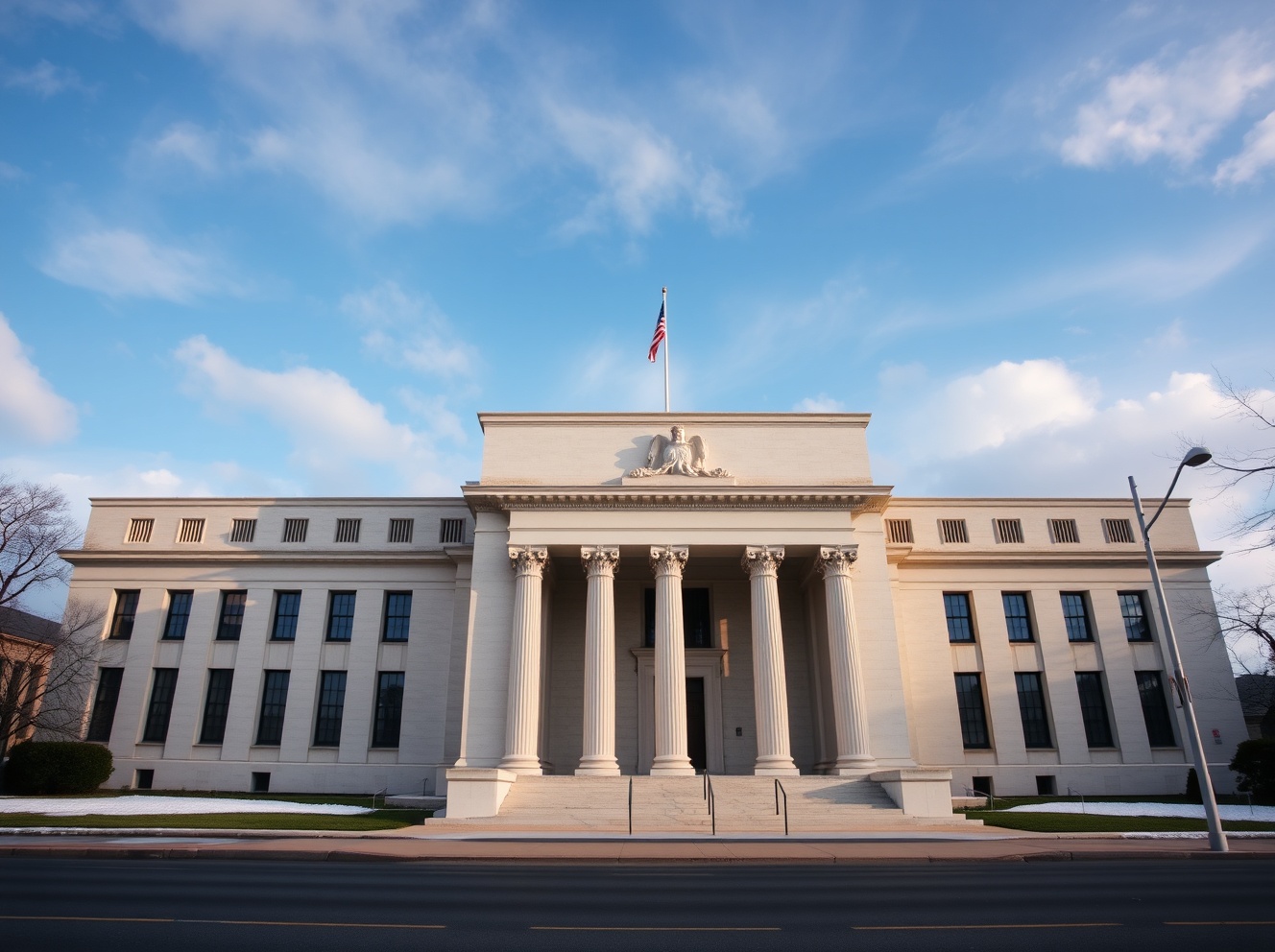
Federal Reserve analysis of AI impact on interest rate decisions and financial market volatility in 2025

BitcoinWorld

Federal Reserve’s Critical Balancing Act: Navigating AI-Driven Volatility and Interest Rate Decisions in 2025

WASHINGTON, D.C., March 2025 – The Federal Reserve faces unprecedented challenges as artificial intelligence transforms financial markets, creating new volatility patterns that complicate traditional interest rate decisions. Recent analysis from Rabobank’s economic research division reveals how central bankers must now account for algorithmic trading, predictive analytics, and machine learning models that operate at speeds beyond human comprehension. This technological revolution arrives precisely when the global economy shows signs of both resilience and fragility, forcing policymakers to reconsider decades-old frameworks for monetary intervention.

Federal Reserve Confronts AI’s Market Transformation

The Federal Reserve now operates in financial ecosystems where AI systems execute millions of trades daily, often reacting to economic indicators before human analysts can process the data. Consequently, volatility spikes can emerge from algorithmic herd behavior rather than fundamental economic shifts. Rabobank’s research team documented this phenomenon throughout 2024, noting that traditional volatility measures like the VIX increasingly fail to capture these new risk dimensions. Moreover, AI-driven liquidity provision creates market conditions that can evaporate within milliseconds during stress events.

Central bank officials have acknowledged these challenges in recent testimonies before congressional committees. Specifically, they highlight how machine learning models can amplify feedback loops between asset prices and economic expectations. For instance, when multiple AI systems interpret the same employment data similarly, they might trigger coordinated market movements that exaggerate the data’s true significance. The Federal Reserve must therefore develop new monitoring tools that track not just economic fundamentals but also the technological infrastructure shaping market responses.

Interest Rate Policy in an Algorithmic Age

Setting interest rates has always involved balancing inflation control against economic growth objectives. However, AI introduces additional complexity by changing how policy signals transmit through financial systems. Rabobank’s analysis shows that since 2023, market reactions to Federal Reserve announcements have become more immediate but also more prone to subsequent reversals as algorithms recalibrate. This pattern creates what economists term “policy signal noise,” where the initial market response provides less reliable information about longer-term expectations.

The Volatility-Feedback Challenge

Rabobank researchers identify a critical feedback mechanism: AI systems trained on historical data may interpret current volatility as signaling future instability, thereby triggering defensive positioning that actually creates the instability they anticipate. This self-fulfilling dynamic forces the Federal Reserve to consider not just what policy to implement but how to communicate it in ways that minimize algorithmic misinterpretation. Some experts suggest that central banks might need to provide machine-readable policy guidance alongside traditional statements.

The table below illustrates how AI has changed key market dynamics since 2020:

Market Characteristic Pre-2020 Pattern 2025 Pattern (Rabobank Projection)
Policy Transmission Speed Hours to days Milliseconds to minutes
Volatility Clustering Days to weeks Minutes to hours
Liquidity Depth Relatively stable Highly variable by time of day
Cross-Asset Correlation Moderate during stress Extreme and instantaneous

Rabobank’s Framework for Modern Central Banking

Rabobank’s economic team proposes a three-pillar approach for central banks navigating this new environment. First, they recommend enhanced market microstructure analysis that monitors not just what trades occur but which algorithms dominate trading at given moments. Second, they suggest developing “circuit breaker” mechanisms that respond to algorithmic herd behavior rather than just price movements. Third, they advocate for closer collaboration between central banks and financial technology regulators to ensure monetary policy tools remain effective.

The Dutch banking group’s research draws from multiple data sources, including:

  • Algorithmic trading volume metrics from major exchanges
  • Latency arbitrage patterns in Treasury markets
  • Natural language processing of financial news sentiment
  • High-frequency volatility measures across asset classes

This comprehensive approach allows Rabobank to identify relationships that traditional analysis might miss. For example, their models show that certain AI trading strategies create predictable volatility patterns around economic data releases, regardless of the data’s actual content. The Federal Reserve could potentially use this insight to time interventions more effectively or adjust communication strategies.

Global Implications and Coordination Challenges

AI-driven markets don’t respect national borders, creating coordination challenges for the Federal Reserve and other central banks. When European algorithms react to U.S. policy announcements, or Asian trading systems trigger volatility in American markets during off-hours, purely domestic approaches become insufficient. Rabobank notes that the Bank for International Settlements has begun facilitating discussions about this issue, but concrete frameworks remain under development.

The technological asymmetry between large financial institutions and smaller players presents additional concerns. Sophisticated AI systems give their operators significant advantages in interpreting and reacting to Federal Reserve policy. This disparity could potentially distort market functioning and undermine policy transmission. Some economists therefore argue for transparency requirements regarding algorithmic trading strategies, though such proposals face practical and philosophical objections.

Historical Parallels and Novel Elements

While financial innovation has always challenged central banks, Rabobank analysts emphasize that AI represents qualitative rather than just quantitative change. Previous technological advances like electronic trading accelerated existing processes, but AI systems introduce entirely new decision-making mechanisms. These systems sometimes develop strategies their human programmers don’t fully understand, creating what researchers call the “black box problem” for market supervision.

The Federal Reserve has responded by expanding its technical staff and establishing partnerships with academic computer science departments. However, the pace of AI advancement continues to challenge these efforts. Rabobank’s timeline shows that major AI trading innovations now emerge every 6-12 months, while central bank policy frameworks typically evolve over years or decades.

Conclusion

The Federal Reserve’s task of managing interest rates amidst AI-driven volatility represents one of the most significant challenges in modern central banking history. Rabobank’s analysis provides crucial insights into how artificial intelligence transforms market dynamics and complicates monetary policy decisions. As algorithms increasingly mediate between policy signals and economic outcomes, the Federal Reserve must develop new tools, monitoring capabilities, and potentially new policy frameworks. Success will require balancing traditional economic wisdom with technological sophistication, ensuring that monetary policy remains effective in increasingly automated financial systems. The coming years will test whether century-old institutions can adapt to technology that redefines fundamental market mechanisms almost daily.

FAQs

Q1: How does AI actually increase market volatility?
A1: AI systems can amplify volatility through several mechanisms: they often use similar data and models, creating herd behavior; they react to news and data instantaneously, concentrating market movements; and they can engage in strategies that assume continued liquidity that may disappear during stress events.

Q2: What specific tools is the Federal Reserve developing to monitor AI markets?
A2: While full details aren’t public, the Fed has mentioned developing advanced analytics for high-frequency trading data, natural language processing of financial communications, and machine learning models to detect anomalous trading patterns that might indicate systemic risks.

Q3: Does Rabobank believe AI will make the Federal Reserve’s job easier or harder?
A3: Rabobank’s analysis suggests AI initially makes monetary policy more challenging by introducing new volatility sources and transmission mechanisms. However, properly harnessed, AI could eventually help central banks through better economic forecasting and more precise policy implementation.

Q4: How do other central banks approach AI in financial markets?
A4: The European Central Bank and Bank of England have research initiatives similar to the Fed’s, while the Bank of Japan has focused on AI’s deflationary impacts. China’s central bank has taken the most direct approach, implementing some AI monitoring systems and algorithmic trading restrictions.

Q5: Can the Federal Reserve use AI in its own operations?
A5: Yes, the Fed already uses machine learning for certain functions like fraud detection and economic indicator analysis. However, using AI for core policy decisions raises transparency and accountability questions that require careful consideration.

This post Federal Reserve’s Critical Balancing Act: Navigating AI-Driven Volatility and Interest Rate Decisions in 2025 first appeared on BitcoinWorld.

Read the article at Bitcoin World

In This News

Share:

In This News

Share:

Read More

Fed Minutes Reveal Critical January Hold Decision as Markets Dramatically Shift Rate-Cut Bets

Fed Minutes Reveal Critical January Hold Decision as Markets Dramatically Shift Rate-Cut Bets

BitcoinWorld Fed Minutes Reveal Critical January Hold Decision as Markets Dramatical...
Fed Minutes Reveal Critical Insights Behind January Rate Hold Amid Persistent Hawkish Outlook

Fed Minutes Reveal Critical Insights Behind January Rate Hold Amid Persistent Hawkish Outlook

BitcoinWorld Fed Minutes Reveal Critical Insights Behind January Rate Hold Amid Pers...

Federal Reserve’s Critical Balancing Act: Navigating AI-Driven Volatility and Interest Rate Decisions in 2025

Share:

Federal Reserve analysis of AI impact on interest rate decisions and financial market volatility in 2025

BitcoinWorld

Federal Reserve’s Critical Balancing Act: Navigating AI-Driven Volatility and Interest Rate Decisions in 2025

WASHINGTON, D.C., March 2025 – The Federal Reserve faces unprecedented challenges as artificial intelligence transforms financial markets, creating new volatility patterns that complicate traditional interest rate decisions. Recent analysis from Rabobank’s economic research division reveals how central bankers must now account for algorithmic trading, predictive analytics, and machine learning models that operate at speeds beyond human comprehension. This technological revolution arrives precisely when the global economy shows signs of both resilience and fragility, forcing policymakers to reconsider decades-old frameworks for monetary intervention.

Federal Reserve Confronts AI’s Market Transformation

The Federal Reserve now operates in financial ecosystems where AI systems execute millions of trades daily, often reacting to economic indicators before human analysts can process the data. Consequently, volatility spikes can emerge from algorithmic herd behavior rather than fundamental economic shifts. Rabobank’s research team documented this phenomenon throughout 2024, noting that traditional volatility measures like the VIX increasingly fail to capture these new risk dimensions. Moreover, AI-driven liquidity provision creates market conditions that can evaporate within milliseconds during stress events.

Central bank officials have acknowledged these challenges in recent testimonies before congressional committees. Specifically, they highlight how machine learning models can amplify feedback loops between asset prices and economic expectations. For instance, when multiple AI systems interpret the same employment data similarly, they might trigger coordinated market movements that exaggerate the data’s true significance. The Federal Reserve must therefore develop new monitoring tools that track not just economic fundamentals but also the technological infrastructure shaping market responses.

Interest Rate Policy in an Algorithmic Age

Setting interest rates has always involved balancing inflation control against economic growth objectives. However, AI introduces additional complexity by changing how policy signals transmit through financial systems. Rabobank’s analysis shows that since 2023, market reactions to Federal Reserve announcements have become more immediate but also more prone to subsequent reversals as algorithms recalibrate. This pattern creates what economists term “policy signal noise,” where the initial market response provides less reliable information about longer-term expectations.

The Volatility-Feedback Challenge

Rabobank researchers identify a critical feedback mechanism: AI systems trained on historical data may interpret current volatility as signaling future instability, thereby triggering defensive positioning that actually creates the instability they anticipate. This self-fulfilling dynamic forces the Federal Reserve to consider not just what policy to implement but how to communicate it in ways that minimize algorithmic misinterpretation. Some experts suggest that central banks might need to provide machine-readable policy guidance alongside traditional statements.

The table below illustrates how AI has changed key market dynamics since 2020:

Market Characteristic Pre-2020 Pattern 2025 Pattern (Rabobank Projection)
Policy Transmission Speed Hours to days Milliseconds to minutes
Volatility Clustering Days to weeks Minutes to hours
Liquidity Depth Relatively stable Highly variable by time of day
Cross-Asset Correlation Moderate during stress Extreme and instantaneous

Rabobank’s Framework for Modern Central Banking

Rabobank’s economic team proposes a three-pillar approach for central banks navigating this new environment. First, they recommend enhanced market microstructure analysis that monitors not just what trades occur but which algorithms dominate trading at given moments. Second, they suggest developing “circuit breaker” mechanisms that respond to algorithmic herd behavior rather than just price movements. Third, they advocate for closer collaboration between central banks and financial technology regulators to ensure monetary policy tools remain effective.

The Dutch banking group’s research draws from multiple data sources, including:

  • Algorithmic trading volume metrics from major exchanges
  • Latency arbitrage patterns in Treasury markets
  • Natural language processing of financial news sentiment
  • High-frequency volatility measures across asset classes

This comprehensive approach allows Rabobank to identify relationships that traditional analysis might miss. For example, their models show that certain AI trading strategies create predictable volatility patterns around economic data releases, regardless of the data’s actual content. The Federal Reserve could potentially use this insight to time interventions more effectively or adjust communication strategies.

Global Implications and Coordination Challenges

AI-driven markets don’t respect national borders, creating coordination challenges for the Federal Reserve and other central banks. When European algorithms react to U.S. policy announcements, or Asian trading systems trigger volatility in American markets during off-hours, purely domestic approaches become insufficient. Rabobank notes that the Bank for International Settlements has begun facilitating discussions about this issue, but concrete frameworks remain under development.

The technological asymmetry between large financial institutions and smaller players presents additional concerns. Sophisticated AI systems give their operators significant advantages in interpreting and reacting to Federal Reserve policy. This disparity could potentially distort market functioning and undermine policy transmission. Some economists therefore argue for transparency requirements regarding algorithmic trading strategies, though such proposals face practical and philosophical objections.

Historical Parallels and Novel Elements

While financial innovation has always challenged central banks, Rabobank analysts emphasize that AI represents qualitative rather than just quantitative change. Previous technological advances like electronic trading accelerated existing processes, but AI systems introduce entirely new decision-making mechanisms. These systems sometimes develop strategies their human programmers don’t fully understand, creating what researchers call the “black box problem” for market supervision.

The Federal Reserve has responded by expanding its technical staff and establishing partnerships with academic computer science departments. However, the pace of AI advancement continues to challenge these efforts. Rabobank’s timeline shows that major AI trading innovations now emerge every 6-12 months, while central bank policy frameworks typically evolve over years or decades.

Conclusion

The Federal Reserve’s task of managing interest rates amidst AI-driven volatility represents one of the most significant challenges in modern central banking history. Rabobank’s analysis provides crucial insights into how artificial intelligence transforms market dynamics and complicates monetary policy decisions. As algorithms increasingly mediate between policy signals and economic outcomes, the Federal Reserve must develop new tools, monitoring capabilities, and potentially new policy frameworks. Success will require balancing traditional economic wisdom with technological sophistication, ensuring that monetary policy remains effective in increasingly automated financial systems. The coming years will test whether century-old institutions can adapt to technology that redefines fundamental market mechanisms almost daily.

FAQs

Q1: How does AI actually increase market volatility?
A1: AI systems can amplify volatility through several mechanisms: they often use similar data and models, creating herd behavior; they react to news and data instantaneously, concentrating market movements; and they can engage in strategies that assume continued liquidity that may disappear during stress events.

Q2: What specific tools is the Federal Reserve developing to monitor AI markets?
A2: While full details aren’t public, the Fed has mentioned developing advanced analytics for high-frequency trading data, natural language processing of financial communications, and machine learning models to detect anomalous trading patterns that might indicate systemic risks.

Q3: Does Rabobank believe AI will make the Federal Reserve’s job easier or harder?
A3: Rabobank’s analysis suggests AI initially makes monetary policy more challenging by introducing new volatility sources and transmission mechanisms. However, properly harnessed, AI could eventually help central banks through better economic forecasting and more precise policy implementation.

Q4: How do other central banks approach AI in financial markets?
A4: The European Central Bank and Bank of England have research initiatives similar to the Fed’s, while the Bank of Japan has focused on AI’s deflationary impacts. China’s central bank has taken the most direct approach, implementing some AI monitoring systems and algorithmic trading restrictions.

Q5: Can the Federal Reserve use AI in its own operations?
A5: Yes, the Fed already uses machine learning for certain functions like fraud detection and economic indicator analysis. However, using AI for core policy decisions raises transparency and accountability questions that require careful consideration.

This post Federal Reserve’s Critical Balancing Act: Navigating AI-Driven Volatility and Interest Rate Decisions in 2025 first appeared on BitcoinWorld.

Read the article at Bitcoin World

In This News

Share:

In This News

Share:

Read More

Fed Minutes Reveal Critical January Hold Decision as Markets Dramatically Shift Rate-Cut Bets

Fed Minutes Reveal Critical January Hold Decision as Markets Dramatically Shift Rate-Cut Bets

BitcoinWorld Fed Minutes Reveal Critical January Hold Decision as Markets Dramatical...
Fed Minutes Reveal Critical Insights Behind January Rate Hold Amid Persistent Hawkish Outlook

Fed Minutes Reveal Critical Insights Behind January Rate Hold Amid Persistent Hawkish Outlook

BitcoinWorld Fed Minutes Reveal Critical Insights Behind January Rate Hold Amid Pers...