Gold faces near-term weakness but H2 recovery still expected

Share:
Metals Focus forecasts total gold demand will fall 2% in 2026 to 4,177 tonnes, driven by an 11% drop in jewellery demand and a 15% decline in central bank purchases while physical investment demand jumps 15% to its highest level since 2013 and for the first time exceeds jewellery. Near-term downside risk is expected as stronger US rate-hike bets and a firmer dollar leave prices vulnerable (FXStreet flags $4,300), though analysts expect a H2 2026 recovery; the shift toward bars and coins may influence safe-haven flows and affect crypto, DeFi, CEX liquidity and token adoption dynamics.
Predictions Markets
See what traders are focused on


Gold prices are facing near-term downside pressure and could test key support levels as weaker overall demand combines with rising expectations of higher US interest rates and a stronger dollar.
Metals Focus, a specialist precious metals research firm, forecast on Friday that total gold demand will fall 2% this year to 4,177 tonnes.
The decline is driven mainly by an 11% drop in jewellery demand and reduced central bank purchases.
Demand shift from jewellery to investment
Carsten Fritsch, commodity analyst at Commerzbank AG, highlighted the key trends in the forecast.
Total demand is expected to decline by 2% to 4,177 tons.
The main factors weighing on demand are weaker jewellery demand, which is projected to fall by 11%, and lower gold purchases by central banks.
High gold prices have prompted consumers to shift toward bars and coins.
As a result, physical investment demand is expected to surge 15% to its highest level since 2013, and for the first time on record, surpass jewellery demand.
Central bank buying to moderate
Metals Focus cites rising energy prices as the reason for the expected 15% decline in central bank gold purchases, noting that some central banks had to intervene to support their currencies and consequently sell gold.
Additionally, there are expected to be increased gold sales by the Russian Central Bank.
This comes even as the Polish Central Bank continues aggressive accumulation, with reserves now reportedly at 613 tonnes.
Gold came under fresh selling pressure on Monday.
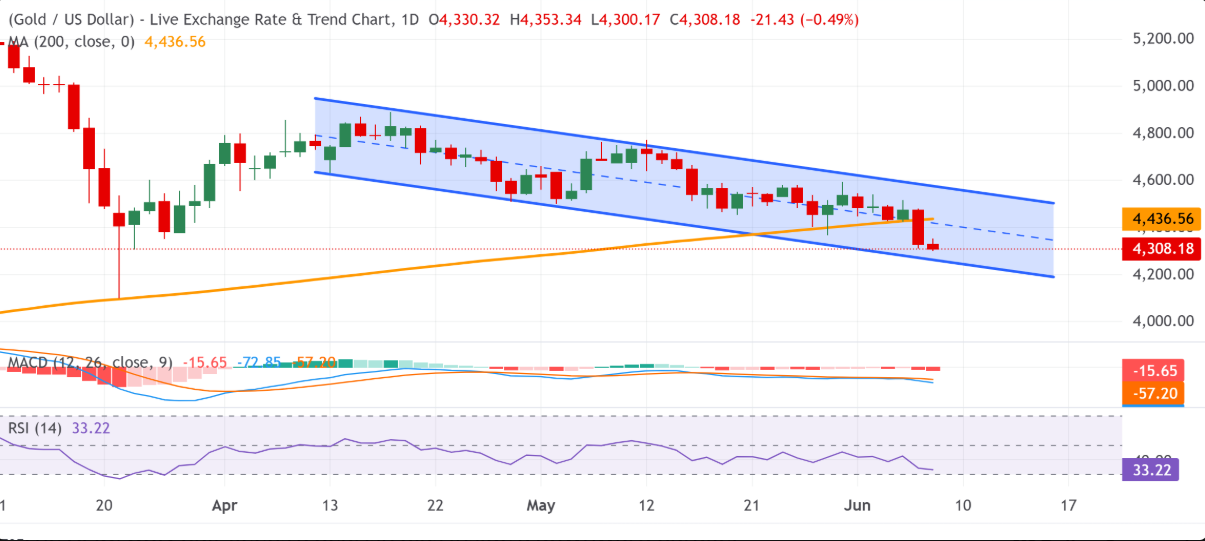
FXStreet analysts warned that the metal remains exposed to further declines, stating “$4,300 gold seems vulnerable near March low as geopolitics and Fed hike bets support USD.”
Rising US rate hike expectations, driven by persistent war-related inflation risks, are strengthening the dollar and pushing bond yields higher, classic headwinds for non-yielding gold.
Investment demand offers support
Despite the overall demand decline, the strong rise in bar and coin buying reflects robust retail and institutional interest in gold as a hedge against uncertainty.
This shift is helping to cushion the impact of weaker jewellery and official sector demand.
Fritsch and Metals Focus both expect gold to resume its upward trend in the second half of 2026, supported by renewed investment flows and eventual monetary easing.
Near-term risks and catalysts
In the coming months, gold faces several downside risks.
Sustained high prices could continue to suppress jewellery consumption in major markets like India and China.
Renewed central bank selling, particularly by Russia, and stronger US economic data that delay rate cuts could keep pressure on prices.
However, any escalation in Middle East tensions or signs of economic slowdown could quickly revive safe-haven buying.
A resolution to the Iran conflict that eases energy prices would also support gold by reducing inflation fears and opening the door for earlier Fed rate cuts.
Longer-term bullish factors intact
Structural drivers for gold remain strong.
These include ongoing de-dollarisation efforts by central banks, elevated global government debt levels, and gold’s traditional role as an inflation and currency hedge.
“Like us, Metals Focus anticipates a resumption of the upward trend in the gold price for the second half of the year," Fritsch said.
Technically, gold is approaching important support near its March lows, as per data from commodity trading platforms.
A break below this level could open the door to further corrective moves, while a strong rebound would signal renewed bullish momentum.
Investors may find attractive entry points on dips if prices test lower supports, especially with physical demand providing underlying resilience.
However, traders should remain cautious in the near term given the combination of softer demand forecasts and monetary policy uncertainty.
Transitional phase
The gold market is undergoing a transitional phase.
While total demand is projected to moderate in 2026, the surge in investment buying signals healthy underlying interest.
Near-term price weakness appears likely as high interest rate expectations and a strong dollar dominate sentiment, but the second half of the year holds potential for a recovery as these pressures ease.
With geopolitical risks still present and structural tailwinds firmly in place, gold is likely to remain range-bound or slightly softer in the short term before resuming its longer-term uptrend later in 2026.
The post Gold faces near-term weakness but H2 recovery still expected appeared first on Invezz


Read More

Gold Price Hits Two-Month Low Below $4,300 as US Yields Surge: What’s Next for XAU/USD?