
AI agent payments network AIsa raises $6.5M seed co-led by Alibaba and Tribe Capital
Share:
Predictions Markets
See what traders are focused on

Quick Take
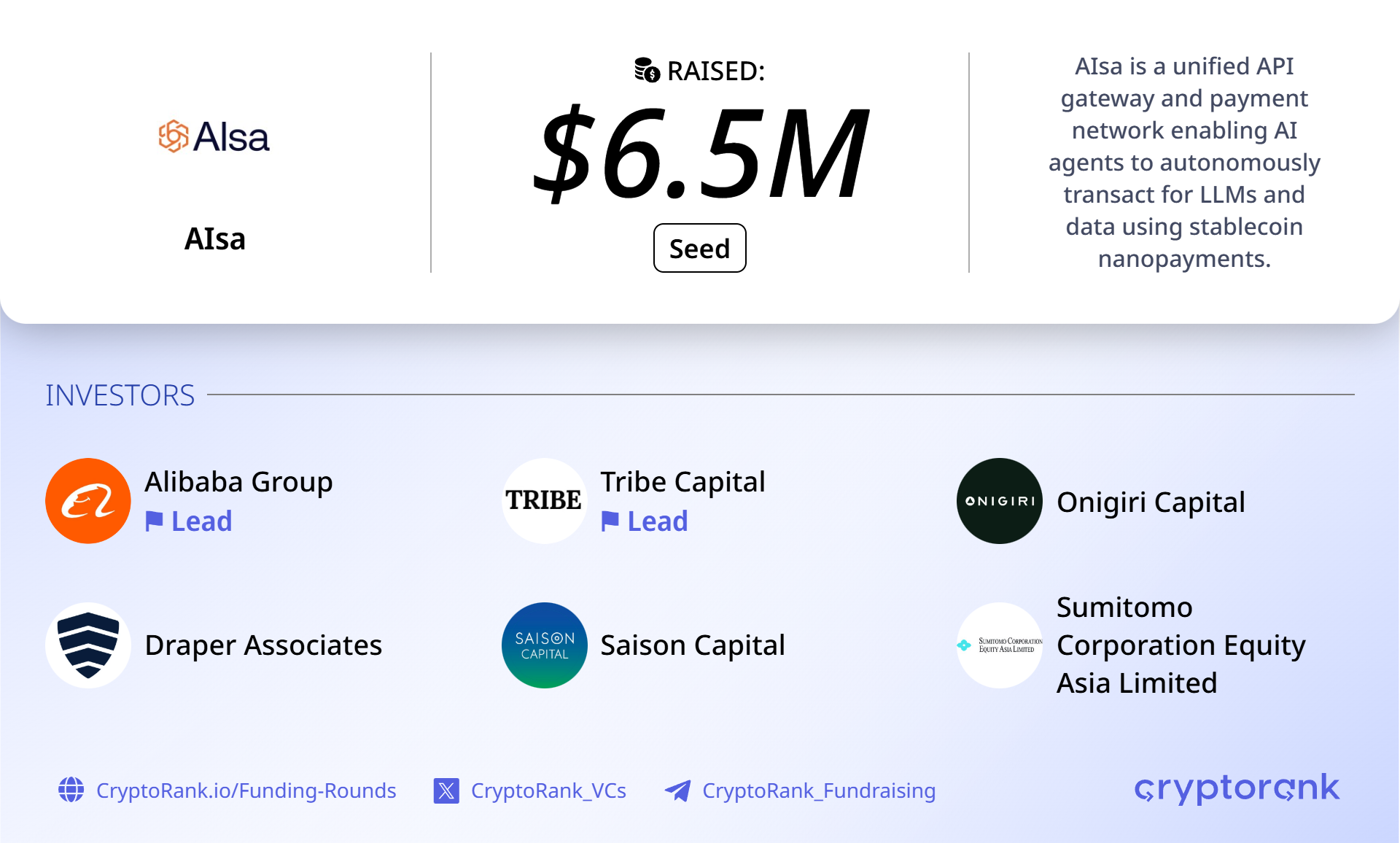
- AIsa has secured $6.5 million in total funding to date, including a new seed round co-led by Alibaba and Tribe Capital with Draper Associates, Sumitomo Corporation and Saison Capital participating.
- The San Francisco startup runs a unified resource and payments layer for AI agents, enabling usage-based access to APIs, data and SaaS tools with fiat and stablecoin settlement.
Seed round details
San Francisco-based AIsa has raised a total of $6.5 million in funding to date, including a new seed round co-led by Alibaba and Tribe Capital, the company announced. Other participants in the financing include Draper Associates, Sumitomo Corporation, Saison Capital and additional undisclosed investors.
The round size and valuation were not broken out from the disclosed cumulative funding figure. AIsa said it plans to use the capital to expand headcount, scale its payments infrastructure and broaden the range of models, data sources and APIs connected to its network.
Product and positioning
AIsa operates a unified resource and transaction layer designed for AI agents rather than human end users. Through a single programmable interface, agents and developers can discover, access and pay for AI models, APIs, real-time data, search, SaaS tools, compute resources and agent services.
The platform combines a resource gateway with an agent-native payments system that meters usage, enforces business-defined spend controls and settles transactions in either fiat or stablecoins. Customers such as Impossible Finance are using AIsa to consolidate access to models, data and APIs while shifting from subscription and contract-heavy models to pure usage-based billing.
Traction and integrations
AIsa launched in 2025 and reports sharp growth in 2026 as agent frameworks have matured. From February to June 2026, registered agent users on the platform increased 150x, while aggregate API calls and transactions processed grew 200x, according to the company.
The company says it has onboarded more than 50,000 registered agents without paid marketing. Growth has been driven by ecosystems such as OpenClaw and Hermes, which route AI-native developers and their agents into AIsa's resource and payment network.
According to x402's public leaderboard, AIsa ranks as the top seller and top server in the x402 ecosystem. The network also integrates with emerging agent-payment initiatives from Circle, Visa and Stripe, positioning it at the intersection of AI infra, payments and marketplace tooling.
Founder and investor views
"Every major payment network won by sitting next to the resources its users actually wanted to buy. PayPal grew alongside eBay, and Stripe grew alongside internet commerce," said Jordan Liu, founder and CEO of AIsa. "AI agents are becoming economic actors. They research, call tools, consume data and make payments on behalf of users and businesses. But they cannot operate through signup flows, subscriptions and checkout pages designed for humans."
Francis Zhan, investor at Tribe Capital, framed AIsa as infra for agent-native monetization. "As agents become first class citizens of the internet, we believe they will need to pay for APIs, data, compute, identity, permissions, and services in a more programmatic way than humans do. Existing monetization rails like ads, subscriptions, manual onboarding, enterprise sales do not map cleanly to agents," he said.
Use of proceeds and roadmap
AIsa plans to use the new financing to grow its engineering team, expand its resource marketplace and deepen enterprise controls such as budgets, approval workflows and audit trails. Another focus is scaling stablecoin settlement capabilities for AI agents and enterprises transacting globally.
The company positions itself as the resource and transaction network that sits alongside emerging agent wallets, banks and control planes. With fresh capital, AIsa aims to harden its infra to support autonomous agents transacting at internet scale while broadening the set of integrated payment networks and on-chain settlement options.


