Russia Proposes Simplified Crypto Licensing Process for Banks and Brokers
Share:
Central Bank of Russia proposes simplified crypto exchange licensing for banks and brokers via a notification process and a temporary cap that limits bank crypto exposure to 1% of capital; the bill heads to parliament in March and is likely to pass in spring. Russia plans to block unregistered crypto exchanges this summer, creating an on‑shore opportunity for a domestic CEX (Moscow Exchange aims to capture part of ~$15 billion in fees global exchanges earn from Russia), boosting regulated crypto adoption and market capture. Regulatory framework treats digital currencies and stablecoins as tradable assets (not for domestic payments); qualified investors face no limits while others are capped at 300,000 rubles annually, balancing adoption with AML/security controls.
Predictions Markets
See what traders are focused on

- The Central Bank of Russia suggested that banks and brokers get crypto exchange licenses via a simple notification process.
- CBR Governor Elvira Nabiullina said that banks can only invest up to 1% of their capital in crypto at first, to keep risks low.
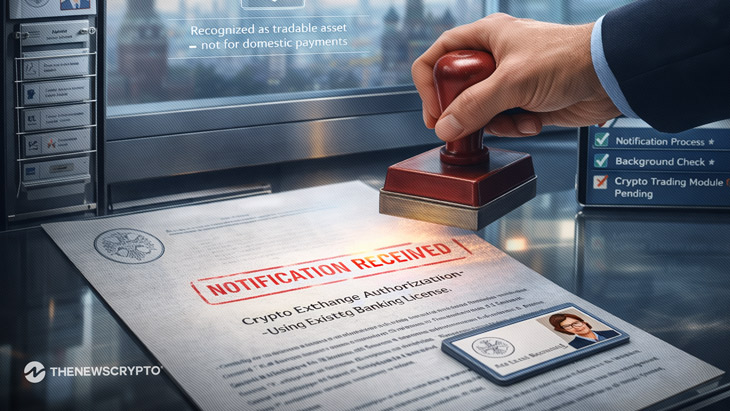
The Russian central bank has announced a significant change as it regulates digital assets, suggesting that commercial banks and brokers are allowed to obtain licenses for cryptocurrency exchanges through a simple process instead of going through the entire licensing procedure.
According to theInterfax reports, Central Bank of Russia Governor Elvira Nabiullina said at the annual meeting of lending institutions with the Central Bank that the institutions could receive crypto exchange authorization through a notification process and operate as intermediaries based on their current banking licenses.
As part of a cautious approach, Nabiullina believes that existing experience in preventing money laundering, fraud, and terrorist financing could help protect clients when crypto is legalized. With that, she proposed a temporary restriction on banks’ participation in the asset class as part of a cautious approach to risk.
As she added, “However, we would still like to limit the level of risk a bank takes in this area to one percent of capital. Let’s start by seeing how banks operate within the one percent cap, and then see whether we need to move forward.”
Blocking Unregistered Crypto Exchanges
Even as banks and brokers gain a simplified path to crypto licensing, last month, Russia announced plans to block crypto exchange and big crypto platform websites that are not officially registered in Russia as early as this summer, which shows Russia’s commitment to keeping crypto activity within regulated channels.
Also, Sergey Shvetsov of the Moscow Exchange added that worldwide crypto exchanges are receiving about $15 billion in fees from Russia, and the exchange aspires to enter the market in order to collect those fees and increase revenues.
Further, the Interfax reports mentioned that previously, in December 2025, Russia’s Central Bank proposed crypto regulations recognizing digital currencies and stablecoins as tradable assets, but not for domestic payments. Exchanges, brokers, and trustees can operate under existing licenses. Qualified investors face no limits, while others can buy up to 300,000 rubles annually. While the bill will go to parliament in March and likely pass in the spring.

Read More

BitRiver Founder Faces Escalating Legal Challenges as Fraud Investigation Expands