A satellite just learned to find things on its own — here’s what that means
Share:
In April, Loft Orbital’s Yam-9 became the first reported satellite to autonomously identify targets in orbit by running JPL’s NAVI-Orbital with Google DeepMind’s Gemma 3 vision-language model on an Nvidia Jetson Orin AGX GPU, flagging areas of interest in real time instead of downlinking terabytes of imagery. Loft (12 spacecraft, targeting 50–100), Planet Labs and Kepler are advancing orbital AI to expand onboard edge compute, reduce bandwidth, and improve security and situational awareness, a development that is neutral for crypto markets but positive for broader adoption of space-based compute and AI.
Predictions Markets
See what traders are focused on

BitcoinWorld
A satellite just learned to find things on its own — here’s what that means
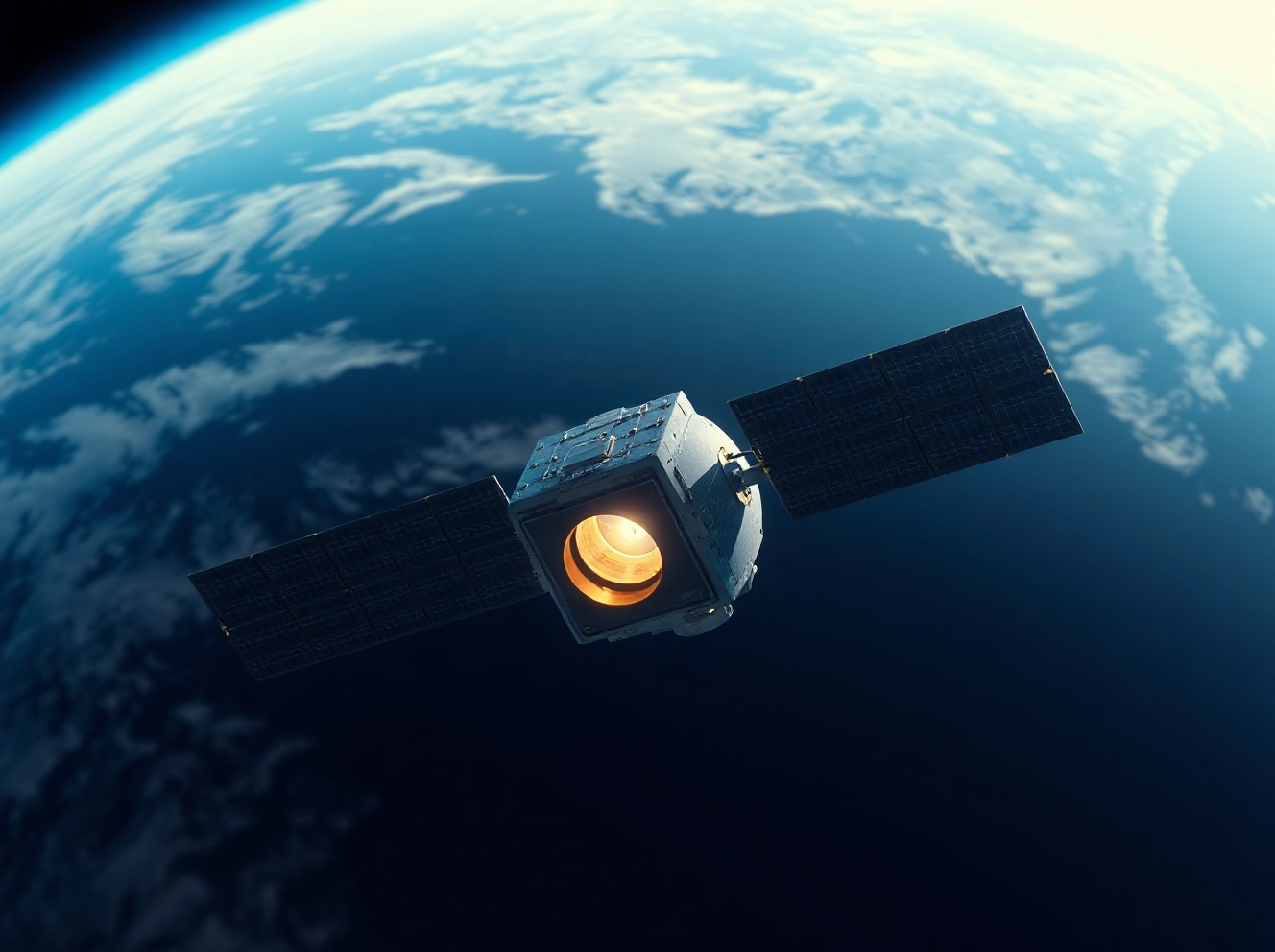
For the first time, an Earth observation satellite has identified targets in orbit without human assistance. The milestone, achieved in April aboard Loft Orbital’s Yam-9 spacecraft, marks the first reported deployment of a vision-language model (VLM) in space — and signals a fundamental shift in how satellite data could be collected, processed, and monetized.
How a VLM works in orbit
Typically, satellites capture vast amounts of imagery and beam it down to Earth, where analysts spend hours or days sifting through the data. The Yam-9 satellite, built by infrastructure-as-a-service company Loft Orbital, instead ran a software package from NASA’s Jet Propulsion Laboratory called NAVI-Orbital, which hosted Google DeepMind’s Gemma 3 VLM. The model was asked to classify sensor data at the boundary of natural environments and human development, or to identify infrastructure near railway hubs — and it delivered results in real time, onboard the spacecraft.
VLMs combine the contextual reasoning of large language models with computer vision. Gemma 3, designed for edge computing, is optimized to run on limited hardware far from a data center. On Yam-9, it operated on an Nvidia Jetson Orin AGX GPU, one of the leading chips used in space compute.
Near-term and long-term implications
In the short term, this capability reduces the flood of raw data that analysts must wade through. Instead of downloading terabytes of imagery, ground teams receive only flagged areas of interest. Loft Orbital’s head of AI, Paul Lasserre, told Bitcoin World that the technology “opens the door to always-on, patrol layers in space,” allowing users to set natural-language commands such as “monitor this border and let me know when something is suspicious.”
Longer term, the demonstration is a proof point for running larger-scale AI infrastructure in space. The lessons learned in power management, memory optimization, and thermal control for small models will inform how companies deploy more ambitious compute systems on orbit.
Industry momentum and competition
Loft Orbital is not alone in pursuing orbital AI. Planet Labs flies satellites with Jetson Orin processors, currently used for simpler object detection, but a spokesperson confirmed research into VLMs and other AI applications. Kepler Communications, which operates the largest group of GPUs in space, declined to comment on specific deployments due to non-disclosure agreements but noted “several undisclosed use cases of our compute environment” since its spacecraft launched in January.
Lasserre said the goal is to expand the constellation to between 50 and 100 satellites like Yam-9 to ensure real-time coverage of any point on Earth. Loft currently operates 12 spacecraft.
Beyond Earth: AI assistants for astronauts
The NAVI-Orbital project originated at JPL from researcher Taran Cyriac John, who envisioned a digital assistant for astronauts exploring the Moon or Mars. Juan Delfa Victoria, technical lead in JPL’s AI group, described the challenge: “Astronauts in pressurized suits cannot tap on a keyboard. So how about we provide an assistant — like in video games and movies, where you see an AI which is interactive?”
That vision, while still years from deployment, shares the same technical foundation as the orbital VLM: efficient, natural-language-driven AI that can operate autonomously in remote, resource-constrained environments.
Conclusion
The first autonomous identification of a target by a satellite using a VLM is a technical milestone with practical consequences. It promises to make space sensors more responsive, reduce ground-station bottlenecks, and pave the way for more intelligent, self-directing spacecraft. As Lasserre put it, “Now that we’ve proven the concept, that’s really the direction of travel.”
FAQs
Q1: What is a vision-language model (VLM)?
A VLM is an AI system that combines the text understanding of large language models with the ability to analyze images. It can respond to natural-language queries about visual data, such as “find infrastructure near railway hubs.”
Q2: Why is running a VLM on a satellite significant?
It allows the satellite to process and triage data in orbit, sending only relevant findings to Earth. This reduces the time and bandwidth needed for analysis and enables near-real-time responses to dynamic events.
Q3: Which companies are working on orbital AI?
Loft Orbital, Planet Labs, and Kepler Communications are among the leading firms deploying or testing GPUs and AI models in space. NASA’s Jet Propulsion Laboratory is also actively developing software for autonomous spaceborne AI.
This post A satellite just learned to find things on its own — here’s what that means first appeared on BitcoinWorld.


Read More

The $3 trillion AI question: Can the industry justify its infrastructure spending?