
Southeast Asia’s power demand to triple by 2030: report

Share:
A Bain and Standard Chartered report finds Southeast Asia’s power demand from green industrial parks, data centres and EVs will more than triple over the next 3–4 years to exceed 100 TWh, requiring over $200 billion of investment with more than half slated for data centres and the region’s green economy expanding from $290 billion toward $430 billion by 2030. However, only about 60% of $540 billion announced green spending is on a credible path, 50–60% of renewables projects in Vietnam, Thailand and Indonesia were cancelled in the past five years and an $18 billion annual grid investment shortfall by 2035 risks delaying crypto infrastructure expansion, raising costs and security/operational risks for crypto mining, data centre hosting, CEX/DEX node operations, token-launch fundraising and broader crypto adoption.
Predictions Markets
See what traders are focused on

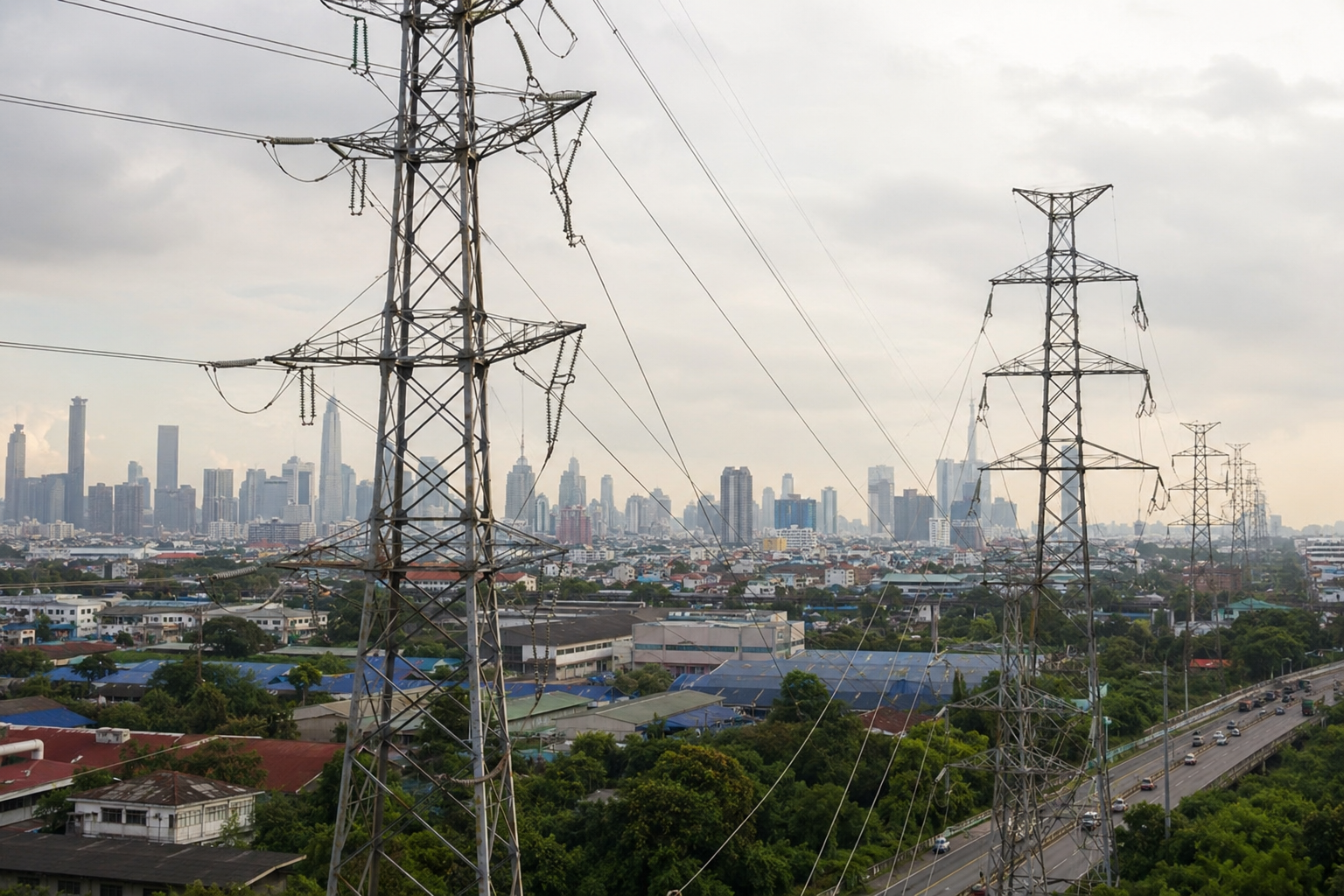
Southeast Asia’s power demand from green industrial parks, data centres and electric vehicles is expected to more than triple over the next three to four years, according to a report published by Bain & Company and Standard Chartered.
The report said demand from these sectors is projected to exceed 100 terawatt-hours during the period, requiring investments of more than $200 billion.
More than half of the planned investments are expected to flow into data centres.
The report noted that nearly all operators are willing to pay a premium to avoid delays linked to grid connections.
The findings come as Southeast Asia’s green economy is currently valued at $290 billion and remains on track to reach $430 billion by 2030.
Data centres and EVs drive power demand growth
The report highlighted that rapid expansion in green industrial parks, electric vehicles and digital infrastructure is placing increasing pressure on the region’s energy systems.
However, despite strong demand projections, only around 60% of the $540 billion in announced green spending across Southeast Asia’s power and electric vehicle value chains is considered to be on a credible path toward deployment under current conditions.
The report pointed to major structural hurdles slowing implementation across the region.
It stated that around 50% to 60% of renewable energy projects in Vietnam, Thailand and Indonesia have been cancelled over the last five years due to system constraints.
These included unclear power purchase agreement structures, permitting challenges and grid connection rules.
The report also warned that Southeast Asia’s power demand growth is expected to outpace grid upgrades.
It estimated an annual shortfall of $18 billion in grid investments by 2035.
In addition, the report said the rules of the green economy have shifted globally due to structural changes, with security and economic growth increasingly taking priority over sustainability goals.
US industrial production rebounds in April
Separately, industrial production in the United States expanded by 0.7% on a monthly basis in April, according to data released by the Federal Reserve on Friday.
The reading followed a revised 0.3% contraction in March and exceeded market expectations for a 0.3% increase.
The Federal Reserve said manufacturing output rose 0.6% during the month.
Mining output slipped 0.1%, while utilities output increased 1.9%.
“Capacity utilization moved up to 76.1 percent, a rate that is 3.3 percentage points below its long-run (1972–2025) average,” the Fed said in its release.
Following the data, the US dollar maintained gains during the American trading session.
At the time of reporting, the US Dollar Index was up 0.35% at 99.20.
Retail sales signal resilient consumer spending
US retail sales also rose in April, indicating continued resilience in consumer spending despite mounting inflationary pressures.
Data released by the US Census Bureau showed Retail Sales increased 0.5% month-on-month to $757.1 billion in April.
The result matched market expectations and followed a revised 1.6% increase in March. The March figure had previously been reported as 1.7%.
On an annual basis, retail sales increased 4.9%.
The Census Bureau said total sales for the February through April 2026 period were up 4.4% compared with the same period a year earlier.
“The February 2026 to March 2026 percent change was revised from up 1.7 percent to up 1.6 percent,” the agency said.
Producer prices post biggest rise since 2022
Meanwhile, wholesale inflation accelerated sharply in April, according to data released by the US Bureau of Labor Statistics.
The Producer Price Index for final demand rose 1.4% on a seasonally adjusted basis during the month, marking the largest monthly increase since March 2022.
Economists had expected a 0.5% rise.
Producer prices had increased 0.7% in March and 0.6% in February.
On a yearly basis, producer prices climbed 6.0% in April, representing the strongest annual increase since December 2022, when the index rose 6.4%.
The stronger-than-expected rise in producer prices is expected to reinforce concerns that inflationary pressures are becoming more deeply embedded across the US economy.
The data could also complicate the Federal Reserve’s efforts to bring inflation back toward its long-term 2% target.
The post Southeast Asia’s power demand to triple by 2030: report appeared first on Invezz


Predictions Markets
See what traders are focused on
Share:
Predictions Markets
See what traders are focused on
Share: