Cardano’s Protocol v11 Is Live With First Governance-Led Hard Fork

Share:
Predictions Markets
See what traders are focused on

Cardano, a decentralized blockchain platform, has officially activated Protocol Version 11 through the Van Rossem hard fork. This makes it the first network upgrade fully approved by the community through onchain voting
The upgrade also brings faster, cheaper smart contracts, giving developers more powerful tools to build on the blockchain.
Cardano Launches Its First Fully On-Chain Governed Hard Fork
Cardano has officially activated the Van Rossem hard fork, upgrading the network to Protocol Version 11 (PV11).
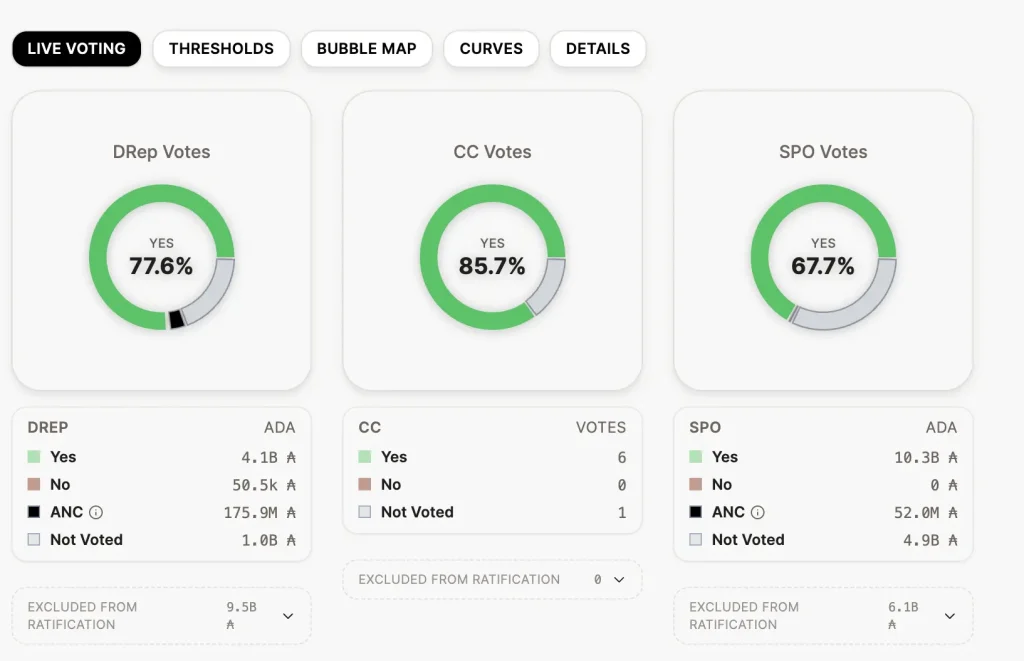
Unlike previous upgrades, this marks the first Cardano hard fork approved entirely through onchain governance. The proposal was voted on by Delegated Representatives (DReps), Stake Pool Operators (SPOs), and the Constitutional Committee (CC) under Cardano’s new governance system introduced in the Conway era.
Following the successful activation, Intersect, the organization coordinating Cardano’s governance process, confirmed the upgrade had gone live on the mainnet.
“The Van Rossem hard fork has been successfully enacted on Cardano Mainnet.”
Intersect announced, thanking ecosystem partners, developers, exchanges, DReps, SPOs, and Constitutional Committee members who helped complete the upgrade safely.
What’s New in Protocol Version 11?
Protocol Version 11 mainly focuses on making Cardano smarter, faster, and more efficient for developers building decentralized applications (DApps).
The upgrade introduces several improvements, including:
- New Plutus smart contract features are introduced through multiple Cardano Improvement Proposals (CIPs).
- Lower smart contract execution costs with improved cost models.
- Faster processing using new case expressions for Boolean, Integer, and Data types.
- Expanded cryptographic functions, including BLS12-381 support.
- Better consistency across Plutus V1, V2, and V3, allowing developers to use the same built-in functions across all versions.
- Stronger ledger rules and improved network security.
According to Intersect, testing showed no performance regressions after the upgrade, while security audits confirmed the safety of the new Plutus features and execution cost models.
The transaction format also remains unchanged, making the transition smoother for existing applications.
Upgrade Opens the Door for Cardano’s Next Phase
Beyond improving today’s network, Protocol Version 11 also lays the technical foundation for Cardano’s upcoming Dijkstra era, where more advanced smart contract capabilities are expected.
Intersect’s Hard Fork Working Group recommended the hard fork in June, and later approved by its Technical Steering Committee before receiving enough governance votes to move forward.
Before activation, Cardano’s Constitution required that at least 85% of active stake pools upgrade to compatible node software, helping ensure a smooth network transition.
Following the successful upgrade, ADA saw a modest market reaction, rising to around $0.1649.


Read More

AI Crypto Tokens at Risk? Hedge Funds DUMP Tech Stocks at Fastest Pace in a Decade