Why The Uniswap (UNI) Token Is Almost Worthless: Researcher

Share:
Predictions Markets
See what traders are focused on

In an analysis, Anders Helseth, Vice President at K33 Research, has mounted a strong case against the viability of the Uniswap (UNI) token. His analysis pivots on the intriguing dynamics of the decentralized finance (DeFi) market, fundamentally challenging the current valuation and future potential of UNI.
Helseth begins his argument with a seemingly straightforward question: “The Uniswap protocol generates significant trading fees, but will the UNI token ever capture its (fair) share?” His conclusion is emphatically negative.
Is The Uniswap (UNI) Token Worthless?
For context, UNI is a governance token for the Uniswap protocol, a decentralized exchange that earns a 0.3% fee on trades. However, as Helseth points out, the entire trading fee currently goes to liquidity providers, with UNI holders standing to gain only if governance votes permit fee dividends to UNI holders.
Even in a slow DeFi market, the fully diluted value of the UNI token is 15 times the annualized trading fees paid when using the protocol, currently around $6 billion. If the UNI token could capture all trading fees, it would arguably present an irresistible buy. However, Helseth makes a compelling argument to the contrary.
“The UNI token currently captures 0% of the 0.3% trading fee, which entirely goes to liquidity providers,” Helseth says, emphasizing the token’s current lack of intrinsic value.
The crux of his argument revolves around three players in the DeFi space: the users, the protocol (and hence UNI token), and the liquidity providers. According to Helseth, the interplay between these actors is detrimental to the UNI token’s potential for revenue generation. Helseth explains:
The entire protocol can be exactly copied within minutes at virtually no cost. This argument implies that all the power lies with the liquidity providers in the fight for trading fees.
The primary concern for users is liquidity and cost-effectiveness. If the same protocol can be replicated at a whim, users would inevitably gravitate towards the version with the most liquidity – to minimize slippage when executing trades. This dynamic significantly empowers liquidity providers who, unlike UNI holders, hold real, valuable tokens.
In addition, even though switching to another smart contract may entail some costs, these are relatively low, reinforcing the bargaining power of liquidity providers.
Concluding, Helseth states: “Given this relatively low cost of switching from the users’ perspective, we cannot conclude with anything else than that the power lies with the liquidity providers. Hence, even though the Uniswap protocol generates significant trading fees, we believe the potential for the UNI token to capture any of this revenue to be almost non-existent.”
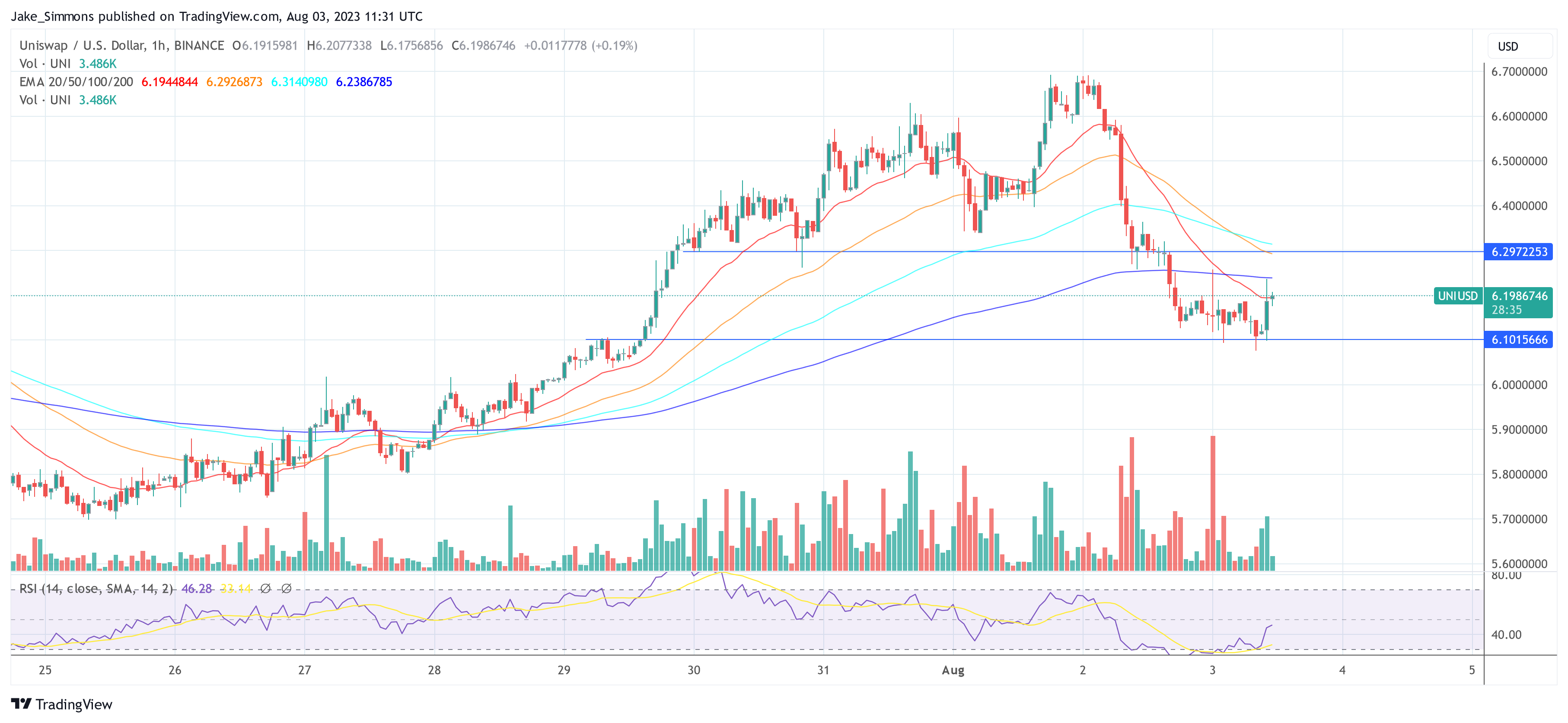
At press time, the UNI price stood at $6.19 after being rejected at the 200-day EMA yesterday.


Read More
Ethereum Foundation Says AI Found Node Risks: What Verification Operators Need to Know