
The Narrative of the Quarter: Prediction Markets

Share:
 CryptoRank
Share:
Key Takeaways:
-
Kalshi is becoming the volume leader, especially in crypto and World Cup-related markets.
-
Polymarket remains highly relevant, especially in political markets.
-
The market is fragmenting by verticals. Crypto, politics, sports, and other markets are no longer moving as one unified segment. Each category now has its own leading venue, user footprint, and liquidity profile.
The first half of 2026 brought a noticeable change to the prediction markets landscape. Instead of competing for users, the leading prediction markets now show signs of specialization on specific events. As such, Kalshi built a lead in crypto and FIFA World Cup markets, while Polymarket held its position in politics. The result is a market split along topical lines rather than a single dominant platform, with each leader's advantage confined to specific categories.
In this report, we take a look at the continuously changing prediction markets landscape and analyze data to see how the hottest narrative evolves and what to expect in the following quarters. The report is based on on-chain data and fundraising data from CryptoRank, which shows a full-scale picture of this sector.
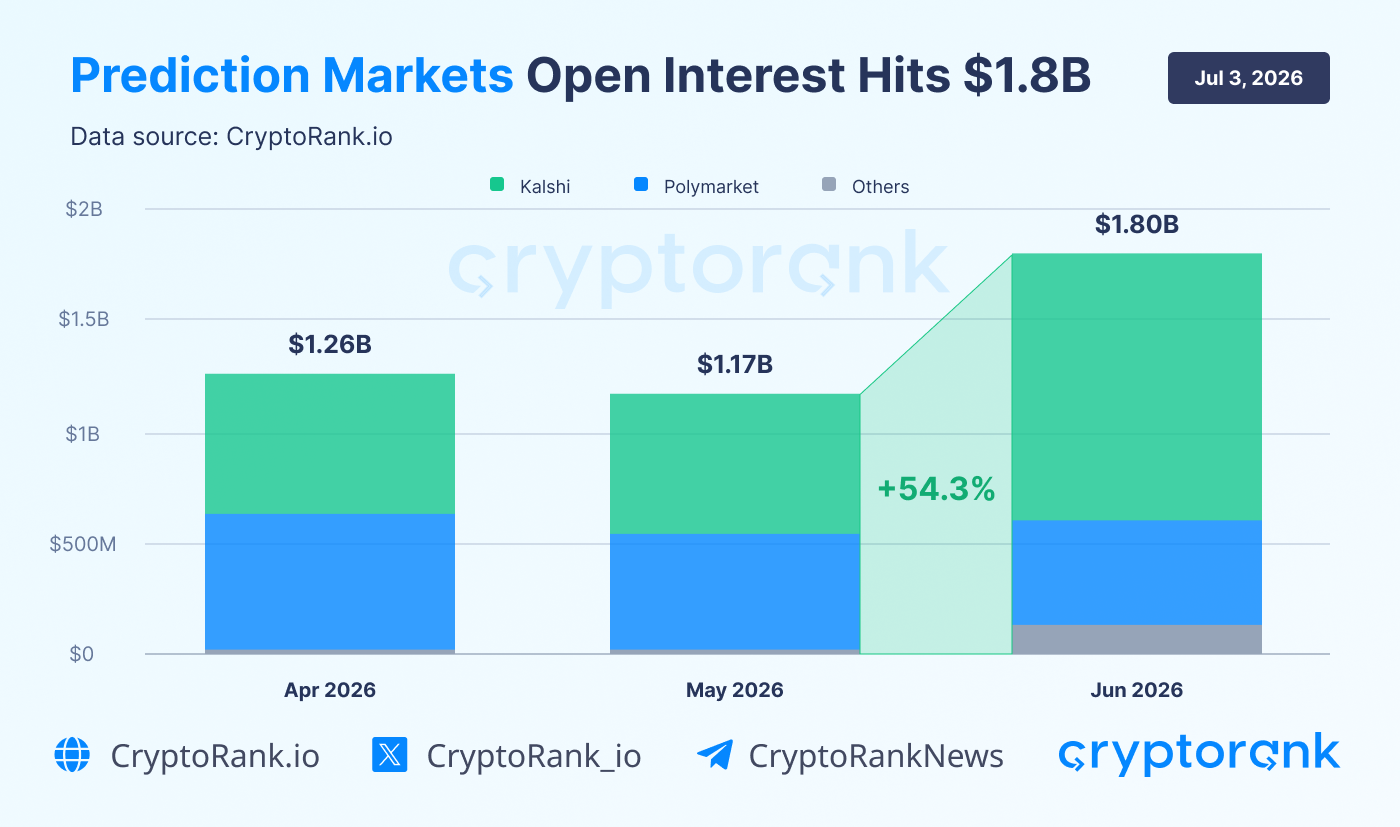
1. Prediction Markets Open Interest Hits $1.8B
By the end of June, total prediction market open interest (OI), which reflects the amount of capital currently committed to prediction market positions, reached $1.8B. This indicator directly reflects the activity on the platforms. OI is up 54% from a month ago, amid the start of the FIFA World Cup.
Source: CryptoRank MCP
The structure of open interest is also important. In June, the market became more diversified:
-
Kalshi now leads in terms of Open Interest, after months of tight rivalry with Polymarket.
-
Polymarket saw a decline in OI, but it still has a huge gap from the top-3 entrants.
-
Others also show significant growth, which means that liquidity is gradually spreading beyond the two leading platforms.
2. Trading Volume Without Sports Markets: Weekly Activity Surges Past $3B
The weekly trading volume shows that even excluding sports events, prediction markets activity has accelerated significantly in June. The latest weekly volume reached $3.1B, with Kalshi reaching $2.6B and Polymarket settling only $492M. The data suggests that Kalshi dominates with over 80% market share.
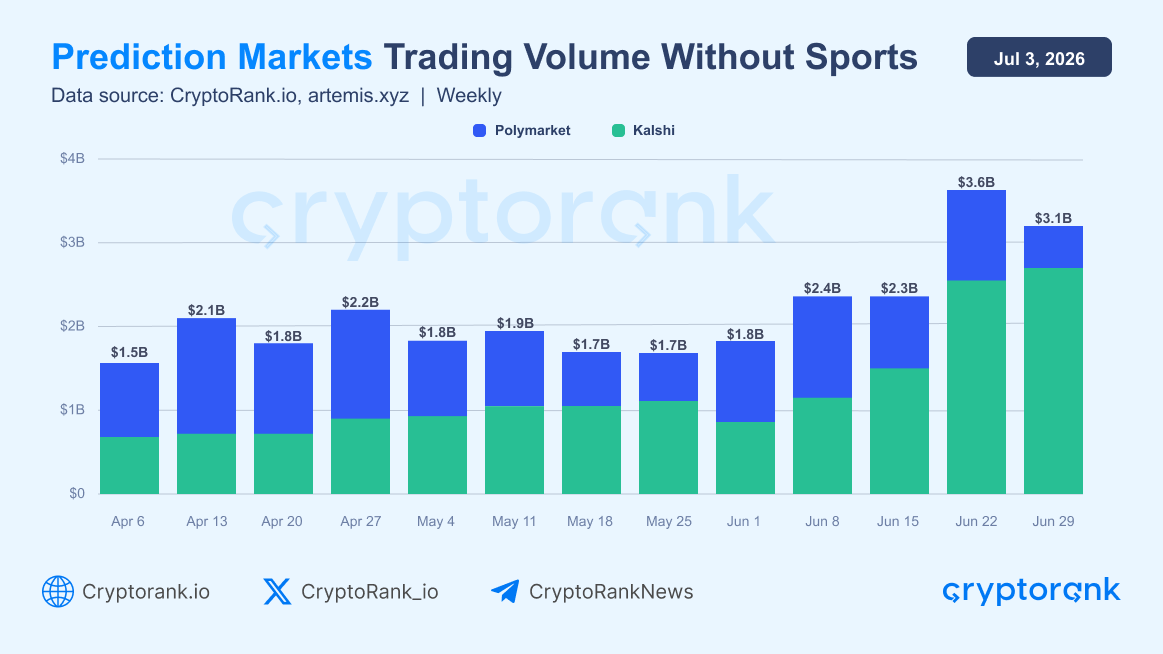
This is one of the strongest signals in our research. Even without sports markets, trading volume is expanding rapidly. That means the growth is not purely dependent on one seasonal activity or a specific category of events.
The growth of trading volume without sports suggests that prediction markets are becoming broader and more resilient. Kalshi is currently leading this expansion in raw volume, while Polymarket remains a major player, but its share is rapidly declining.
3. Open Interest Market Share Without Sports Markets Shows A Balanced Landscape
Unlike trading volume, open interest market share without sports markets looks much more balanced. The latest split between Kalshi and Polymarket is nearly 50/50. However, Kalshi is quickly overtaking the share of Polymarket, gaining 8.5% since the beginning of Q2.
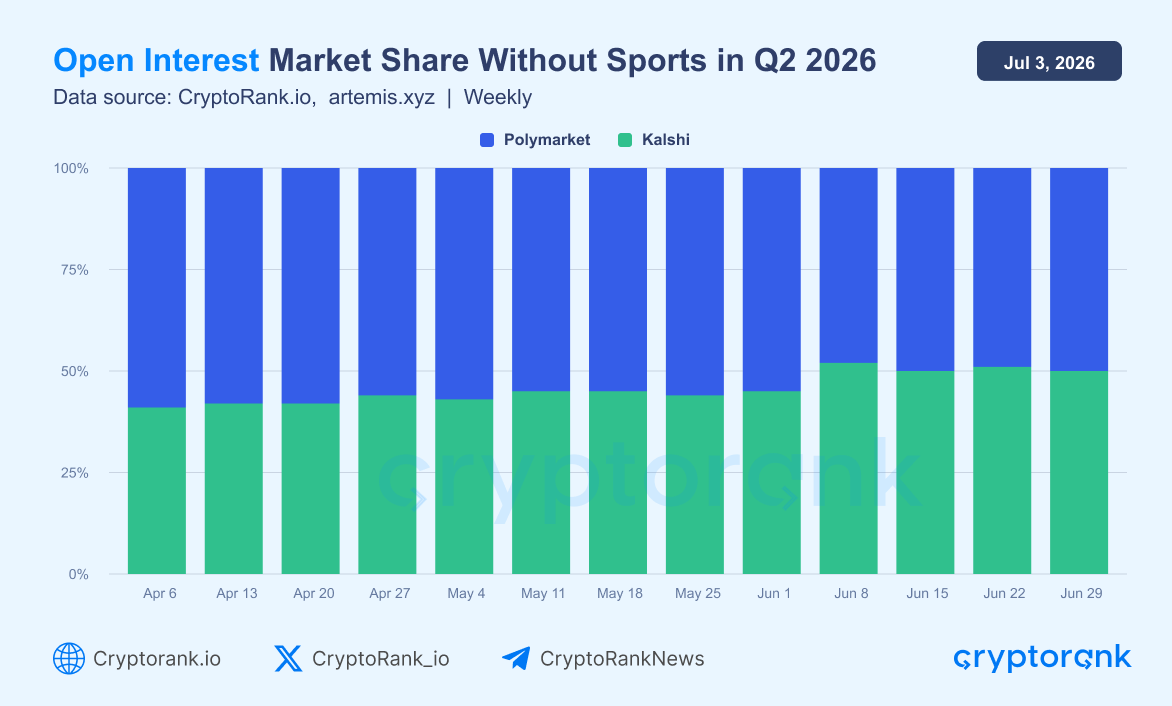
It means that user interest in Kalshi grows much faster, which indicates faster position rotation, shorter-duration markets, and more active speculative flow on its platform. This makes Kalshi’s leadership less about replacing Polymarket outright and more about capturing the highest-velocity part of the prediction market flow.
4. Kalshi Leads In Crypto Prediction Volume Share
A similar situation has arisen in crypto markets. Crypto-related prediction markets show the clearest shift toward Kalshi, overtaking nearly 42% of the market from Polymarket.
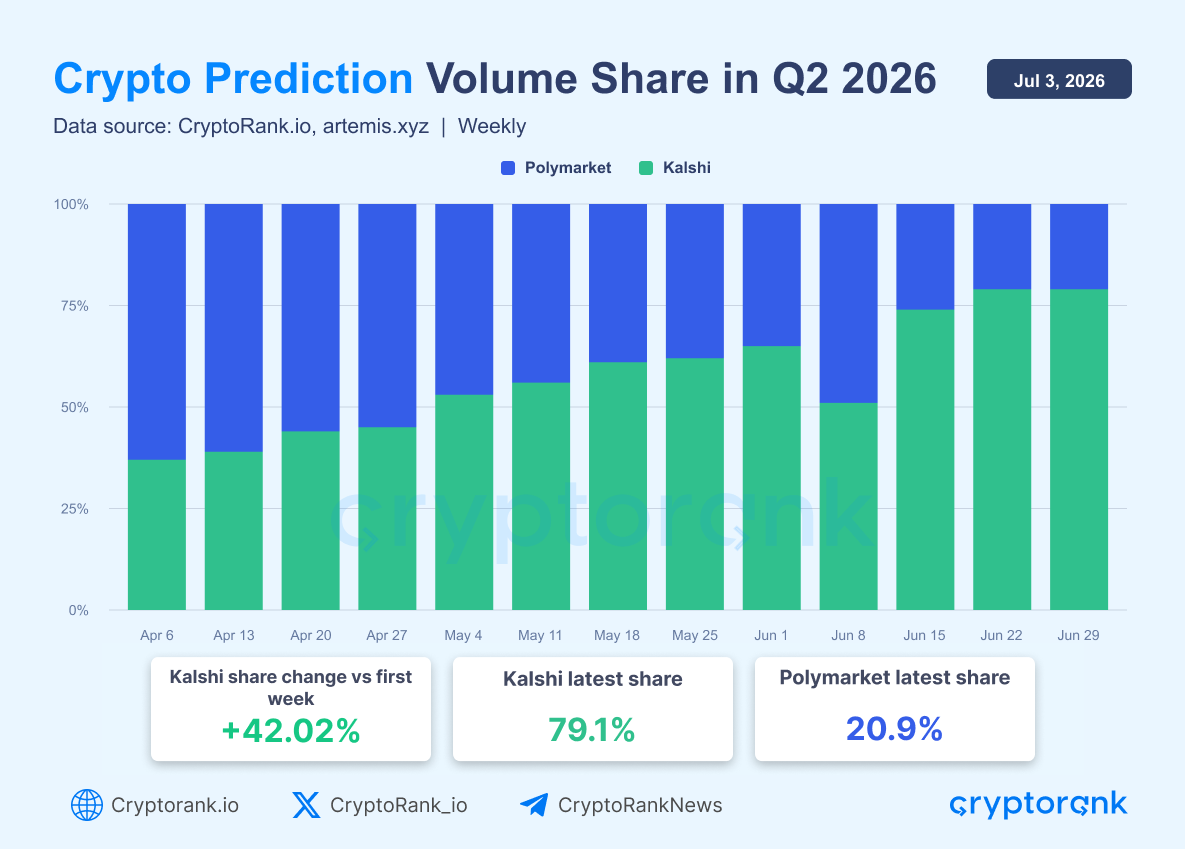
Polymarket may still retain a strong position as the more established crypto-native platform, but Kalshi has become a venue with a higher capital turnover rate. Users open and close positions more frequently, especially in short-duration markets.
5. Politics Markets Is Where Polymarket Remains Dominant
Politics markets remain heavily concentrated on Polymarket. Nearly 96% of all political prediction markets trading in Q2 took place on Polymarket.
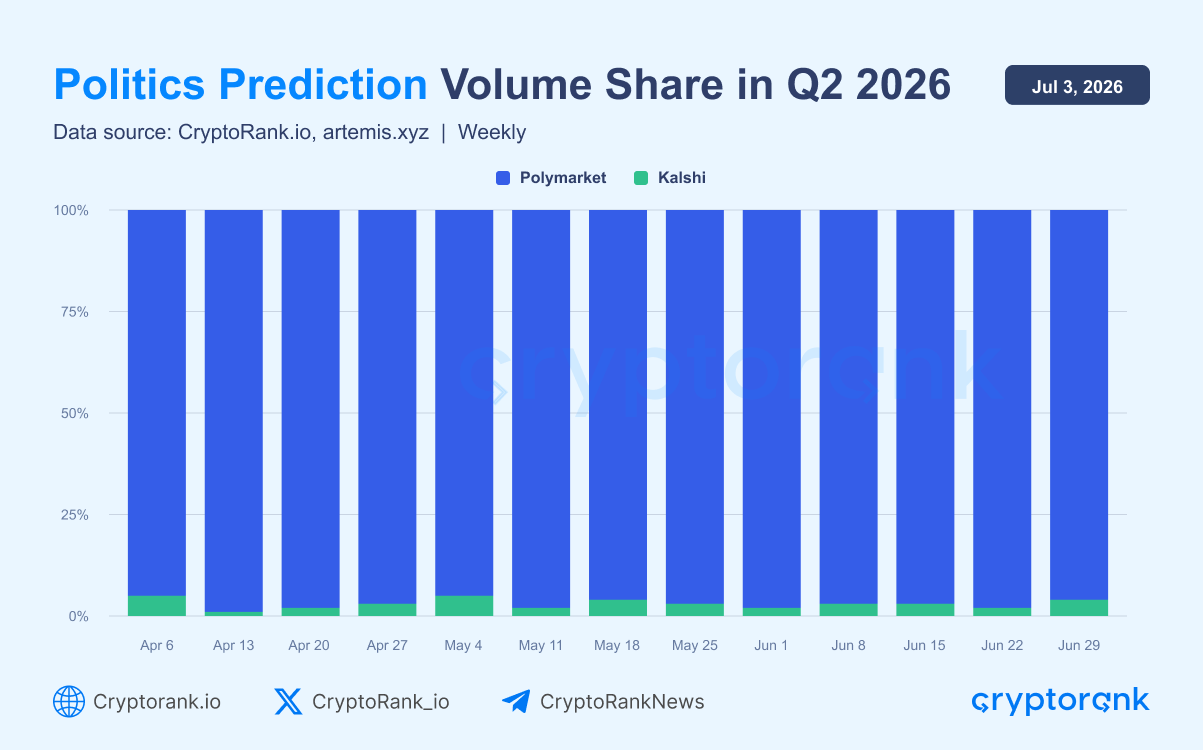
Trading volume in political prediction markets reached $5.7B in Q2 2026, with Polymarket accounting for 97% ($5.5B). However, activity remains below the Q4 2024 peak, when the U.S. presidential election drove politics prediction volume to $7.4B. Compared with that period, overall volume is down 23.0%, while Polymarket’s volume has declined by 11.3% from $6.2B.
6. The FIFA 2026 World Cup Volume by Venue: Sports Becomes a Major Growth Driver
World Cup-related trading volume shows explosive growth across June. Major global sports events can rapidly expand prediction market activity, attracting both casual participants and more active traders. Unlike crypto or politics markets, the World Cup markets volume is more balanced. Kalshi leads with $2.8B volume, but Polymarket maintains the second position with $1.8B.
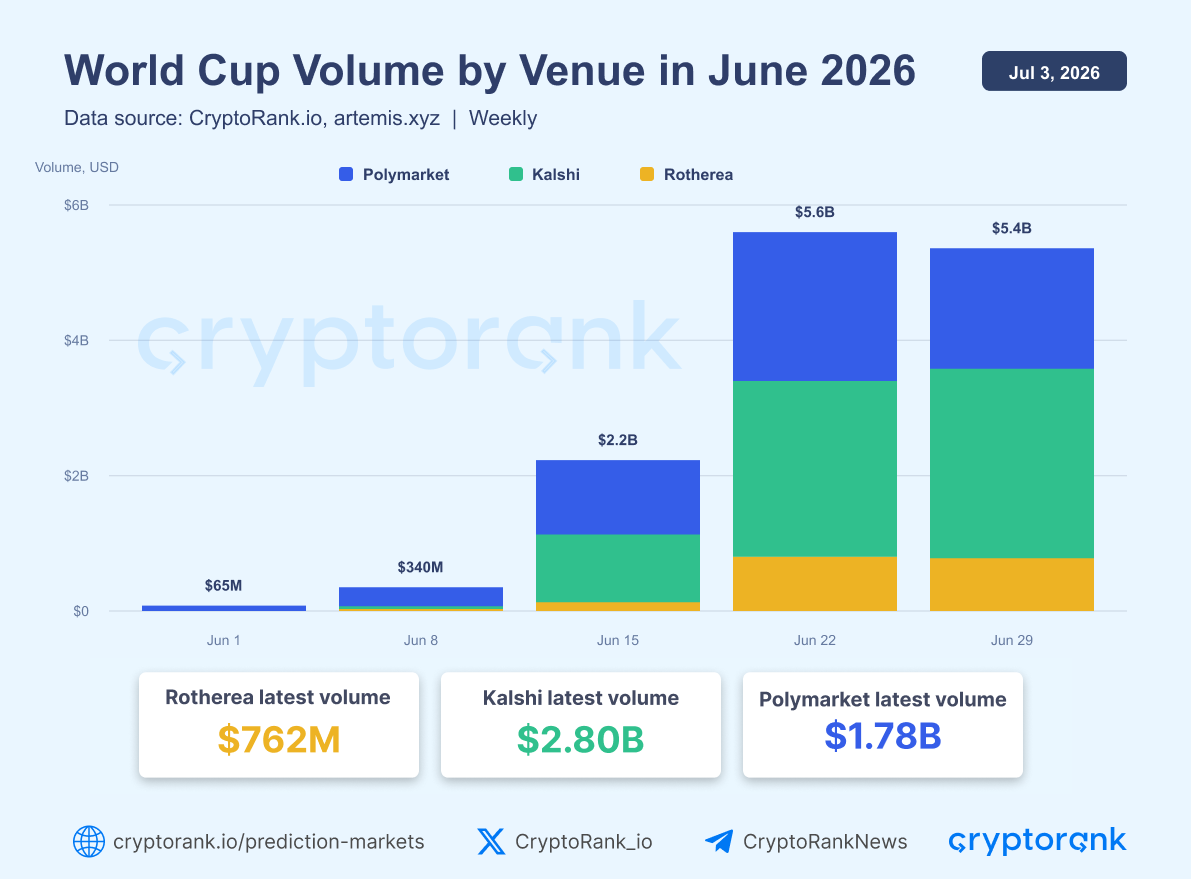
The FIFA 2026 World Cup has become a major catalyst for prediction market growth – since its start, the daily prediction market volume has increased by ~75%. Sports-related event markets can produce large volume spikes and may become one of the most important user acquisition channels for the sector. Previously, the March Madness 2026 championship was sports event in the history of prediction markets with nearly $2.5B in total volume.
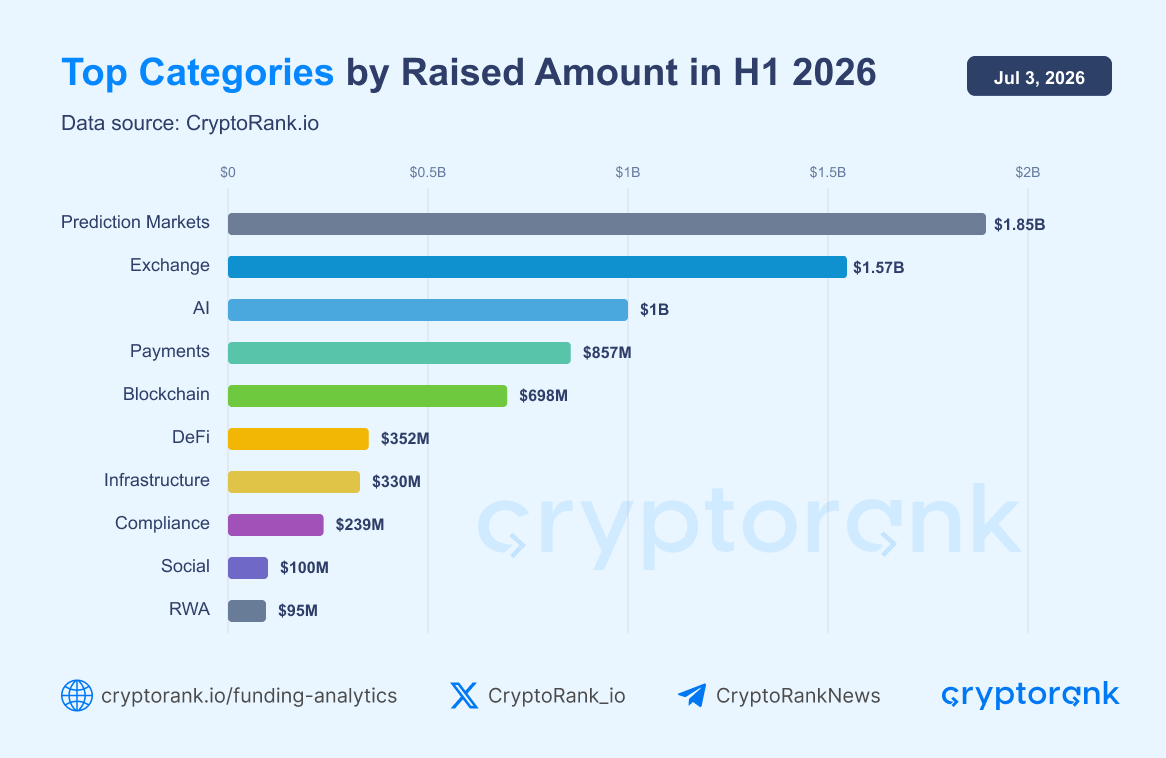
7. Prediction Markets Drew the Most VC Interest in H1 2026
Prediction markets became the top-funded crypto category in H1 2026, highlighting strong investor demand for the sector. In H1 2026, the top 10 crypto funding categories raised a combined $7.1B. Prediction Markets ranked first with $1.85B, ahead of Exchanges with $1.57B and AI with $1.00B.
Source: CryptoRank API
Prediction Markets alone attracted 26% of all capital raised among the leading categories. Investor interest in prediction markets is not limited to user activity or trading volume. Capital allocation is also shifting toward event-based trading platforms, suggesting that investors increasingly view the sector as a major financial infrastructure category rather than a niche betting vertical.
Conclusion
Prediction markets platforms are much less competitive in the same markets now. Q2 2026 showed a clear split by verticals: Kalshi is gaining control of the highest-velocity segments, especially crypto and World Cup-related markets, while Polymarket remains the dominant venue in politics and continues to hold a meaningful share of open interest. This suggests that the sector is becoming more specialized, with leadership determined less by overall brand strength and more by liquidity depth, market type, and user behavior within each category.