
HIP-4: A New Financial Primitive on Hyperliquid
Share:
 CryptoRank
Share:
Key Takeaways
• HIP-4 introduces fully collateralized outcome contracts, allowing event-based markets to settle within a fixed range, typically between 0 and 1.
• Unlike standalone prediction markets such as Polymarket and Kalshi, HIP-4 could make outcome trading native to Hyperliquid’s core trading infrastructure.
• Integration with HyperCore may improve capital efficiency by allowing the same collateral base to support spot, perpetuals, and outcome contracts.
• HIP-4 expands potential use cases beyond prediction markets, including binary options, event hedging, crypto insurance, and macro or geopolitical risk markets.
• If adoption scales, HIP-4 could become a new growth driver for Hyperliquid by increasing trading volume, strengthening $HYPE demand, and enabling a broader ecosystem of event-based financial products.
While Polymarket and Kalshi continue to dominate the prediction markets space, Hyperliquid is preparing to reshape the landscape.
The platform, already leading in perpetuals trading, is rolling out HIP-4, integrating outcome trading directly into the core of HyperCore.
⚙️ What is HIP-4?
HIP-4 introduces fully collateralized outcome contracts — a new class of financial instruments.
These contracts settle within a fixed range at expiration, typically 0 or 1. At first glance, they resemble traditional prediction markets — but the use cases go much further:
• Binary options — simple instruments with fixed outcomes
• Event hedging — protection against specific macro or corporate events
• Limited derivatives without leverage or liquidations — safer tools for conservative users
• Crypto insurance — on-chain insurance-like products
• Macro & geopolitical hedges — hedge global risks or trade on them
This isn’t just another prediction market — it’s an attempt to embed event-based trading directly into Hyperliquid’s trading infrastructure.
🔍 How is it different from Polymarket & Kalshi?
Traditional prediction markets operate in isolation — capital is locked within a single app and doesn’t interact with other instruments.
Hyperliquid changes this model:
• Outcome contracts run in the same environment as spot and perpetuals
• Shared risk engine and portfolio margin system
• One collateral can back multiple positions simultaneously
• No need for separate liquidity pools — capital is reused
As a result, capital becomes more efficient, and the ecosystem scales organically.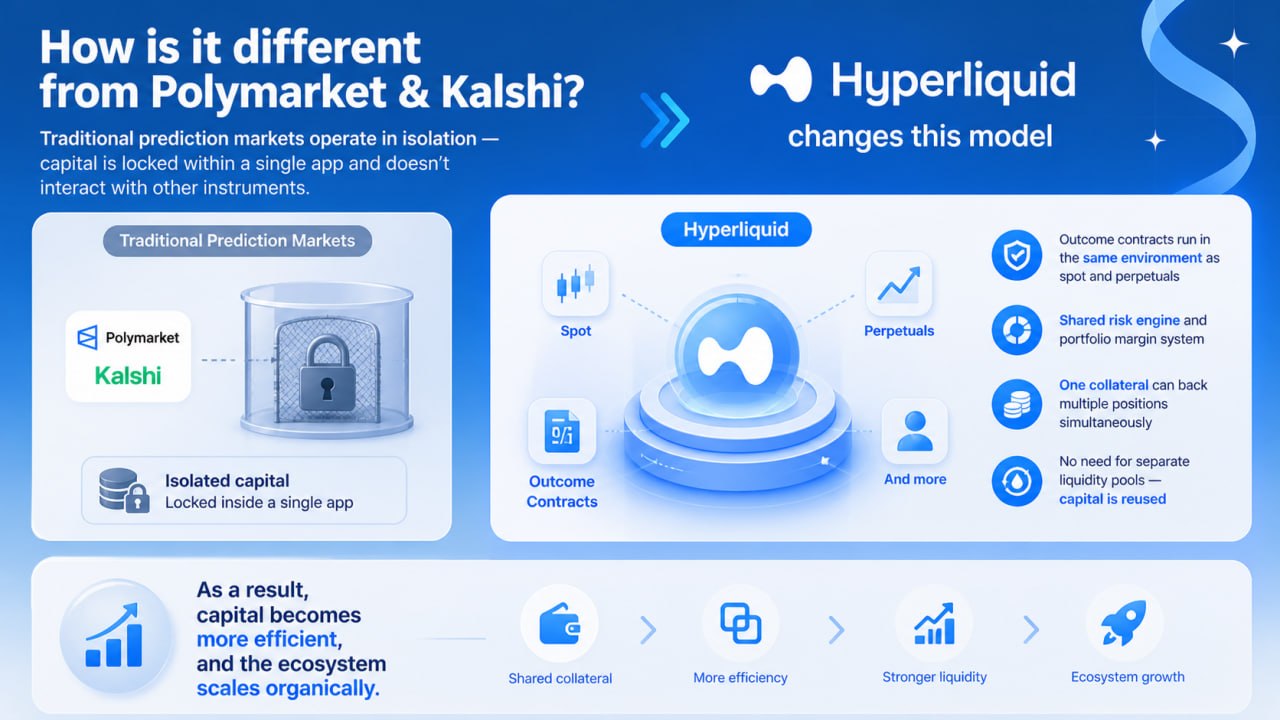
📈 Why this could be a growth driver
The success of HIP-3 already proved the platform’s potential — new markets brought tens of billions in additional trading volume.
Conservative estimates suggest HIP-4 could add $125B+ in annual volume with moderate adoption.
Key growth drivers:
• Tokenomics — launching event markets requires staking 1M $HYPE, with creators earning a share of fees → sustained demand for the token
• Native Markets — better retail integration and accessibility
• Builders Program — incentivizes new products and services around Hyperliquid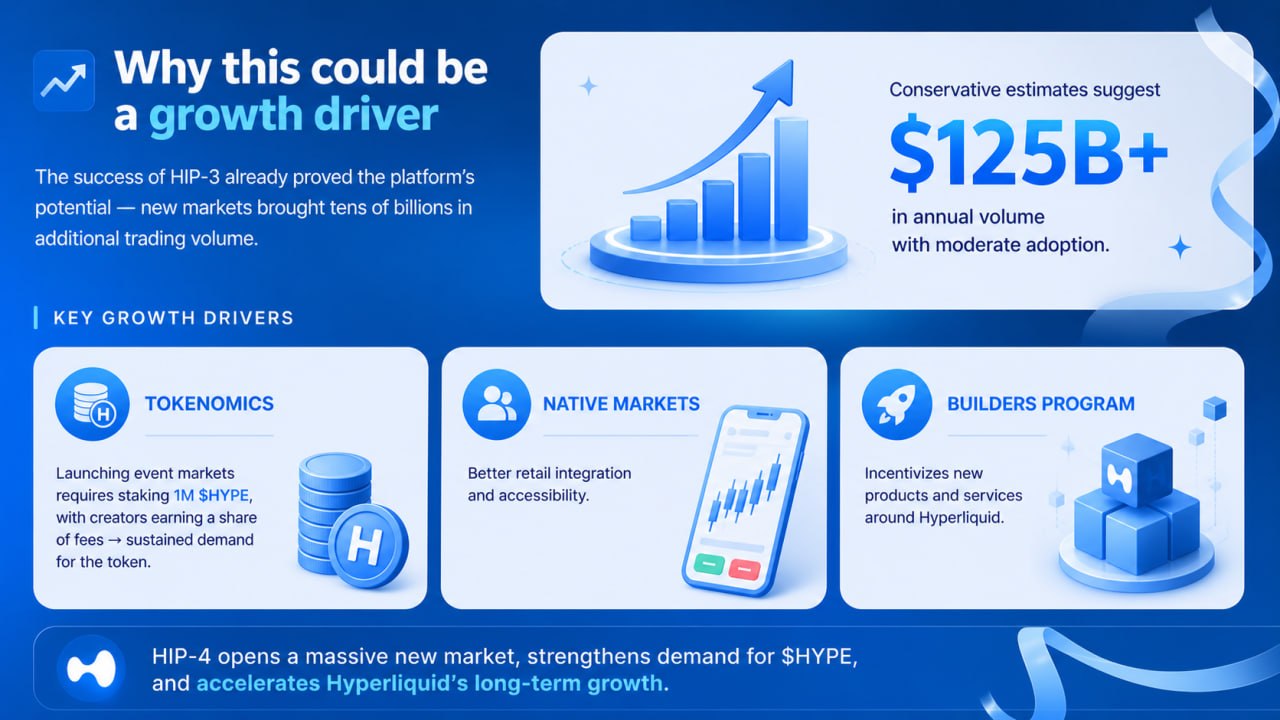
💡 Key Takeaway
Right now, the market views HIP-4 too narrowly — just as another prediction market.
But if outcome trading becomes native to Hyperliquid, this isn’t just a new product — it’s a new financial layer on top of an already active trading system.
HIP-4 could be for Hyperliquid what HIP-3 was for perps — an upgrade first underestimated, then repriced.
This isn’t just an update.
It’s a step toward a more integrated financial ecosystem — and a foundation for a new wave of products.