
Gate’s Expansion Into Global Stock Markets

Share:
 CryptoRank
Share:
Key Takeaways
-
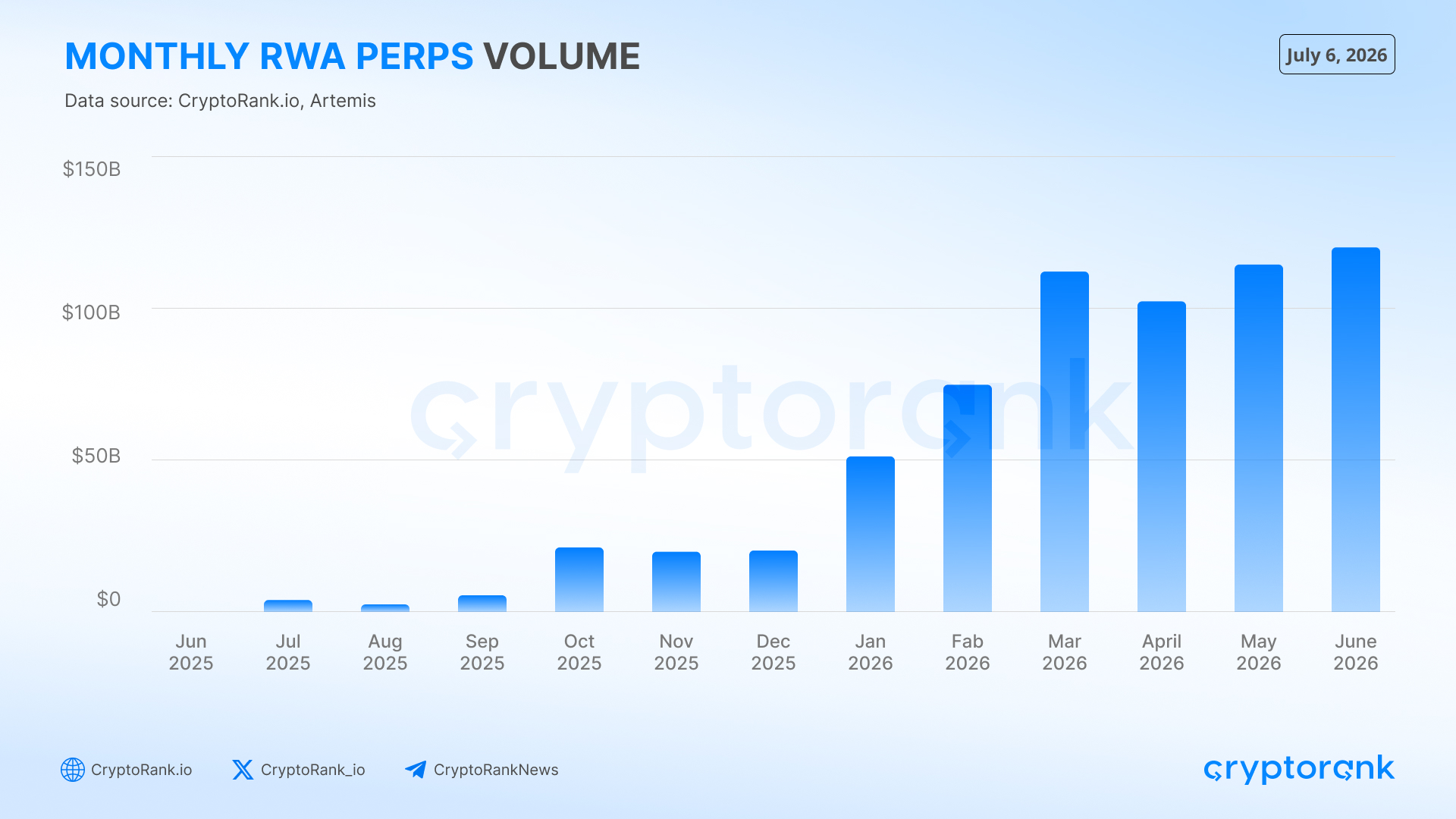
RWA perpetuals volume on crypto exchanges has gone from about 1% to over 33% of total crypto perps volume since the start of the year, reaching more than $120 billion in June 2026, with equities the largest single asset class by open interest.
-
Gate Stocks expands beyond Gate's own CFD and perpetual lines by giving users direct, USDT-funded ownership of more than 10,000 US equities and ETFs through licensed broker Alpaca with SIPC protection.
-
Gate became the first CEX to support direct trading of 1,500+ Hong Kong and 1,000+ Korean stocks, expanding beyond US equities into two key Asian markets that remain difficult for many foreign retail investors to access through one USDT-funded account without manual FX conversions.
-
Gate also launched gStocks, tokenized securities with real stock reserves and 24/7 trading.
Why Crypto Is Becoming a TradFi Trading Venue
The current bear market has hit altcoins particularly hard. Interest in altcoins has declined across the industry because most altcoins failed to rally significantly during the last bull market. Traders looking for volatility have turned elsewhere, while the US stock market has been outperforming crypto, setting a new ATH again and again.
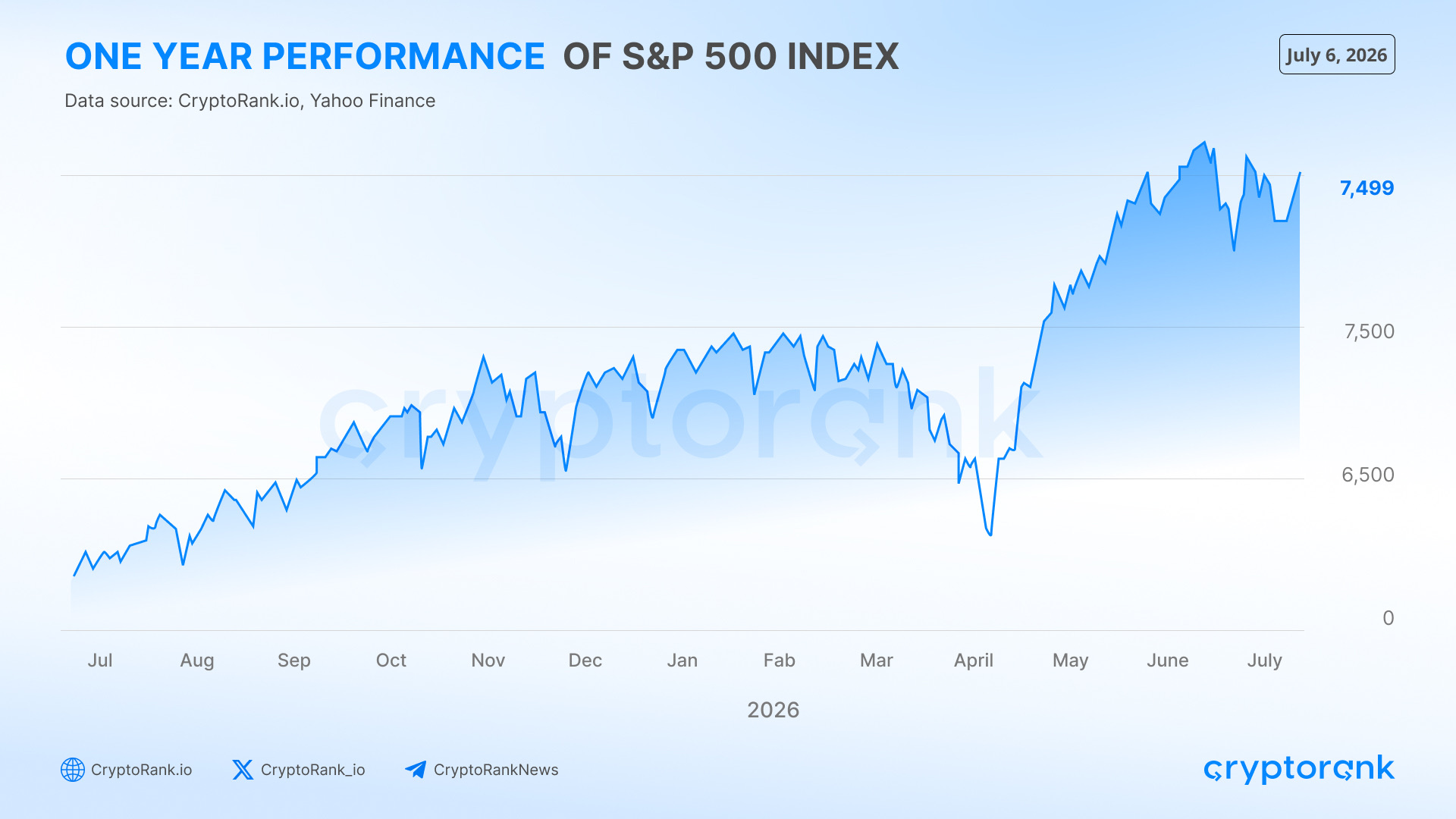
Amid this shift, crypto exchanges have begun offering trading in tokenized real-world assets (RWAs), a new application for infrastructure that was built mainly for spot and derivatives crypto trading. On-chain trading offers continuous access, in some cases 24 hours a day and seven days a week and in others 24 hours across five trading days, along with the market depth and execution speed that both retail and professional traders need.
Perpetual futures on stocks add a further draw, a derivative structure that regulation keeps off traditional stock exchanges entirely. The appetite for the product has been substantial. Since the beginning of the year, the share of total crypto perpetuals volume attributable to RWA perpetuals, an instrument spanning tokenized stocks, commodities, and structured products, has risen from about 1% to more than 25%, and in May it crossed 33%.
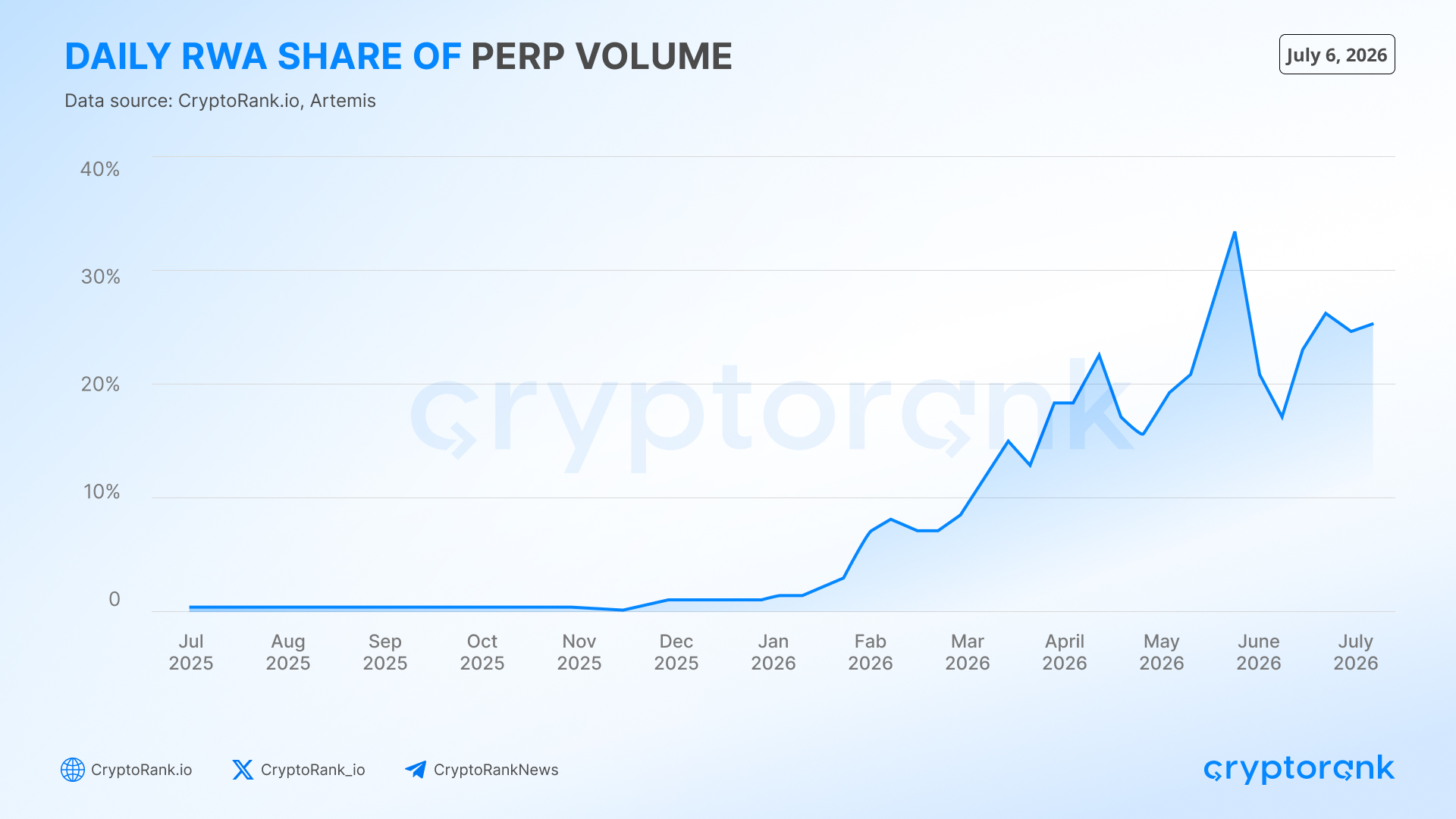 Crypto platforms offer two types of tokenized RWA trading, spot and perpetual. Spot assets are highly composable and can be used off centralized exchanges, in DeFi protocols for example. Perpetual contracts, by contrast, cover a different range of assets and remain tied to the issuing platform, unable to move off-exchange the way spot tokens can. Even so, they are a genuinely novel product: no traditional exchange lists an equivalent, a futures contract on a single stock with no expiration date.
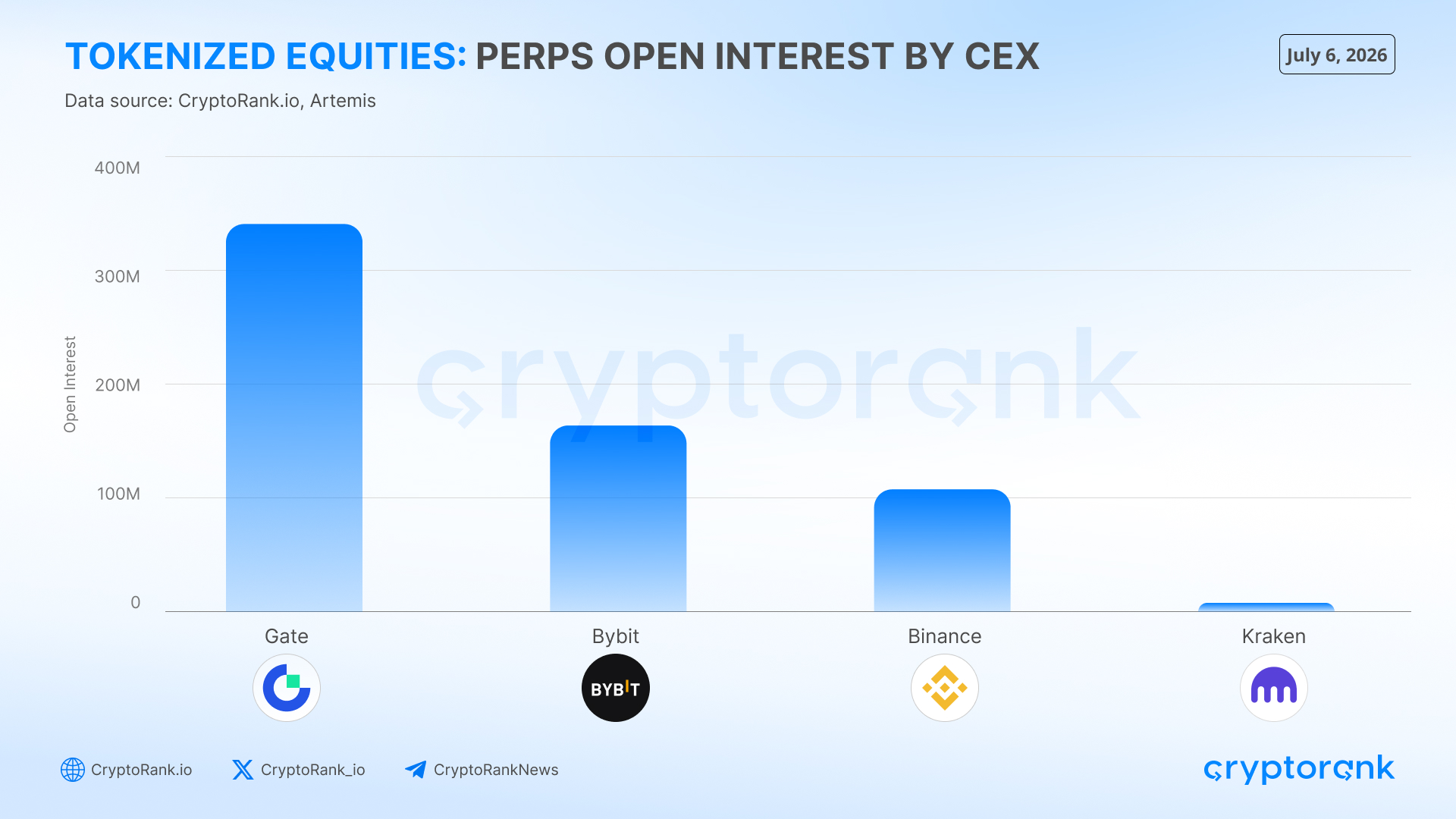
The market for RWA perpetuals is currently concentrated among a handful of leaders. Gate, and Bybit account for most of it, followed by other top-tier centralized exchanges (CEXs). Gate holds the leading position across CEXs with nearly $340 million in OI, almost double Bybit's total. By asset class, equities hold the largest share of open interest, at more than $1.3 billion as of June 2026.
RWA perpetuals volume has risen steadily and now appears to have reached a plateau, with more than $120 billion traded in June 2026.
 In May 2026, Gate recorded nearly $5.1 billion in RWA perpetuals volume, placing it among the five most active platforms by this measure.
Gate’s Expanding TradFi Product Suite
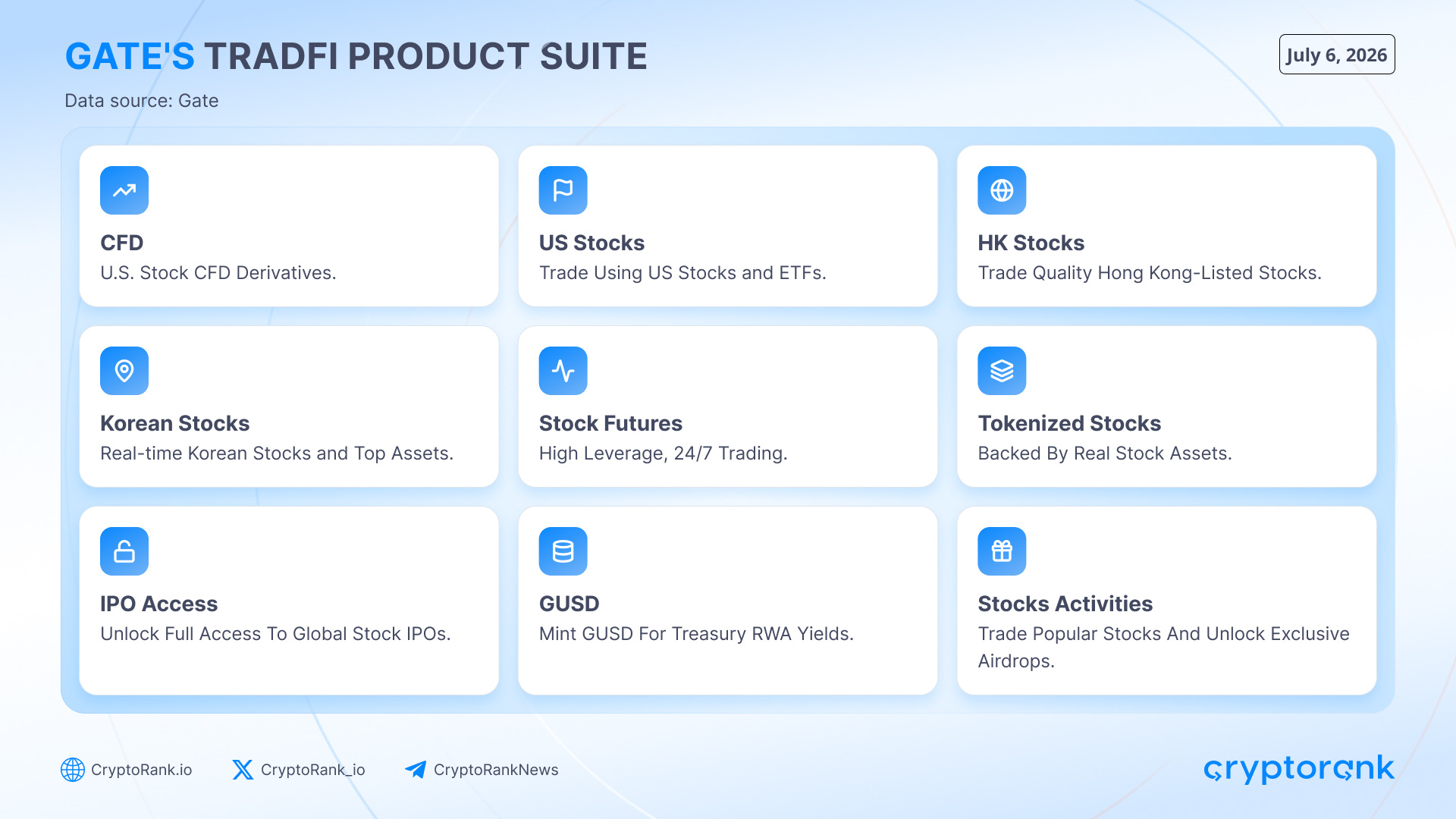
While Gate already holds a strong position in the TradFi perps, their next move went the other direction. On June 1, Gate launched Gate Stocks, giving users direct ownership of US-listed equities and ETFs, funded entirely in USDT. Direct ownership provides investors with stock positions that support dividend and corporate action processing.
On July 3, Gate further diversified its TradFi portfolio by introducing gStocks, tokenized securities with real stock reserves, 24/7 trading, auto-settled dividends, and more. Users now have a full range of TradFi products to choose from in one Gate account.
Table 1: Difference between Gate Stocks and Tokenized Stocks
|
Feature |
gStocks |
Gate Stocks |
|---|---|---|
|
Asset Structure |
Tokens 1:1 backed by real underlying stock reserves |
US stocks accessed through regulated broker Alpaca |
|
Asset Coverage |
Popular assets via order book trading model |
10,000+ stocks and ETFs |
|
Liquidity |
Order book matching, strong liquidity on popular assets |
Direct access to exchange liquidity and NBBO pricing |
|
Holding Costs |
No holding cost; idle assets can earn yield via Simple Earn |
Zero holding cost for spot positions |
|
Dividends |
Automatically settled and credited, no manual claim |
Automatically distributed in stablecoins |
Gate Stocks execution runs through Alpaca, a self-clearing broker-dealer handling order execution, clearing, settlement, and custody, along with dividend distribution and corporate actions. Users fund a stock account with USDT from their existing Gate balance, without opening an external brokerage account.
Coverage spans more than 10,000 stocks and ETFs across the NYSE, Nasdaq, NYSE Arca, NYSE American, and BATS. Fractional purchases start at 0.01 share. Trading is available on both the web platform and the mobile app. Selected assets support 24/7 trading, giving crypto-native users a more flexible experience with always-on markets.
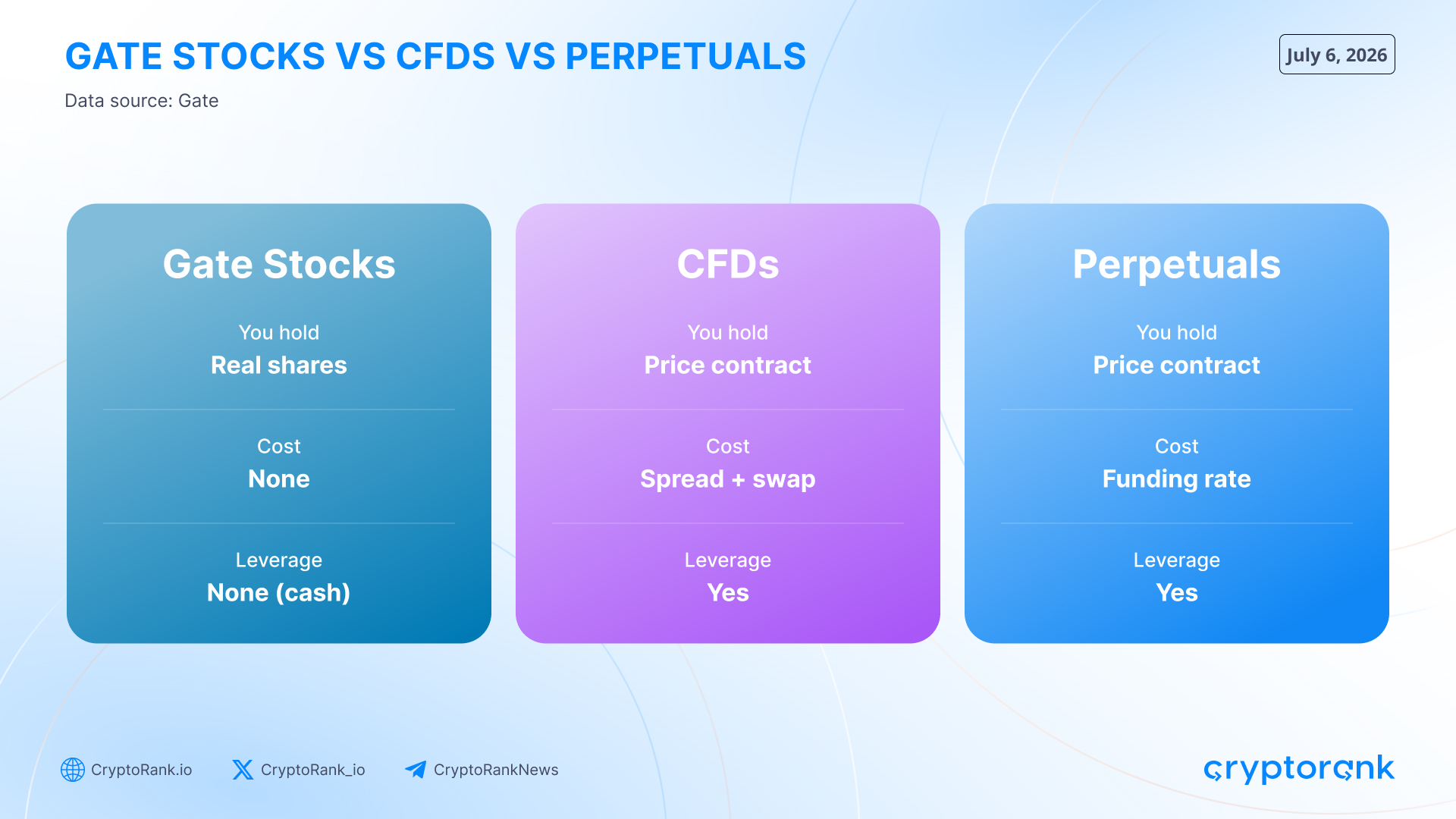
Because Gate Stocks settles in real shares rather than a contract, it carries none of the holding costs built into CFDs (contracts for difference) and perpetuals. While Gate's CFDs charge spreads, commissions, and overnight swap fees, and perpetuals charge a periodic funding rate charge to keep price tethered to spot, Gate Stock charges none. Gate Stocks is also integrated with Gate’s VIP fee system, with stock trading fees as low as 0.023%.
The clearest distinction is what a position actually represents. A CFD or perpetual position is a claim against Gate. A Gate Stocks position is a custodied security, protected through Alpaca's SIPC membership up to $500,000 per account.
Expansion Into Global Equities
Gate Stocks began with direct ownership of US equities. Within weeks, the same custody model extended to two more markets, Hong Kong and then South Korea, becoming the first CEX to support these markets.
 Gate now supports more than 1,500 Hong Kong securities across the Main Board and GEM, including Tencent, HSBC, and Xiaomi. This solves a very notable problem for foreign investors: there are only a few platforms that enable them with access to mainland Chinese equities. International investors hold only around 4% of Chinese stocks, and the alternative route, Qualified Foreign Institutional Investor status, requires years of asset-management experience and a minimum asset scale. Gate's account does not provide direct A-share access, but it does put a slice of mainland China's largest companies inside the same account as a user's crypto holdings.
Addition of Korean stocks followed, covering the top 1,000 KRX-listed companies by market cap across KOSPI and KOSDAQ, such as Samsung Electronics, SK Hynix, and NAVER. Korea has historically been the harder market to enter. A foreign investor registration requirement stood for more than 30 years before Seoul removed it in December 2023. Now, the Korean stock market is also available for Gate Stocks users.
The three markets are not yet on equal footing inside Gate's own product. On July 1, Gate launched a stock transfer service letting users move positions to external brokerages at no charge, settled through the Depository Trust Company for US shares and the Central Clearing and Settlement System for Hong Kong shares. Korean holdings are outside that service. A Gate Stocks position in Samsung Electronics is real ownership, the same claim made in the previous section, but for now it is ownership that stays inside Gate.
The Bottom Line
Gate's recent launches show how crypto infrastructure can strip out some of the friction built into cross-border investing, though not all of it. Direct ownership of US, Hong Kong, and Korean equities inside one account makes Gate one of the clearer examples of a crypto exchange turning into a broader financial platform, even as gaps such as the missing Korean transfer service and Hong Kong's own exclusion show how much of that shift is still unfinished. Altogether, these product updates strengthen Gate’s position in the emerging TradFi assets trading space.