
From Crypto Venues to Multi-Asset Platforms: How Leading CEXs Are Rewriting the Rules of Traditional Finance and Why Gate is Winning

Share:
 CryptoRank
Share:
Key Findings
-
CEXs processed $19.17 trillion in spot crypto volume in 2025 — but global equities traded $155 trillion and forex processes $9.6 trillion per day. The TAM expansion case is structural, not opportunistic.
-
The industry deployed $37 billion in M&A in 2025 to buy TradFi licenses and capabilities. Kraken, Coinbase, and Ripple each made headline acquisitions. Gate took a different path: building natively.
-
Gate has already launched 430+ TradFi CFD instruments, spanning stocks, forex, metals, indices, and commodities. The portfolio is expanding rapidly, with 10 to 20 new assets being onboarded daily, with peak daily volume exceeding $25 billion.
-
As a pioneer among CEXs, Gate operates five TradFi product formats simultaneously under one unified account: CFDs, perpetual futures on traditional assets, tokenized equities, RWA yield products, and pre-IPO allocations
-
Gate holds a No. 1 CEX Transparency ranking in TradFi and Stocks by RootData, backed by independently verified proof-of-reserves since 2020.
Introduction
Crypto exchanges are expanding their ambitions. The platforms that spent the last decade competing on token listings, trading fees, and derivatives depth are now building product stacks that look increasingly like full-service financial institutions, offering CFDs on equities and commodities, tokenized stocks, RWA yield products, and institutional prime brokerage infrastructure alongside their core crypto business.
The timing is not accidental. CEX expansion into traditional finance is driven by a macro environment shift, where institutional adoption of digital assets accelerates, while crypto and TradFi are increasingly merging. At the same time, regulatory frameworks are finally providing the clarity needed to build compliant cross-asset infrastructure.
Institutional capital is reshaping the demand side. US spot crypto ETFs have accumulated over $55 billion in cumulative net inflows since their January 2024 launch, with total AUM surpassing $120 billion.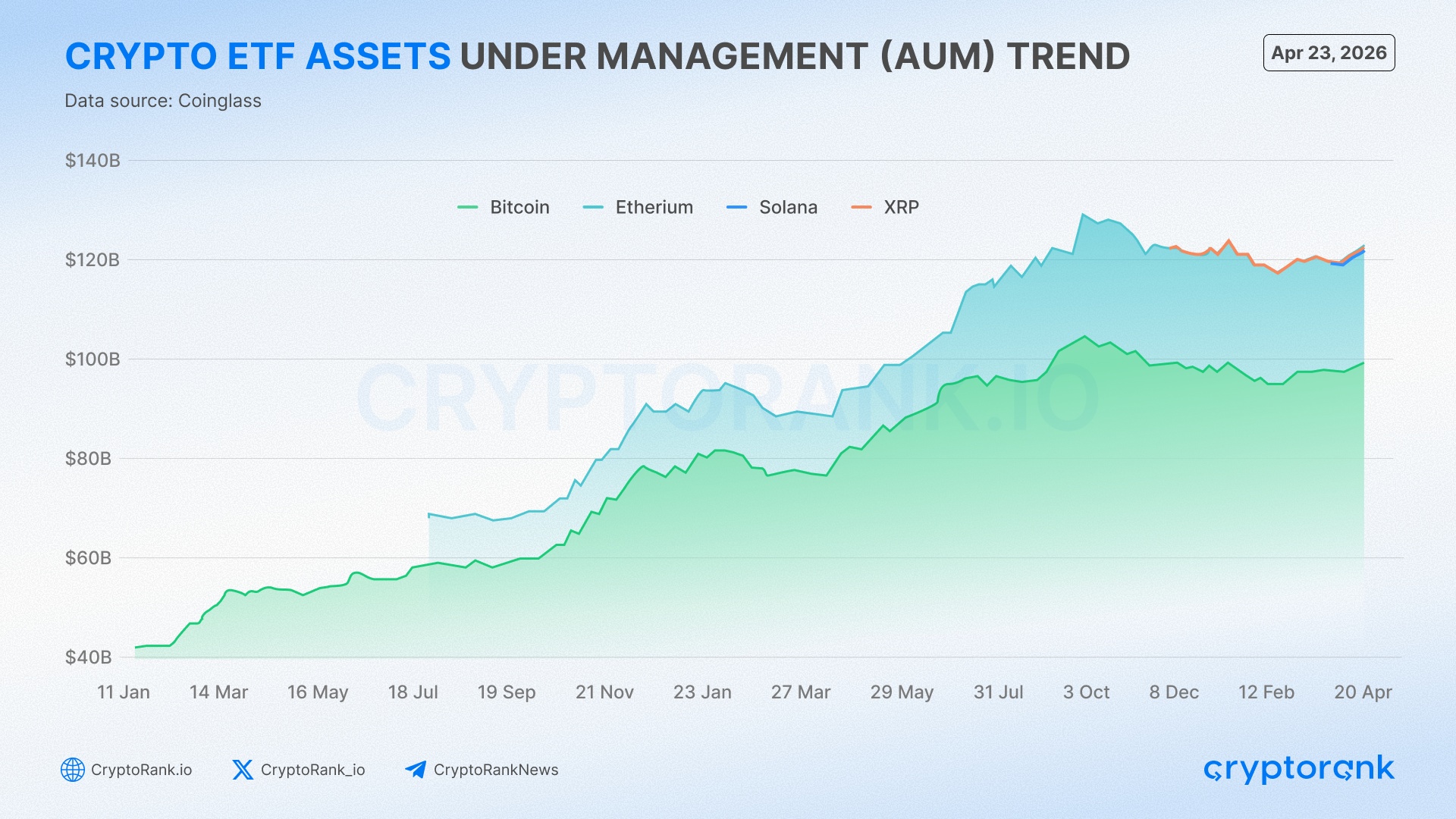
ETFs are bought through traditional brokers, not exchanges, but their scale signals that institutional investors have formally classified crypto as a legitimate asset class. That classification creates demand for the broader infrastructure that comes with it: direct execution, custody, cross-asset margining, and prime brokerage services that traditional brokers do not offer for crypto.
Real-world asset tokenization points in the same direction. The on-chain tokenized real-world asset market reached $30 billion, having grown over 1,000% in three years. Major institutions, including BlackRock, Apollo, Franklin Templeton, and Goldman Sachs, have moved from pilots into production. When the world's largest asset managers commit operational resources to tokenized instruments, they validate the rails exchanges are building on. 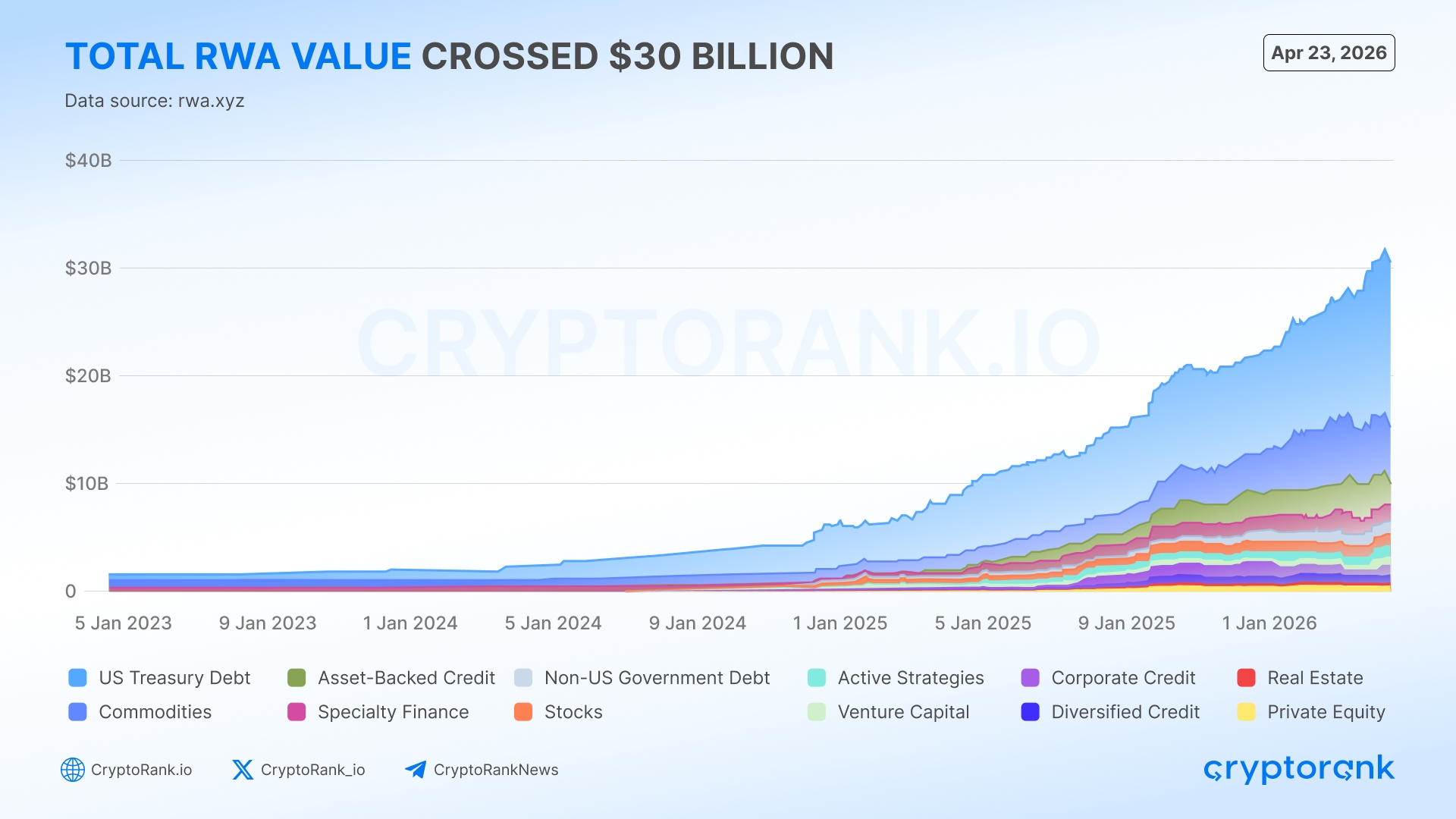
How CEXs Are Entering TradFi: Three Playbooks
Crypto exchanges are pursuing convergence with traditional finance through three distinct strategies, often in combination.
The first is acquisition. Buying a regulated broker or exchange provides an immediate license, a client base, and product capabilities that would take years to build from scratch. The industry moved at scale in 2025, when crypto M&A reached a record $37 billion for the year. Examples include Kraken acquired NinjaTrader for $1.5 billion to get CFTC-licensed futures infrastructure. Coinbase acquired Deribit for $2.9 billion, which added institutional-grade options to the platform. Ripple paid $1.25 billion for Hidden Road to become the first crypto company that owns a global multi-asset prime broker.
The second is tokenized equities. Issuing blockchain-based tokens backed by real shares enables 24/7 trading, fractional ownership, and USDT settlement without fiat conversion or brokerage paperwork. Robinhood launched tokenized US stocks on Arbitrum for EU users in June 2025. Gate, Bybit and Kraken integrated the xStocks framework around the same time, which processed over $10 billion in combined exchange and on-chain volume since launch. Furthermore, Gate was the first exchange globally to pair xStocks spot trading with a perpetual futures market for tokenized stocks, introducing a product category that hadn't previously existed. The combined xStocks framework has processed over $10 billion in exchange and on-chain volume since launch.
The third is native CFD platforms. Rather than acquiring a regulated broker, some exchanges have built CFD trading directly into their product stack, covering forex, indices, commodities, and equities under conventional market session rules, fixed leverage, and overnight financing mechanics. For instance, Gate built its CFD platform natively, integrating it directly into its existing unified account architecture alongside spot, futures, and tokenized assets, enabling seamless cross-asset trading experience for its users.
The CEX TradFi Landscape: Where Everyone Actually Stands
Most exchanges are partial participants. The gap between announced ambitions and operational product depth is significant.
Binance offers perpetual futures on a handful of commodities and indices alongside its crypto derivatives. It does not operate a CFD platform with traditional market session mechanics, and its tokenized equity exposure is limited. Its regulatory posture in major markets remains complex, which constrains its ability to build compliant cross-asset infrastructure in the near term.
Coinbase made the largest single bet on TradFi derivatives infrastructure via the Deribit acquisition, and it operates a regulated broker in the US. Its TradFi product offering remains focused on institutional crypto rather than consumer-facing access to equities, forex, or commodities for its general user base.
Kraken is probably Gate's most direct competitor in breadth of ambition. The NinjaTrader acquisition adds CFTC-licensed futures, and xStocks integration adds tokenized equities. But Kraken does not operate a native CFD platform with the full range of asset classes, and its unified account architecture across crypto, futures, and traditional assets is still in development relative to Gate's current state.
Bybit integrates xStocks for tokenized equities and offers some perpetual futures on traditional assets, but has not launched a CFD platform with comprehensive traditional market coverage. Its TradFi volume numbers are not independently published at comparable granularity.
Gate is operating all five formats — CFDs, perpetual futures on traditional assets, tokenized equities, RWA yield products, and pre-IPO allocations — under a single unified account. That combination is not replicated elsewhere in the industry at comparable scale.
|
Exchange |
Native CFD platform |
Perpetuals on TradFi assets |
Tokenized stocks Provider |
Pre-IPO |
RWA yield |
|
Gate |
MT5, 430+ assets |
FX, metals, indices, commodities, stocks |
Ondo, xStocks |
SpaceX (SPCX) |
BUIDL/USDY-style products |
|
Bybit |
MT5 via Mauritius |
Gold/silver + select equity perps |
xStocks |
No |
Limited |
|
OKX |
No |
20+ equity perps |
xStocks |
No |
Standard Chartered institutional collateral mirroring |
|
Binance |
No |
Gold/silver + TSLAUSDT |
No |
No |
BlackRock BUIDL collateral integration |
Case Study: Gate’s TradFi Architecture in Depth
Gate's TradFi architecture is built around a single principle, using USDT as a universal collateral layer to access both crypto and traditional markets. Instead of requiring bank transfers and separate brokerage accounts, users move funds into a TradFi subaccount where USDT is represented as USDx at a 1:1 ratio. This removes FX conversion costs and reduces funding time from 1-3 days in traditional systems to near-instant transfers inside the platform.
The core product layer is based on CFDs, which provide exposure to real-world prices without ownership of the underlying asset. Through this system, Gate offers trading on forex pairs, global indices such as the S&P 500 and NASDAQ, commodities like gold and crude oil, and a comprehensive selection of US and Hong Kong equities. All contracts are settled in USDx, have no expiration date, and follow traditional market sessions, effectively replicating a standard CFD brokerage model within a crypto-native infrastructure. In terms of scale, Gate has already launched 430+ TradFi CFD instruments, including stocks, forex, metals, indices, and commodities. The portfolio is expanding rapidly, with 10 to 20 new assets being onboarded daily, with peak daily volume exceeding $25 billion.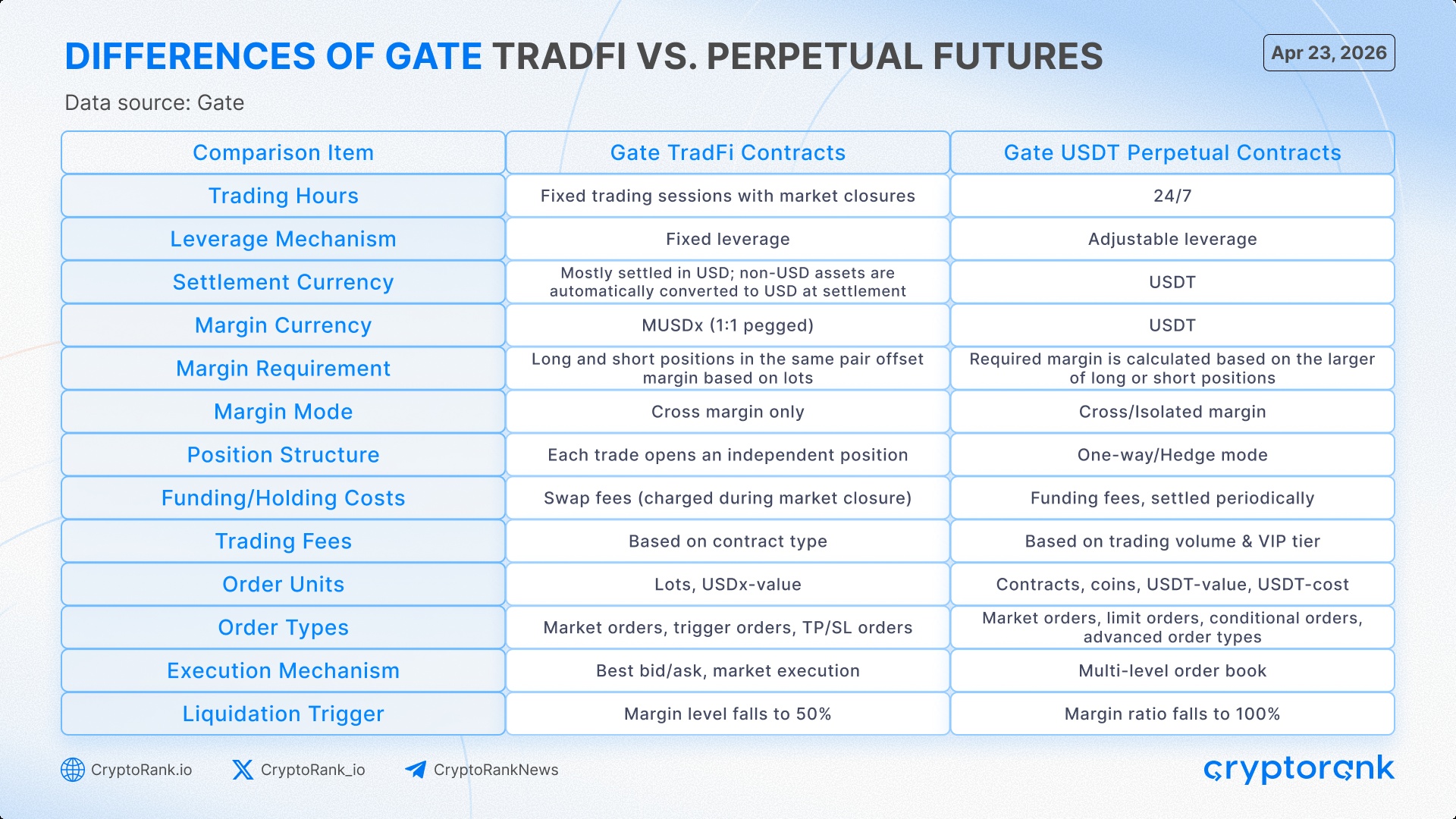
A key structural advantage is that the same underlying asset can be traded through multiple formats. For example, indices and commodities can be accessed via CFDs during market hours or through perpetual futures that operate 24/7, creating parallel liquidity layers. This allows users to switch between traditional execution and continuous trading depending on market conditions, something rarely available in a single platform.
Execution is supported through integration with MetaTrader 5 (MT5), a standard platform serving a multi-trillion dollar market in global FX and CFD trading. The setup reduces reliance on external brokers and aligns the trading experience with established industry infrastructure.
Risk management follows a more traditional framework, with fixed leverage, isolated positions, and liquidation triggered when margin levels fall below 50%. Costs include spreads, commissions, and overnight swap fees, rather than crypto-style funding rates.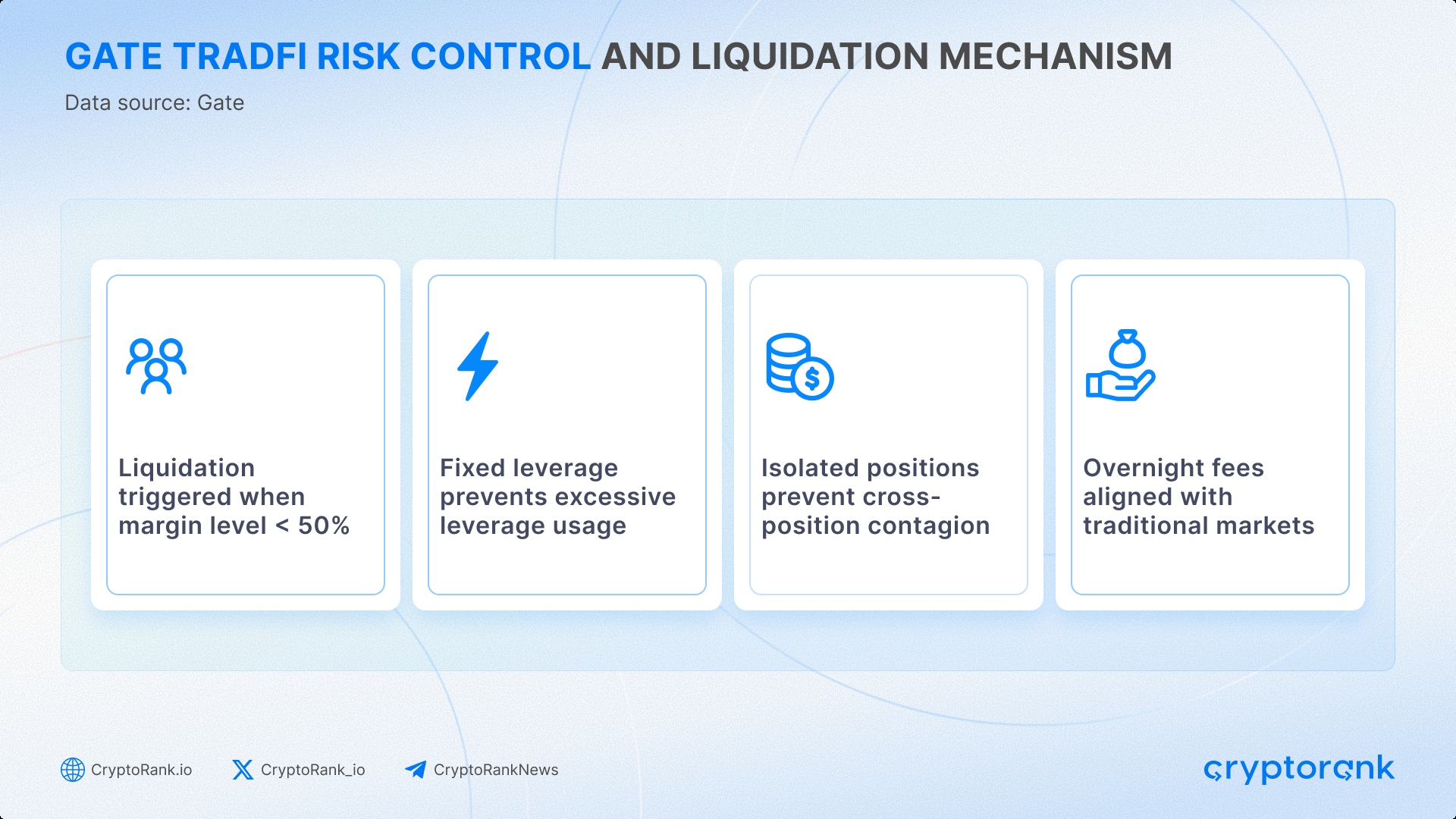
Beyond CFDs, Gate is expanding into tokenized equities and real-world asset products, with 250+ tokenized stocks already available. This creates multiple exposure layers per asset, tokenized instruments, derivatives, and yield products, all using the same USDT-based collateral. Gate also launched a pre-IPO reservation system, which allows users to subscribe to pre-public equity allocations using USDT or GUSD.
Regulatory Depth as a Moat
Regulatory infrastructure is where most crypto exchanges stop short. Licenses are expensive, slow to obtain, and operationally demanding. For a platform targeting institutional TradFi business, however, they are not optional. Gate has been built systematically toward that bar, and now its licensing footprint now spans 81+ jurisdictions.
Recently, Gate was ranked 1st in the Crypto Exchange Transparency (Stock Category) rating by RootData. The widest set of licenses and strong support by notable market makers and custodians enable trust, which results in the highest trading volume across peers.
The Bottom Line
The question for crypto exchanges is no longer whether to expand into traditional finance. The institutional capital has arrived, the regulatory frameworks are clarifying, and product demand for cross-asset trading, tokenized equities, and CFD access within a single platform is measurable in trading volume rather than projected in analyst forecasts.
Gate's position entering 2026 is that it has pursued this transition more broadly than most: a five-format TradFi product stack, and a compliance footprint spanning 81+ jurisdictions with reserves independently verified since 2020.
Whether that combination proves sufficient to compete with established TradFi brokers on their own ground is the open question the next several years will answer. What is already clear is the direction of travel.