
The Other Side of Crypto Business: Analysis of Project Fails and Shutdowns

Share:
 CryptoRank
Share:
2022: The Domino Effect

It all started in early May, when UST lost its dollar peg and LUNA became virtually worthless. Within days, the Terra ecosystem erased roughly $40B in market value, turning a tokenomics failure into the first systemic shock of the cycle.
The next domino was Three Arrows Capital. The fund, which managed up to $10B in crypto assets, was heavily overleveraged and suffered major losses after Terra’s collapse. On June 27, Voyager declared 3AC in default on a loan worth more than $650M, while total creditor claims against the fund were later estimated at around $3.5B.The crisis then spread to centralized lenders. The collapse reached its peak with FTX. Customers attempted to withdraw around $6B in 72 hours, and on November 11, FTX, Alameda Research, and affiliated entities filed for bankruptcy. Just 17 days later, BlockFi followed after relying on a $400M FTX credit facility and lending FTX $275M. The events of 2022 were therefore not isolated failures, but a chain reaction of leverage, unsecured lending, and interconnected balance sheets.
2023–2024: The Aftermath of the Previous Cycle

One of the largest bankruptcies was Genesis Global Holdco. Following the collapse of FTX, the Genesis lending division suspended withdrawals on November 16, 2022, and filed for bankruptcy protection in January 2023. At the time of the filing, the company owed at least $3.4B, while claims from its 50 largest creditors alone exceeded $3.5B. Losses from Three Arrows Capital had already weakened Genesis, and after FTX failed, Gemini Earn users lost access to roughly $940M in assets.
Silvergate Bank demonstrated how quickly the crisis could spread beyond the crypto market itself. During the fourth quarter of 2022, deposits from digital-asset clients declined from $11.9B to $3.8B, a fall of almost 68% in just three months. To meet withdrawal requests, Silvergate was forced to sell $5.2B in debt securities, realizing a $718M loss. The company’s net loss for the full year reached $949M, after which the bank announced a voluntary liquidation in March 2023.
Gradually, the domino effect gave way to a slower and more selective process of gradual reduction. Companies were increasingly shutting down not because of one sudden counterparty failure, but because of a combination of weak demand, regulatory risks, limited revenue, and an inability to fund an unprofitable business model indefinitely.
2025–2026: The Era of Hacks

By 2025–2026, the crypto market was no longer experiencing a single systemic collapse. Instead of one dramatic catastrophe, the industry faced a continuous stream of shutdowns caused by a large number of exploits and an inability to withstand competition.
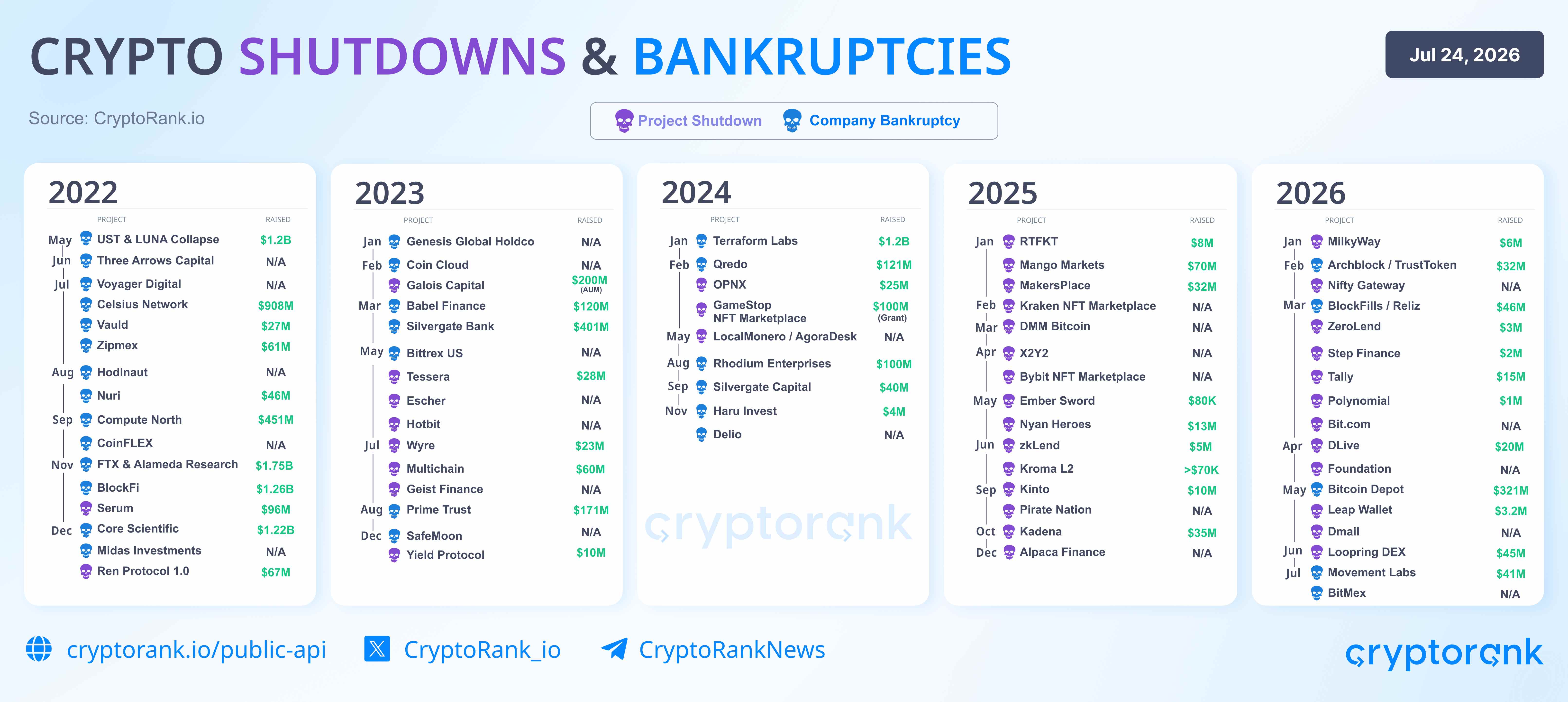
Built with CryptoRank API
In the summer of 2025, the lending protocol zkLend announced its closure. In February, it had suffered an attack that resulted in the loss of approximately $9.6M in user funds. A similar chain of events led to the shutdown of the Ethereum L2 Kinto. In July 2025, an attacker drained 577 ETH, valued at approximately $2M at the time. Following the exploit, the token lost more than 80% of its value, while the team was unable to secure funding to restore the network.
The shutdown of Alpaca Finance demonstrated that a project could cease operations even without a major exploit. At the height of leveraged yield farming, the protocol held more than $900M in TVL. By May 2025, however, that figure had fallen to approximately $54.6M, a decline of almost 94%.
The liquid staking protocol MilkyWay, launched in December 2023, raised $6M in funding. However, by the time operations were wound down, the project’s tracked TVL stood at only around $2.6M. MilkyWay attempted to expand beyond Celestia by adding support for Initia, Babylon, and its own L1 infrastructure, but its expenses grew faster than its user base.
In February 2026, the multichain lending protocol ZeroLend announced that it would shut down. The team explicitly described its economics as unsustainable, as both users and liquidity continued to decline across supported networks such as Manta, Zircuit, and X Layer.
For Step Finance, the decisive blow was a direct financial loss. At the end of January 2026, approximately 262K SOL was stolen from the project’s treasury. In February, Step Finance announced an immediate shutdown.
One of the most illustrative bankruptcies was Movement Labs. The project had raised at least $41.4M, yet in July 2026 the company filed for Chapter 11 protection with only $100K–$500K in assets and liabilities exceeding $1M. The crisis began with a market-maker agreement that allowed one party to rapidly sell 66M MOVE shortly after the token’s launch. The sales triggered a price decline, investigations, the suspension of the market maker by Binance, and a subsequent token buyback.
Finally, in July 2026, BitMEX announced its closure. One of the oldest crypto derivatives exchanges, BitMEX had once helped popularize highly leveraged perpetual futures. The platform will cease operations on September 23 after more than 11 years in business. BitMEX did not report bankruptcy or a shortfall in customer assets, describing the decision instead as the result of a strategic review.
From a Liquidity Crisis to a Crisis of Demand
In 2022, crypto companies collapsed because of leverage and interconnected balance sheets. In 2023–2024, the market uncovered accumulated deficits and dealt with the consequences of previous bankruptcies. By 2025–2026, the main risk was no longer debt itself, but the absence of a sustainable business model.
Capital helped teams build products and postpone difficult decisions, but it could not replace users, fees, and organic demand indefinitely. That is why the crisis of 2025–2026 was less dramatic than the collapse of FTX, yet more unforgiving: projects did not disappear in a single day, but gradually shut down as expenses continued to rise while meaningful revenue never materialized.