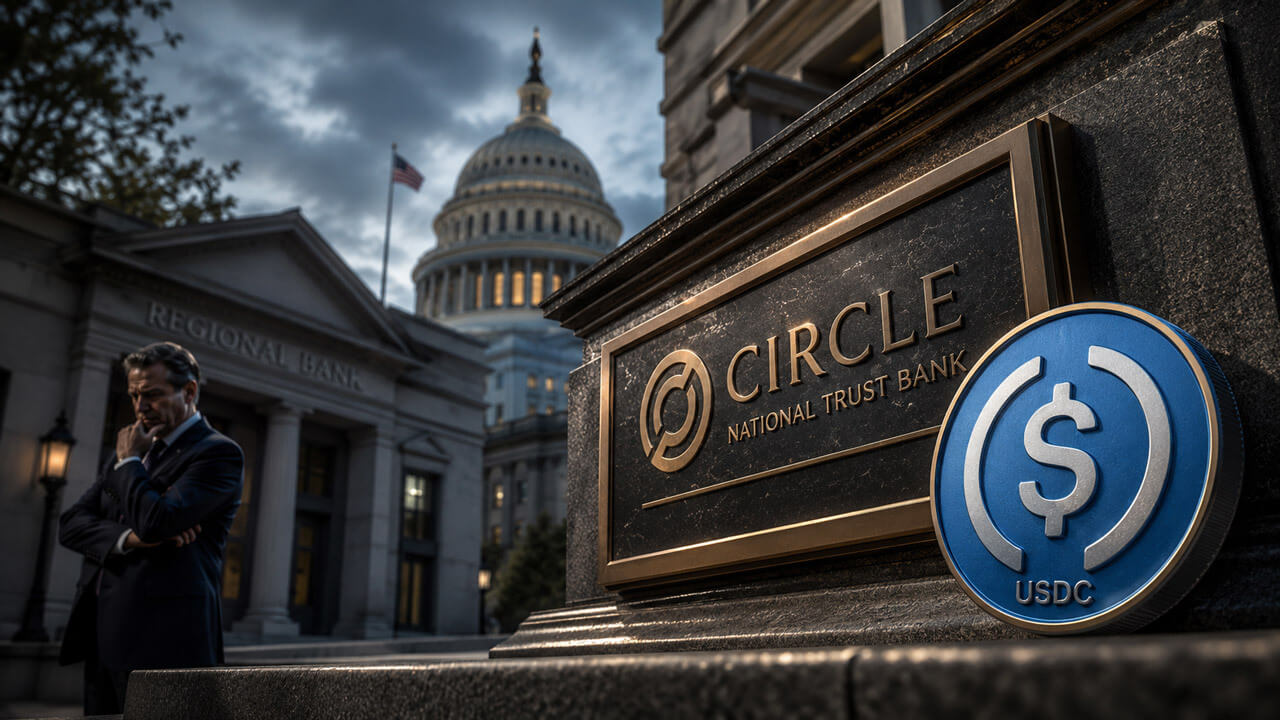
Circle President Defends USDC Moat as Stock Crumbles From $260 to $62

Поделиться:
Рынки предсказаний
Что в фокусе у трейдеров?

Circle’s stock price has become a pressure gauge for the company’s claim that regulated stablecoins can build durable moats. A 76% drop from $260 to $62 doesn’t usually align with the narrative of a dominant infrastructure play, and Circle President Heath Tarbert had to address that directly during a July 14 interview with FOX Business, as detailed in the original report.
Tarbert’s message was a long-game thesis: Circle is building what he calls full-stack internet platform infrastructure, and the stock will eventually reflect that. The timing matters because Circle is arguing this just as the Open USD consortium—a 140-member group featuring Visa, Stripe, Mastercard, and Google—formalizes a competing vision for stablecoin issuance. The consortium promises interoperability and broad distribution through existing payment rails, challenging Circle’s position as the regulated stablecoin standard.
What $73 Billion and 34 Chains Really Mean
Tarbert pointed to two numbers that Circle believes are extremely difficult for any consortium to replicate quickly. USDC has $73 billion in circulation and native support on 34 Layer-1 and Layer-2 blockchains. That breadth of chain support is not a minor integration detail; it means USDC is already embedded in the developer workflows and liquidity routing for DeFi protocols across ecosystems, as shown by recent blockchain developer activity rankings that put Ethereum, Solana, and Polygon among the most active environments—all chains where USDC functions natively.
Native deployment matters because cross-chain bridges introduce latency and security vulnerabilities. A consortium that launches a stablecoin on a handful of chains later this year might find that liquidity and developer tooling have already clustered around USDC. Tarbert’s network effects argument leans heavily on the idea that minting another dollar token is easy, but persuading every lending protocol, DEX, and yield aggregator to re-plumb their infrastructure around a new asset is an entirely different problem.
The Tether Shadow and the Regulatory Edge
Circle’s competitive positioning isn’t only about Open USD. Tether remains the largest stablecoin by market cap, operating with a much lighter regulatory footprint. Tarbert drew a deliberate line: USDC is the largest regulated stablecoin and holds the highest actual transaction volume. That framing matters because transaction volume—not just issuance—is what generates fee revenue and signals real usage rather than parked capital.
The regulatory dimension complicates the consortium picture as well. Washington’s stablecoin legislation remains in flux, with major crypto bills facing last-minute banking opposition that could reshape who gets to issue dollar tokens. A framework that enforces strict reserve and redemption requirements benefits Circle because it is already operating under those constraints with USDC. The consortium players, many of which have not yet publicly detailed their reserve structures, may have to adapt quickly if the legislative environment tightens.
What remains uncertain is whether the market will reward Circle’s patience. The stock’s collapse suggests investors are pricing in the possibility that a payments-industry consortium backed by Visa and Mastercard can erode USDC’s share faster than Tarbert’s network effects can defend it. The consortium’s distribution advantage—direct access to merchants and card networks—is not imaginary, but stablecoin adoption to date has been driven by DeFi capital, not retail payments. If the market shifts toward consumer and merchant settlement, that advantage could become more threatening.
What the Stock Tells You That Press Statements Don’t
Tarbert’s answer was structurally sound for a long-duration asset story: the fundamentals are in place, the moat is real, and the stock price will catch up. But a 76% drawdown also signals that public markets see a path where Circle’s regulated status becomes less of a differentiator and more of a cost center. The stablecoin sector is moving toward tokenized treasury products and real-world asset integrations, as seen in the broader drive to put $20 billion of real-world assets on-chain, and that shift could create demand for multiple compliant stablecoins rather than a single winner.
The next few months will test whether Circle’s infrastructure-first approach can withstand a payments-industry offensive while Washington sorts out the legislative framework. For traders and market participants watching the stablecoin wars, the gap between Circle’s $73 billion circulation figure and its $62 stock price is the only number that currently speaks without a corporate filter.
В этой новости
Монеты

$ 1.90K
+2.00%
$ 0.99916
-0.01%
$ 0.99980
0%
$ 77.56
+2.57%
$ 0.00406
-0.51%


Рынки предсказаний
Что в фокусе у трейдеров?
Поделиться:
В этой новости
Монеты
$ 1.90K
+2.00%$ 0.99916
-0.01%$ 0.99980
0%$ 77.56
+2.57%$ 0.00406
-0.51%Рынки предсказаний
Что в фокусе у трейдеров?
Поделиться:
Читать больше
Tether’s US Exchange Access at Risk: GENIUS Act Sets 2028 Deadline for Stablecoin Compliance