Smart AI deposits could soon force banks to raise loan rates for everyday borrowers

Поделиться:
A Dallas Fed analysis published Aug. 25 warns AI-directed, programmable bank accounts and tokenized deposits could enable instant fund migration and weaken the implicit long-duration funding that supports bank lending. Using July 15 bank balance sheets the model estimates about $7.03 trillion of asset-side interest-rate exposure in 10-year equivalents, with $5.84 trillion backed by deposit characteristics, and finds a 10% rise in deposit rate sensitivity (assuming a four-year weighted average life) would cut duration-risk appetite by roughly $700 billion. The report notes The Clearing House’s June 2026 push for 24/7 tokenized commercial-bank money may accelerate crypto adoption and tokenized deposits, forcing banks to issue more term debt or raise loan rates and reducing maturity transformation capacity.
Рынки предсказаний
Что в фокусе у трейдеров?

AI-directed bank accounts could move deposits rapidly among banks, weakening a funding advantage that helps finance long-term credit, according to a Federal Reserve Bank of Dallas analysis published Aug. 25.
Although customers can withdraw demand deposits at any time, balances tend to remain at banks for years, and deposit rates usually rise by less than market rates. That makes deposits behave partly like long-duration funding.
The Dallas Fed approximates their effective duration as weighted average life multiplied by one minus the deposit beta, which measures how responsive deposit rates are to short-term rates.
Instant settlement would let yield-sensitive customers switch banks quickly, while programmable rules and agentic AI could automate the move. In June 2026, The Clearing House announced an initiative to develop 24/7, interoperable tokenized commercial-bank money, including automated and agentic-commerce uses.
Using commercial-bank balance sheets as of July 15 and its own duration assumptions, the Dallas Fed estimated about $7 trillion of asset-side interest-rate exposure in 10-year equivalents. Roughly $5.84 trillion was supported by the duration characteristics of deposits other than large time deposits.
In plain terms, those stable funding characteristics help banks hold assets whose values are sensitive to interest-rate changes.
In one sensitivity case, what the authors describe as a 10% increase in deposit price sensitivity, assuming a four-year weighted average life, reduced aggregate duration-risk appetite by about $700 billion in 10-year equivalents.
A separate 10% reduction in weighted average life cut modeled maturity-transformation capacity by about $580 billion.
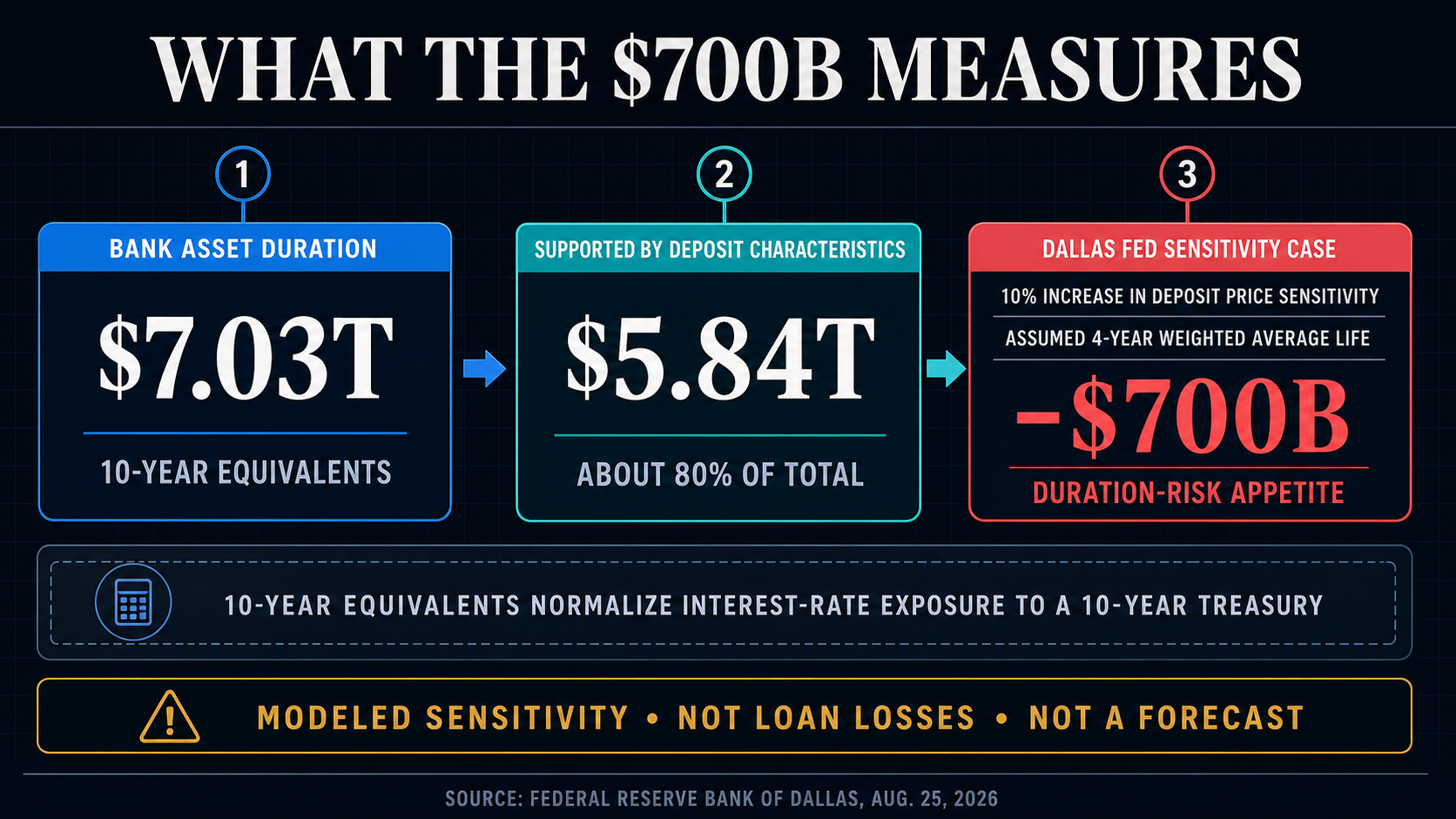
A 10-year equivalent converts an exposure into the interest-rate risk of a comparable position in 10-year Treasuries, but the credit effect would depend on how banks adjust their assets and funding.
Banks could issue more term debt to keep lending composition closer to unchanged, but the Dallas Fed said wholesale funding would likely raise borrowing costs for consumers and businesses. They could also hold more reserves and Treasuries against faster, less predictable outflows, leaving less room for illiquid credit.
A 2025 Central Bank of Brazil paper found that heavier use of the Pix instant-payment system increased liquid-asset holdings and reduced liquidity transformation, evidence that instant payments can alter bank liquidity behavior even though Pix is not a direct comparison with US tokenized deposits.
Tokenized deposits remain early in development, the magnitude is uncertain, and the authors said their views should not be attributed to the Dallas Fed or the Federal Reserve System.
The post Smart AI deposits could soon force banks to raise loan rates for everyday borrowers appeared first on CryptoSlate.


Читать больше

Soluna’s 1 billion-share proposal exposes the funding challenge behind its AI and Bitcoin expansion