GENIUS Act deadline puts stablecoin issuers on the clock

Поделиться:
Regulators have until July 18, 2026 as a one-year rulemaking deadline to implement the GENIUS Act, which takes effect either 18 months after its July 18, 2025 enactment or 120 days after rules are finalized; the rulemaking will define who qualifies as permitted payment stablecoin issuers and set rules for reserves, redemption, custody, capital backstops and supervision. Treasury, FinCEN, OFAC and the OCC proposals fold BSA/AML/OFAC compliance and enforcement into the framework, creating high compliance costs and access gates for foreign and state‑qualified issuers that are likely to favor large incumbents and threaten smaller entrants and some token availability across crypto, DeFi, CEX and DEX ecosystems if rules are not coherent by the deadline.
Рынки предсказаний
Что в фокусе у трейдеров?

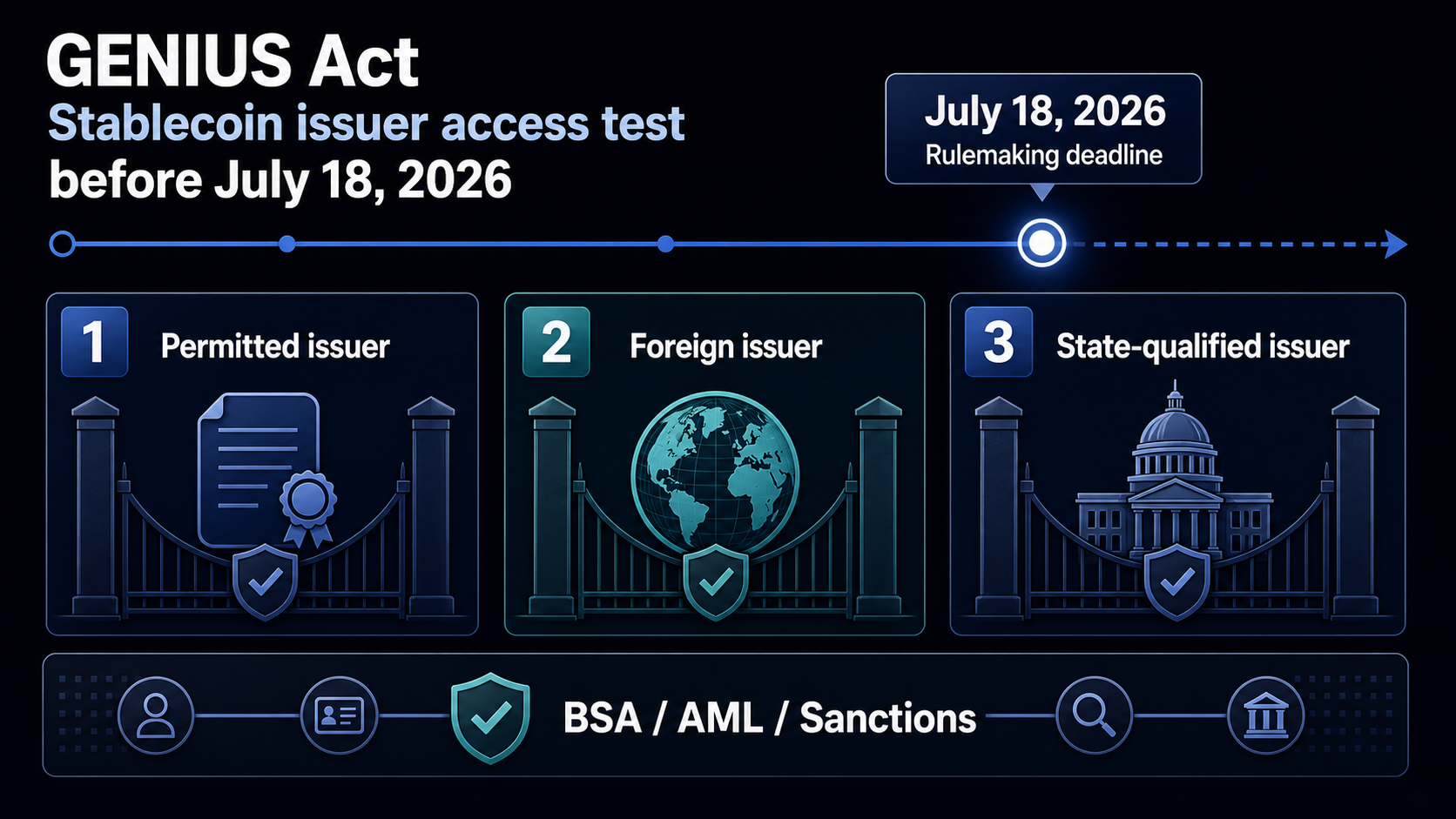
Regulators have until July 18, 2026, to turn the GENIUS Act from a statute into access rules for stablecoin issuers that want a clear regulatory path into the US.
That date is the Act's one-year rulemaking deadline, not a blanket cutoff for users or every restriction on issuers. Public Law 119-27 requires primary federal payment stablecoin regulators, Treasury, and state payment stablecoin regulators to issue implementing regulations through notice-and-comment rulemaking within one year of enactment.
The law’s effective date is separate from this deadline. According to the OCC, the GENIUS Act takes effect on the earlier of two dates: 18 months after its July 18, 2025, enactment, or 120 days after regulators finalize the implementing rules.

Issuer status decides who gets in
For stablecoin issuers, the biggest question is whether they can qualify as a permitted payment stablecoin issuer in the first place. The GENIUS Act generally bars anyone outside that category from issuing a payment stablecoin in the United States. Digital asset service providers have separate offer-and-sale restrictions with their own three-year timeline and exceptions.
The OCC's February proposal shows how broad the implementation effort could become. Its rule would apply to national bank subsidiaries, federal savings association subsidiaries, and federal branches, as well as foreign payment stablecoin issuers, nonbank entities seeking federal qualified issuer status, and state-qualified issuers within OCC authority.
The Federal Register proposal also places applications, registrations, supervision, reserves, redemption, custody, revocation, and capital backstops within the same implementation framework. After deciding who gets in, regulators are also defining what issuers must look like once they are approved to operate.
Compliance is the next hurdle. Under Treasury’s FinCEN and OFAC proposal, permitted payment-stablecoin issuers would fall under Bank Secrecy Act rules, bringing anti-money-laundering and sanctions requirements with them.
The OCC followed with a June 22 proposal for OCC-supervised issuers that would create AML/CFT supervision, FinCEN consultation, and information-sharing procedures for enforcement or supervisory actions.
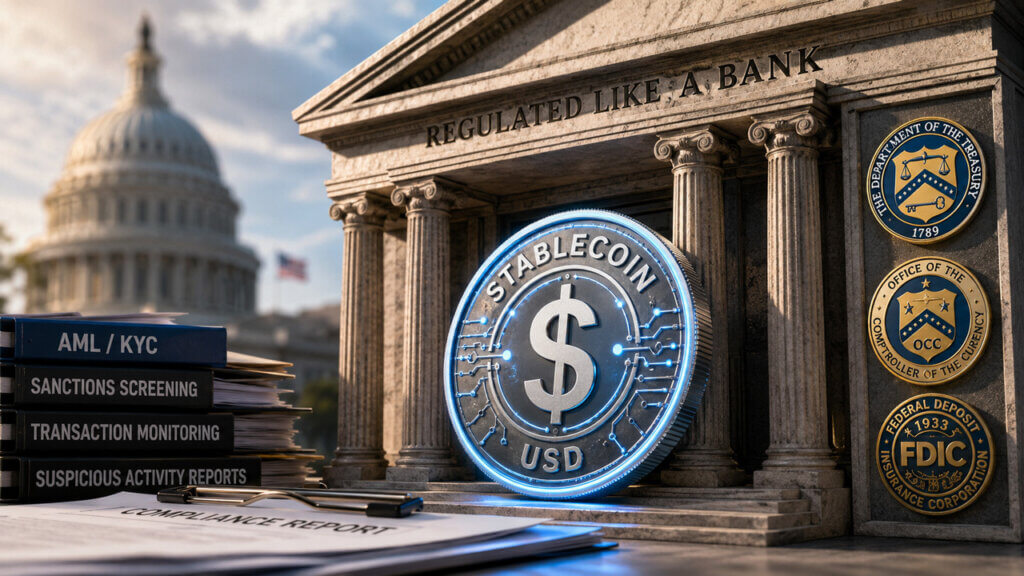
For issuers, that means access to the US market also depends on whether their controls can satisfy BSA, OFAC, and lawful-order requirements before the rules settle into an operating framework.
Foreign payment-stablecoin issuers face a separate barrier because access to the US market depends on complying with lawful orders and establishing reciprocal arrangements under the GENIUS Act.
It also gives the Treasury one year from enactment to issue rules for these foreign-issuer provisions. The OCC’s proposal includes the process details: registration, rejection, appeals, and rescission for foreign issuers under its jurisdiction.
State-qualified issuers face another barrier. Their home state's regulatory regime must be substantially similar to the federal framework, with Treasury responsible for deciding whether it meets that standard.
Although state certifications will depend on the Act’s effective date, the practical problem arrives much earlier: state equivalence will be hard to determine if federal, Treasury, and OCC rules are still unfinished.

The stablecoin fight now comes down to who gets through the US market’s front door.
The issuers most exposed are those still trying to secure a place in the US framework: new federal applicants, foreign issuers seeking US availability, and state-qualified issuers relying on equivalence. If July 18, 2026, arrives without a coherent set of rules, they will be the first to feel it.
The post GENIUS Act deadline puts stablecoin issuers on the clock appeared first on CryptoSlate.


Рынки предсказаний
Что в фокусе у трейдеров?
Поделиться:
Рынки предсказаний
Что в фокусе у трейдеров?
Поделиться:
Читать больше
SEC could start writing crypto rules before the Senate votes on CLARITY