Bitcoin price hits $69,500 because US doubles Treasury buybacks to crush long-term yields
Поделиться:
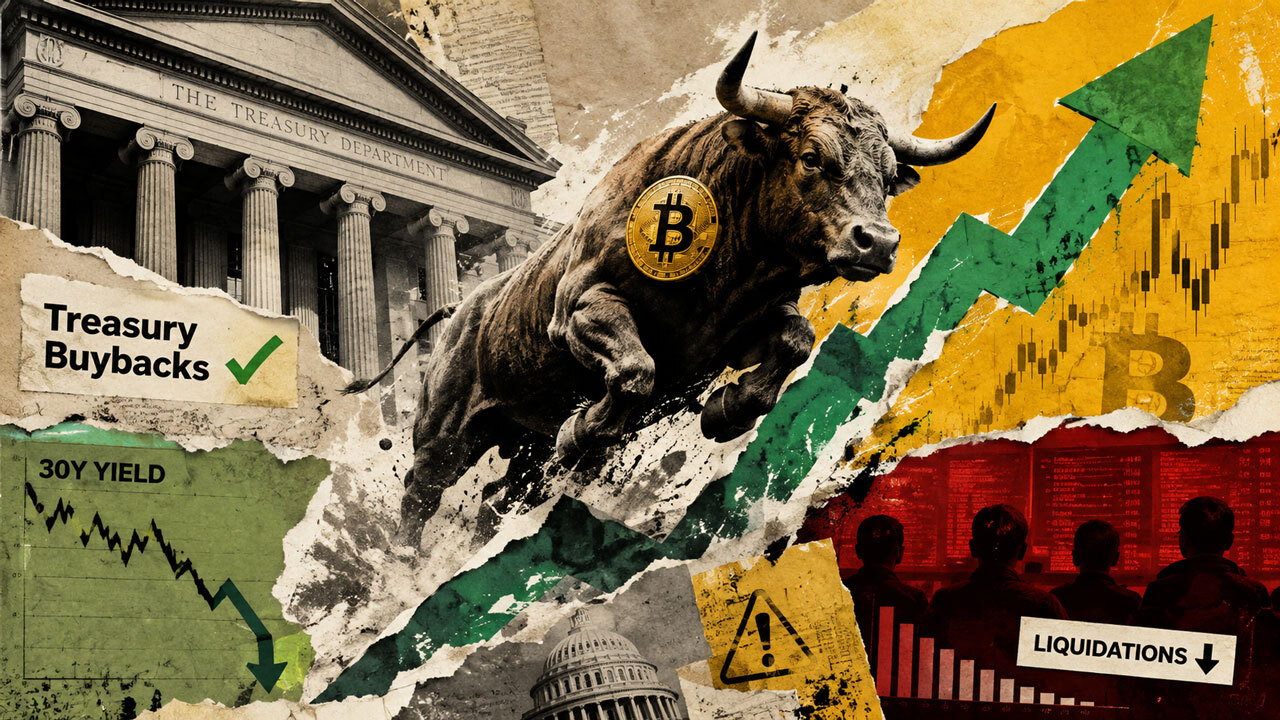
On Aug. 19 the US Treasury said it will double liquidity-support buybacks for 10–20y and 20–30y Treasuries from $2 billion to at least $4 billion per operation starting Sept. 9 through Nov. 4, sending the 30‑year yield down to about 5.19% and the 10‑year to 4.647% and sharply narrowing the curve. The move sparked a crypto rally as Bitcoin jumped above $69,500 (from an intraday low near $64,100 to over $69,000, then ~ $68,000) and Ethereum topped $2,000 to $2,100, while over $400 million of crypto positions were liquidated in one hour and $662 million were wiped out across 24 hours, underscoring market sensitivity, liquidity risks for CEX/DEX and DeFi exposure, and potential upside for crypto adoption if yields remain lower.
Рынки предсказаний
Что в фокусе у трейдеров?

Bitcoin and Ethereum surged above $69,500 and $2,000 on Wednesday after the US Treasury doubled planned buybacks of long-dated government debt.
On Aug. 19, the Treasury Department said it will raise the maximum size of its liquidity-support operations for 10- to 20-year and 20- to 30-year securities from $2 billion to at least $4 billion per operation. The change starts Sept. 9 and runs through Nov. 4.
The announcement brought immediate relief to a bond market battered by rising borrowing costs. The 30-year Treasury yield fell to about 5.19% from Tuesday’s 5.34% peak, its highest since 2007, while the 10-year yield dropped to 4.647%. The gap between 2- and 30-year yields also narrowed sharply.
Data from CryptoSlate shows Bitcoin climbed from an intraday low near $64,100 to over $69,000, before retracing to around $68,000, as yields retreated and risk assets rallied. Ethereum rose as high as $2,100, breaking above $2,000 for the first time since June.
The sharp rebound punished traders positioned for further declines.
CoinGlass data showed more than $400 million in crypto positions were liquidated within one hour, with Bitcoin and Ethereum accounting for most of the losses. Short traders betting against the rally lost about $ 382 million during the period.
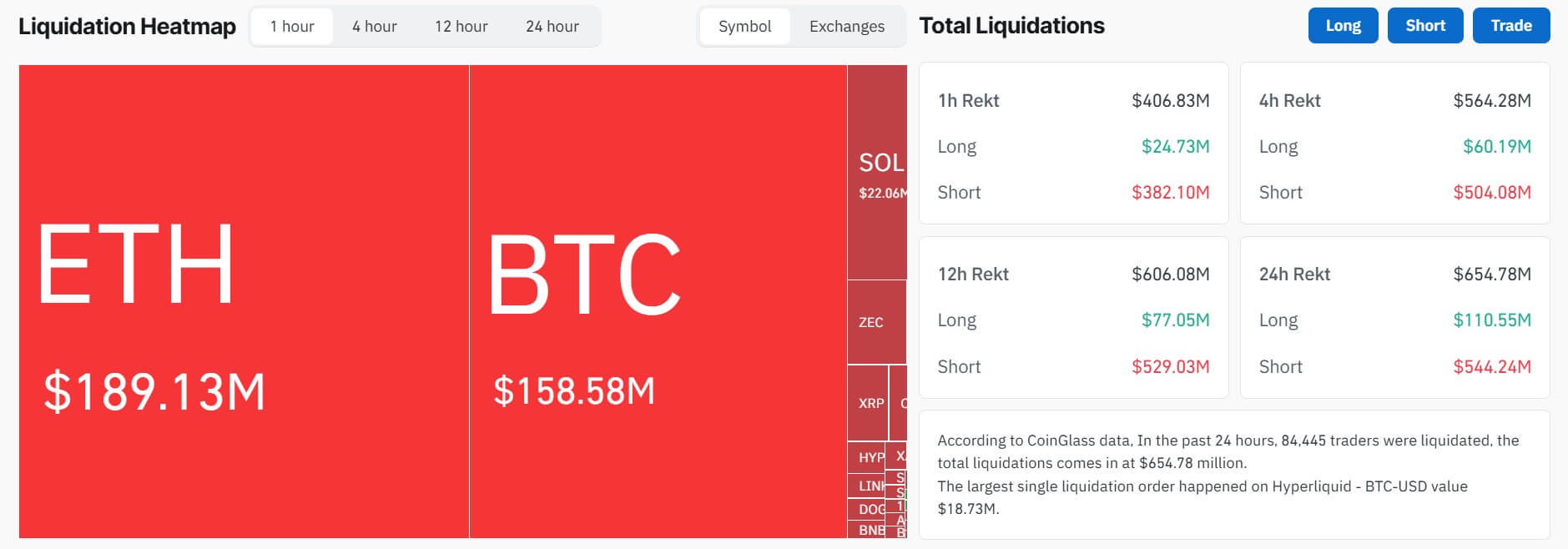
Over the past 24 hours, 83,832 traders were liquidated for over $662 million. The largest single liquidation was an $18.73 million BTC-USD position on Hyperliquid.
Falling yields give Bitcoin breathing room
Treasury said the larger operations are intended to provide greater liquidity support to longer-dated securities, where market participants have consistently offered significantly more debt than the department has been willing to repurchase.
“This increase in buyback operation sizes reflects Treasury’s desire to provide greater liquidity support in longer-dated nominal sectors where there is consistent strong sponsorship from market participants,” the department said.
The move follows a sharp repricing at the long end of the Treasury curve as investors demand greater compensation for inflation, heavy government borrowing and the risks associated with holding debt for decades. Increased corporate issuance, including borrowing tied to artificial-intelligence investment, has added to the supply competing for investor capital.
Those pressures have spilled directly into Bitcoin and other risk assets.
Rising long-term yields, particularly real yields, raise the cost of capital and increase the returns available from risk-free government debt. That can weigh heavily on long-duration assets such as technology stocks and can also pressure Bitcoin by making Treasuries more competitive for investor capital.
Wednesday's reversal therefore removed one source of pressure as Bitcoin recovered above $66,000.
Andre Dragosch, Bitwise Europe's head of research, said the Treasury action showed the “system is showing first signs of cracking,” as policymakers respond to pressure in long-duration government debt.
He added:
“Bitcoin is the canary in the macro coal mine that anticipates changes in financial conditions both to the downside AND upside. Rising yields are already forcing the hand of the Treasury to intervene and BTC is sniffing it out.”
Meanwhile, the operations do not amount to quantitative easing. Federal Reserve asset purchases create reserves and expand the central bank’s balance sheet, while Treasury buybacks are designed primarily to improve liquidity in existing securities and do not reduce the government’s overall debt burden.
Still, the market reaction showed how sensitive Bitcoin and other assets have become to changes in long-term borrowing costs.
Matt Cole, chairman of Bitcoin treasury company Strive, said those pressures could ultimately strengthen a much longer-term Bitcoin thesis if rising debt increasingly pushes policymakers toward lower real rates, greater liquidity and currency depreciation.
Cole said federal debt and persistent deficits leave policymakers with difficult choices: tolerate higher real rates and tighter financial conditions, or manage the strain through policies that support liquidity and nominal growth.
He said:
“There is no painless path. The question is simply where the adjustment gets absorbed.”
Cole has argued for more than a decade that the dollar is in structural decline and said Wednesday’s Treasury move reinforced that view as policymakers respond to pressure in long-duration debt.
He said Bitcoin’s previous major rallies have coincided with periods of dollar weakness, but the asset has never existed through the kind of prolonged dollar decline he believes could unfold over the coming years.
If that thesis holds, Cole said the next five to seven years could provide Bitcoin with a stronger macro tailwind than any of its previous cycles.
The post Bitcoin price hits $69,500 because US doubles Treasury buybacks to crush long-term yields appeared first on CryptoSlate.


Читать больше

Bitcoin turned $10,000 into $870,000 in a decade where 87% of active stock funds failed to beat passive rivals